In the Condon approximation the intensity from to contains the Franck-Condon factorThe lower ground-state vibrational wavefunction is localized near its equilibrium bond length. If the two equilibrium lengths are similar, it overlaps strongly with the upper wavefunction, but its overlap with highly excited upper vibrational states is usually small or suffers oscillatory cancellation. If the equilibrium lengths differ enough that a vertical excitation reaches the outer portion of the upper well, high- transitions can be strong while the overlap is small. Thus the two ends of a long progression are not normally both intense. This is an overlap argument, not a ban on either set of transitions; anharmonicity, a varying electronic transition moment and unusual wavefunctions can modify the intensity envelope.
Write the upper Morse oscillator term values in wavenumber units asThe spacing is . A Birge-Sponer plot therefore falls linearly in this model and can be extrapolated to zero spacing. If its horizontal coordinate is , the plotted line is . Its area from to its zero givesEquivalently a plot against has intercept and triangle area ; subtracting recovers . These conventions distinguish dissociation from the potential minimum and from the lowest vibrational level.
Measured consecutive members fix a local slope and intercept, so unobserved members can be supplied by extrapolation under an explicit spacing law. The upper-state limit on the absorption scale is . A local high-v fit can likewise estimate the remaining energy above an observed member without knowing its absolute v index. Near dissociation a real potential need not remain Morse-like, so an extrapolated triangle has model uncertainty; missing lines must not be silently assumed consecutive.
Successive differences remove the unknown absolute origin and the unknown initial vibrational quantum number. The five spacings are , , , and . Plot them at relative mid-indices . A straight-line fit givesThe curve reaches zero spacing at . Since a quadratic Morse progression has a spacing equal to its derivative at the interval midpoint, integrating the fitted line from the first observed relative level to estimates the energy still needed to reach the continuous limit:Thus the appropriate graphical conclusion is , not a many-digit threshold. Directly fitting a quadratic to the six measured transition positions puts its vertex at about , which checks the arithmetic but not the physical extrapolation law. The slight variation of second differences shows that extrapolating a constant anharmonicity beyond the observed range is approximate. No assignment of the arbitrary index n to an absolute upper-state v is needed.
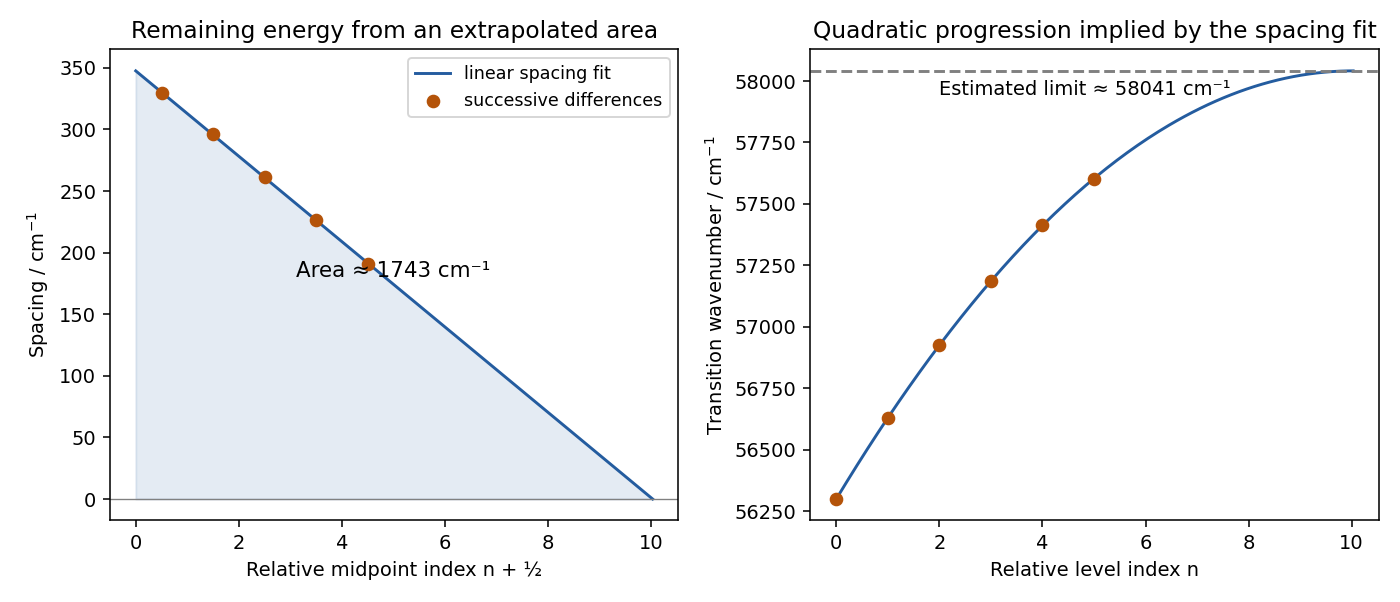
Original relative-index Birge–Sponer extrapolation and the inferred progression limit
. Details. 
Articles by others on the same topic
There are currently no matching articles.