A Fischer carbene complex typically has a low-oxidation-state, relatively electron-rich middle/late transition metal with strong pi-acceptor ligands such as CO. The carbene is treated as a neutral two-electron donor; metal-to-carbene back-donation contributes to its bond, but its carbon remains electrophilic. An OR or NR substituent stabilizes that carbon by heteroatom donation. Here the metal is Cr(0), , in an 18-electron pentacarbonyl complex.
A Schrock carbene complex usually contains an early metal in a high oxidation state, often , with electron-donating ligands rather than a shell of pi-accepting carbonyls. Its alkylidene has substantial dianionic character in ionic counting, and its carbon is correspondingly nucleophilic. Alkyl substituents are common; heteroatom stabilization of an electrophilic carbon is not the defining feature. These are bonding/electronic limiting descriptions rather than a rule based only on the drawn metal-carbon double bond.
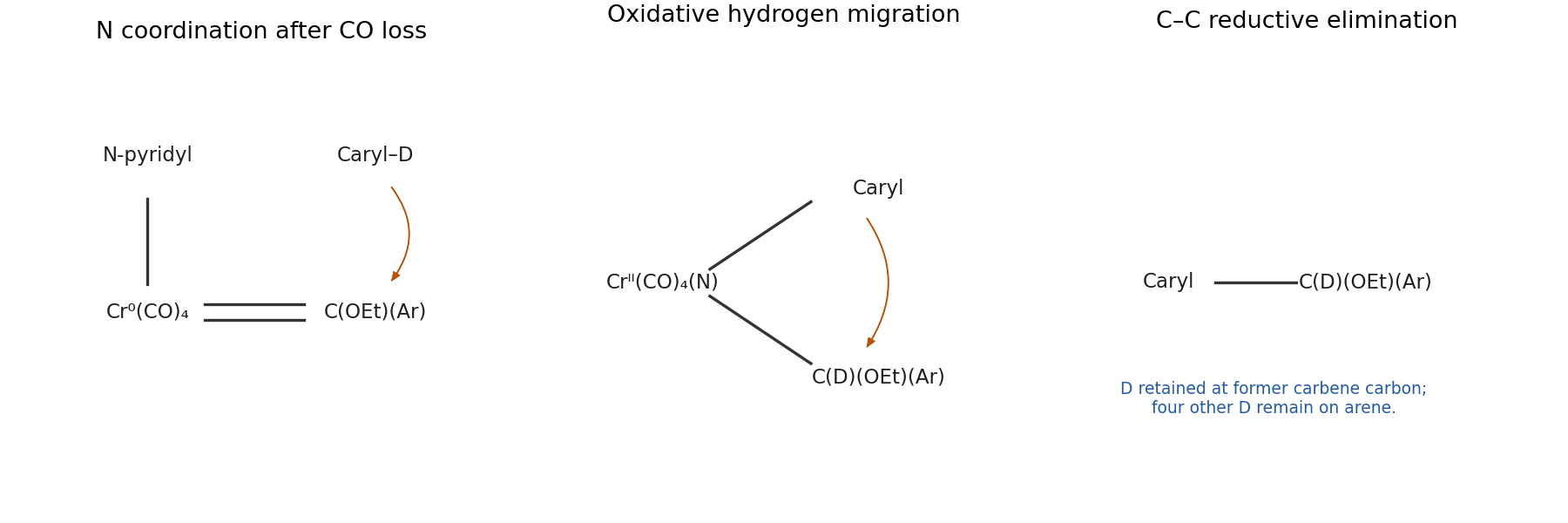
CO first dissociates from the 18-electron Fischer carbene. Pyridyl nitrogen of C then coordinates at the vacant chromium site, positioning an ortho C-D bond of its phenyl group beside the carbene unit.
The appropriate pathway is oxidative hydrogen migration: chromium assists C-D cleavage while D transfers to the electrophilic carbene carbon. The resulting cyclometalated intermediate has both an aryl-Cr bond and an alkyl-Cr bond, the latter to . Formally Cr(0) becomes Cr(II). Reductive elimination between those two carbon ligands forms the new aryl– bond and returns chromium to low oxidation state.
This accounts for all three controls. Extra CO suppresses the coordinative vacancy. Biphenyl E lacks the pyridyl-N directing group and cannot organize the necessary C-H activation geometry. The ortho deuterium moves onto the former carbene carbon rather than being lost to solvent: four D remain on the original phenyl ring and the fifth becomes the benzylic C-D bond.
This is not adequately represented as electrophilic aromatic substitution followed by proton loss, which would discard the diagnostic D. The primary mechanistic study distinguishes oxidative hydrogen migration/reductive elimination from that classical alternative.[ref]

Articles by others on the same topic
There are currently no matching articles.