The first transformation is an Achmatowicz rearrangement, followed by protection and selective reduction; the last is a Johnson-Claisen rearrangement.
- Butyllithium removes the furan 2-proton, giving a 2-lithiofuran. Its carbon attacks the aldehyde carbonyl; protonation of the resulting alkoxide gives the furfuryl alcohol. Carbon-carbon bond formation occurs at the lithiated position.
- Electrophilic oxygen transfer from mCPBA to the electron-rich furan gives an oxidized, ring-opened intermediate. Opening the oxygenated furan gives a hydroxy enedicarbonyl: the original furfuryl hydroxyl then attacks the remote aldehyde intramolecularly. This expands the five-membered furan into a six-membered lactol containing an enone carbonyl. The original furfuryl oxygen becomes the pyran ring oxygen; oxidation of the furan supplies the new carbonyl and lactol functionality.
- AgO/MeI converts the lactol OH into its methyl acetal: oxygen attacks methyl iodide by SN2 reaction, with iodide removal and proton transfer. This protects the anomeric position.
- LiAlH delivers hydride to the remaining ketone carbonyl, followed by protonation. The methyl acetal survives these basic reducing conditions, leaving the depicted allylic alcohol.
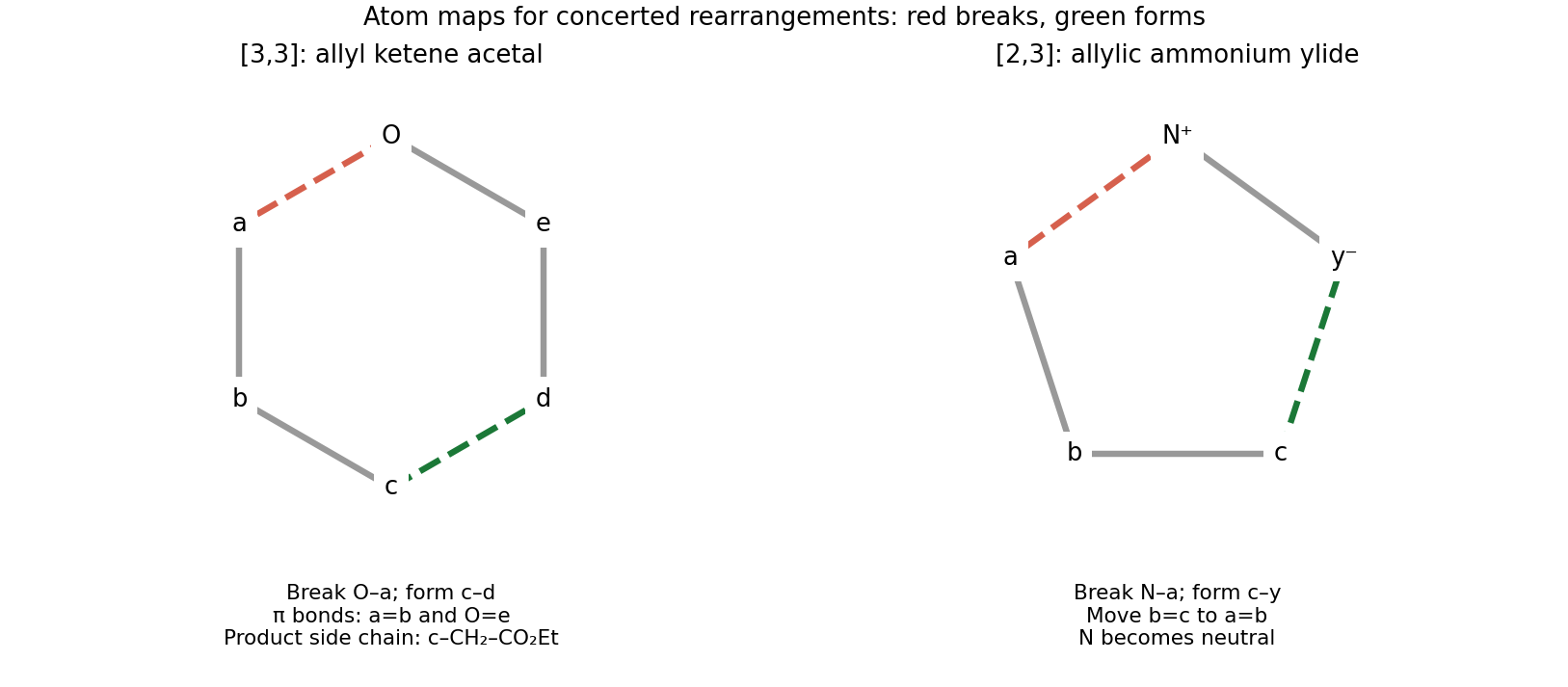
- Under weak-acid catalysis, that allylic OH replaces an ethoxy group of triethyl orthoacetate. Loss of another ethanol molecule, with removal of a methyl proton, gives the mixed ketene acetal . A six-electron, chair-like Claisen rearrangement breaks the allyl-O bond, forms a bond between the terminal allyl carbon and the ketene-acetal CH, and moves the ring double bond one position. Carbonyl formation gives the substituent.
The acetal protects the other oxygenated position during hydride reduction. The orthoester transfers an acetate-derived two-carbon unit through a ketene acetal; it does not directly substitute the allylic OH with an intact acetate ion.

For a concrete choice, draw the intermediate in the planar ring orientation used in the question and put the allylic OH on the upper face, with a solid-wedge C-OH bond. Fix either configuration at the R-bearing and methoxy-bearing centres and retain it throughout; no absolute configuration is specified by the question.
Draw the six-membered rearrangement array with its allylic C-C-C segment along the same ring edge and the O-ketene-acetal tether above that edge. Suprafacial transfer forms the new ring-carbon–CHCOEt bond on that upper face: draw it as a solid wedge, replacing the original allylic OH with the shifted double bond. The R-bearing and methoxy-bearing stereocentres retain their configurations. The opposite OH epimer transfers the tether from the opposite face and gives the opposite new stereocentre. Favor the chair-like transition structure that puts the larger tether substituents outward. This explicitly correlates the selected OH face with the new bond rather than invoking a freely rotating allylic carbocation.
Propionic acid is a weak, relatively high-boiling acid: its normal boiling point is about , compared with about for acetic acid. It provides mild proton catalysis while remaining in the hot orthoester mixture more effectively. This is useful because ketene-acetal formation and the thermal Johnson-Claisen rearrangement require heating, whereas strong acid would threaten the pyran acetal.
This is a practical catalyst choice, not an absolute mechanistic prohibition on acetic acid; acetic-acid-catalysed orthoester rearrangements are also possible.
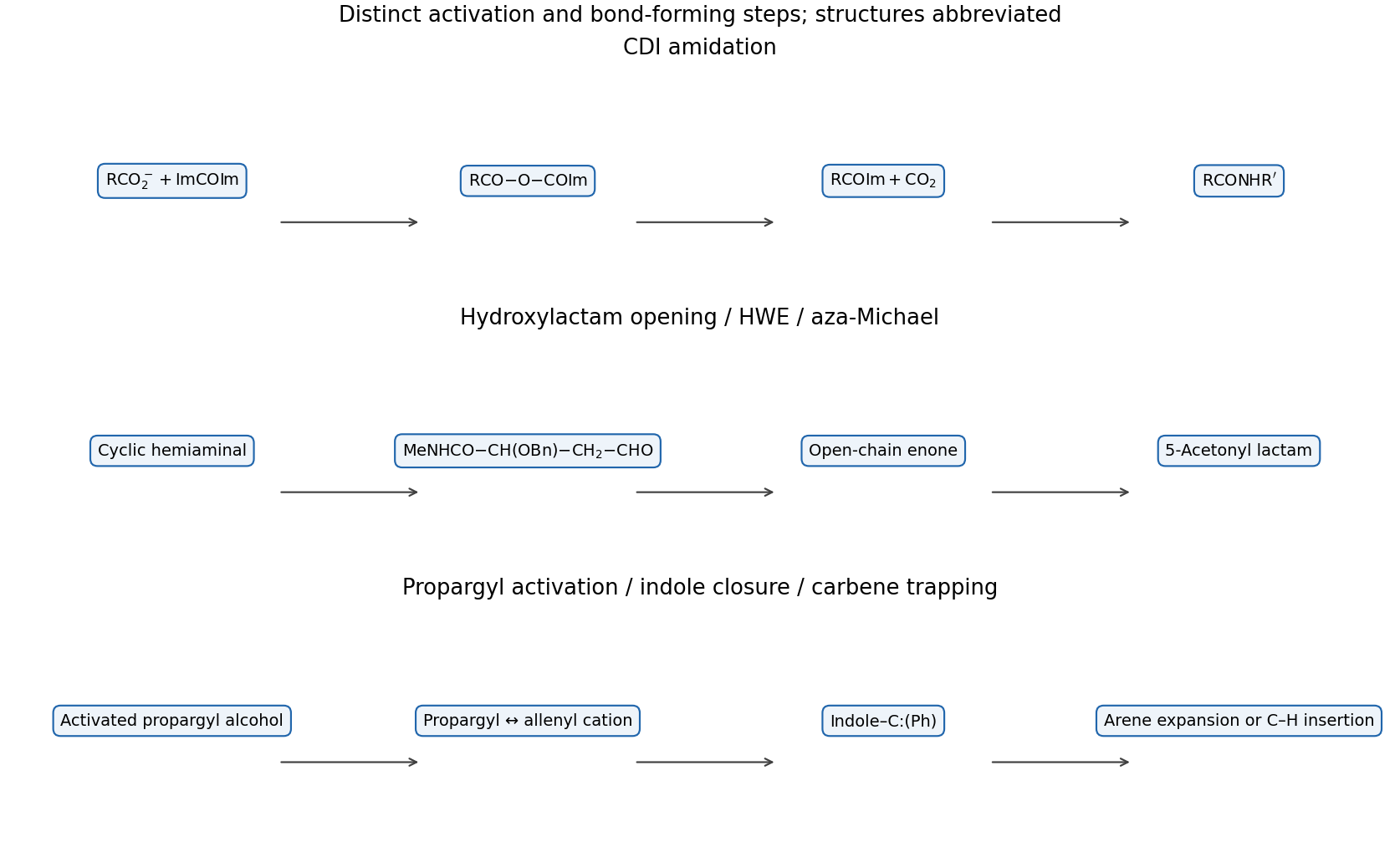
Write Im for an imidazolyl group. The acid protonates one imidazole nitrogen, and its carboxylate attacks the central carbonyl of carbonyldiimidazole. Collapse of the tetrahedral intermediate expels imidazole and gives the mixed anhydride . Acyl transfer to imidazole, with decarboxylation, produces the activated acyl imidazole , CO and imidazole.
The amine attacks the RCO carbonyl of that acyl imidazole. Its tetrahedral intermediate collapses with loss of imidazole; proton transfer gives . The carbonyl originally belonging to CDI leaves as CO, while the product amide carbonyl is the original acid carbonyl. Imidazole serves both as a leaving group and a proton-transfer base.
Activated acyl transfer, hemiaminal opening and carbene formation
. Details. 
Carbonyldiimidazole activates the acid under mild conditions without first isolating an acid chloride. CO and imidazole are convenient byproducts; the latter also buffers proton transfers. Avoiding strongly acidic acid-chloride-forming conditions can preserve sensitive protecting groups and reduce unwanted side reactions. The activated intermediate still reacts readily with an amine, whereas the unactivated acid and amine would mainly form an ammonium carboxylate.
The alcohol first attacks CDI, forming an activated O-carbonylimidazole derivative. Its departure gives the resonance-stabilized propargyl/allenyl cationThe ortho amino nitrogen attacks the central carbon of the allenyl system, closing the five-membered indole ring. Electron redistribution and loss of the N-H proton establish the indole aromatic system while leaving a carbene at the original distal, phenyl-bearing alkyne carbon.
For atom tracking, the original carbinol carbon becomes indole C3, the proximal alkyne carbon becomes C2, and the distal becomes the exocyclic carbene. Attack at the distal alkyne carbon would make a six-membered ring and cannot give the displayed skeleton. This carbene-based rearrangement has a primary experimental precedent.[ref]
With an N-trityl substituent, the carbene attacks a nearby trityl phenyl ring. Addition across an arene bond gives a norcaradiene-like cyclopropane, followed by electrocyclic opening to the seven-membered cycloheptatriene: this is a Buchner ring expansion. Intramolecular trapping explains the fused product rather than an intermolecular carbene reaction.
With N-tert-butyl, there is no pendant arene. Instead the carbene inserts into a C-H bond of one tert-butyl methyl group. The new bond between the carbene carbon and that methyl carbon closes the five-membered N-containing ring; H is transferred to the carbene carbon in the same insertion. The remaining two methyl groups stay on the carbon attached to N.
No stereochemical information need survive from the starting carbinol. Ionization converts that tetrahedral stereocentre into a planar, delocalized propargyl/allenyl cation before cyclization. In achiral conditions the two enantiomeric pathways to the new stereocentre in the tert-butyl-derived product are equivalent, so an enantiopure alcohol is expected to give racemic product. A claim of retained enantiopurity would require evidence for unusually effective conformational memory or ion-pair control.
Articles by others on the same topic
There are currently no matching articles.