Injected sulfur dioxide is oxidized, principally through hydroxyl radical chemistry, to sulfuric acid, which nucleates or condenses into aqueous sulfate particles. A suitably sized, weakly absorbing particle population scatters some incoming sunlight back to space, increasing planetary albedo and decreasing absorbed solar energy. The sulfur dioxide molecules are precursors, not the persistent reflective population.
The albedo lifetime reflects aerosol formation, growth/aerosol coagulation, sedimentation, stratospheric transport and eventual return to efficiently scavenged tropospheric air. The stratosphere has little atmospheric precipitation, so the effect can outlast analogous tropospheric aerosol. The assumed year is an effective persistence scale, not a universal lifetime of sulfur dioxide oxidation or an exact clock for every particle.
For the albedo-to-forcing conversion, Earth intercepts sunlight over a disk but distributes the global mean over its full sphere, giving incident mean flux . The absorbed shortwave flux is , and henceThe cooling magnitude is for the assumed one-year effect of one mass unit of injection. Albedo does not change the sunlight incident at the top of the atmosphere; it changes the absorbed/net incoming flux. The minus sign therefore accompanies the radiative cooling.
For the first year's increase, the forcing increment isUsing linear superposition of the supplied one-year aerosol calibration,This compensates the year-end forcing increment for a one-year aerosol effect. It is not a one-time permanent cancellation of the continuing carbon-dioxide increase. Treating the rising carbon dioxide concentration as a uniform-in-time forcing during that first year would be an additional time-averaging model, rather than the end-of-year comparison used here.
If “steady temperature in 2050” means preventing the next annual increase relative to the climate at the delayed start, the relevant forcing increment isIts smaller value follows from : the same additional ppm gives less incremental forcing at a higher baseline.
That interpretation must be separated from the earlier objective of holding temperature at the original reference climate. To cancel the accumulated increase from to ppm requiresThis annual versus accumulated radiative forcing distinction is essential: the first box offsets just the further year's growth; the second is the equivalent one-year aerosol inventory needed for the accumulated forcing. In subsequent years that inventory must be replaced as particles disappear and increased as carbon dioxide rises. A delayed start does not erase the earlier warming merely because the annual incremental requirement is smaller.
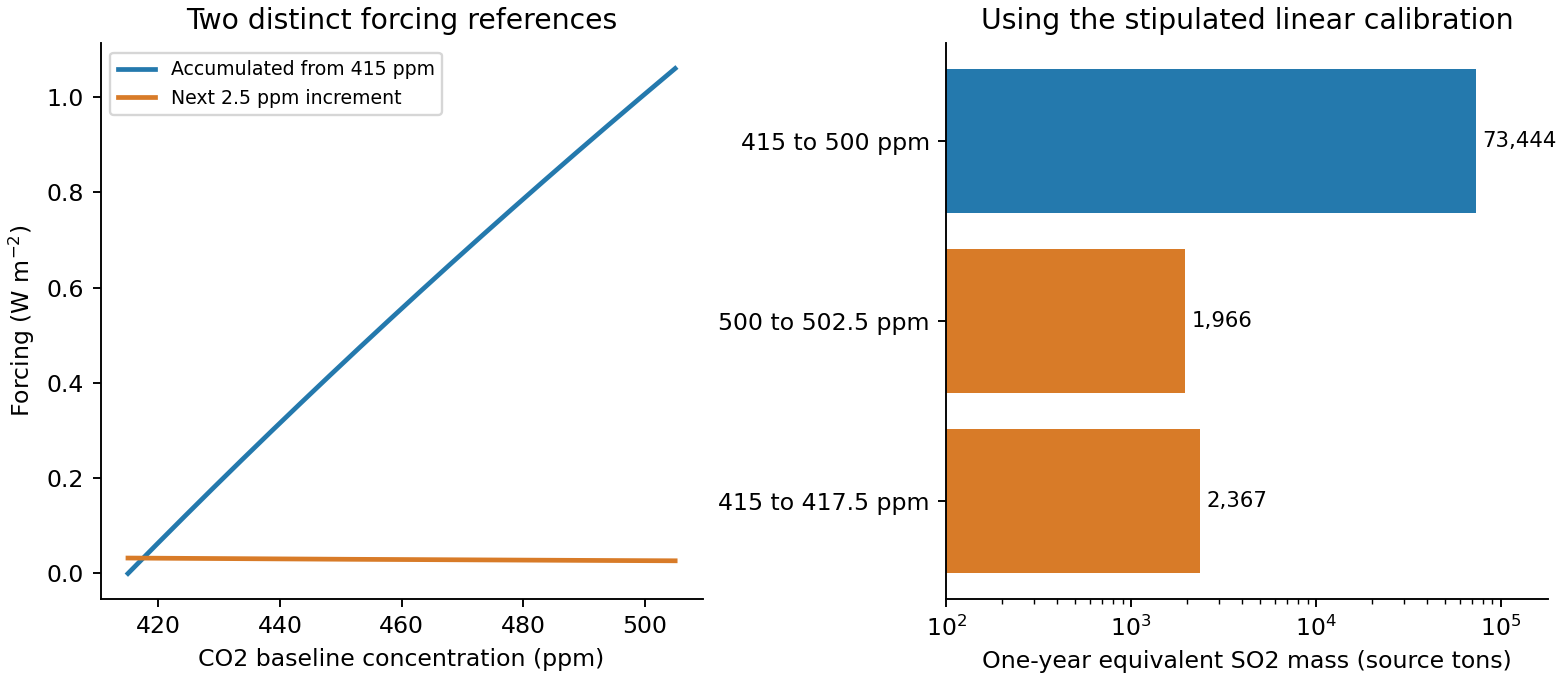

The logarithmic forcing relation implies decreasing incremental forcing per additional ppm, explaining the two annual-increment results. It does not imply that a higher total carbon dioxide burden requires less compensation relative to a fixed original climate. The chosen reference and whether an end-of-year, mean-year or steady maintained aerosol burden is intended must remain explicit.
The numerical mass estimates use an unusually simple, stipulated constant albedo-per-mass calibration. Real particle size and lifetime change with loading, aerosol coagulation, injection altitude/latitude and circulation. Sulfate absorbs radiation as well as scattering it and changes stratospheric chemistry. A global-mean shortwave/longwave radiative forcing balance also need not reproduce regional temperature, rainfall or transient ocean heat uptake; it does not undo CO2-driven acidification. Chemistry–climate simulations explicitly resolve some of these competing aerosol-size, temperature and ozone effects.[ref]
The impact of geoengineering aerosols on stratospheric temperature and ozone by P. Heckendorn and others. Environmental Research Letters 4 (2009), 045108, Abstract: coupled aerosol-size and chemistry–climate simulations
Articles by others on the same topic
There are currently no matching articles.