In (i), any pair of compatible functional groups can react: monomers, oligomers and long chains all participate. For an equimolar, strictly bifunctional mixture without cyclization in step-growth polymerization, the Carothers equation givesHere is functional-group conversion and counts the original monomer molecules. Large degree of polymerization therefore requires nearly complete conversion.
In (ii), growth occurs only at the metal-bound chain end. If initiation is rapid and chain transfer in chain polymerization is negligible, the number of chains is fixed andThis is the linear conversion dependence of living polymerization. Actual zirconocene systems can undergo chain transfer, so linear growth is a limiting model, not a consequence of coordination polymerization alone.
In (iv), a newly initiated chain rapidly attains a large size and then undergoes radical termination. Further conversion mostly creates additional chains. Thus high degree of polymerization can occur at low conversion, without the systematic linear increase of an ideal living system. temperature, initiator depletion and monomer depletion can change that size during the run.
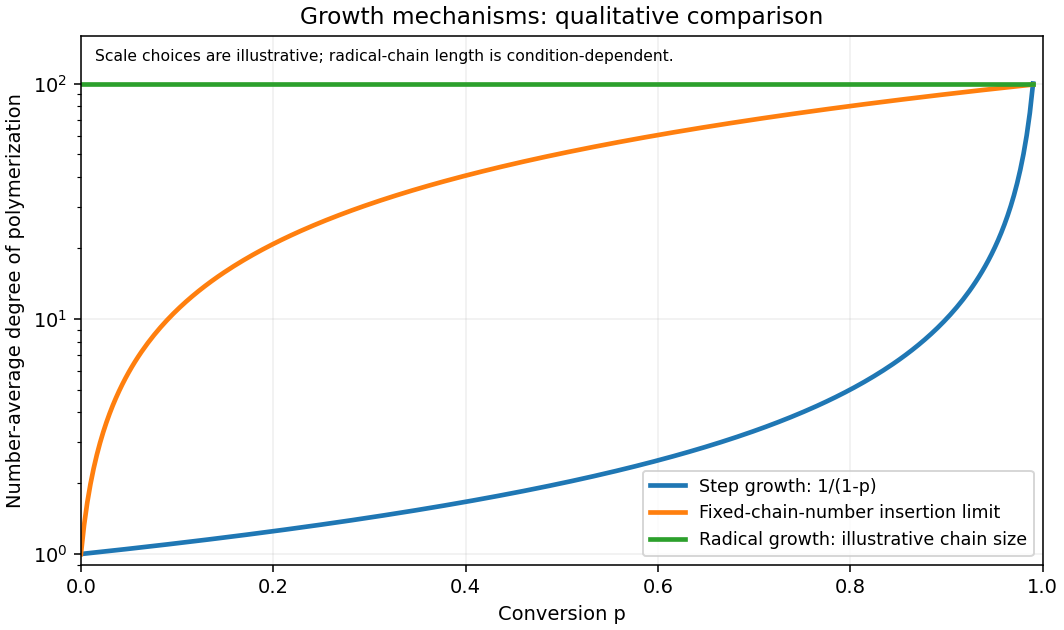
Contrasting idealized degrees of polymerization during three growth mechanisms
. Details. 
Articles by others on the same topic
There are currently no matching articles.