An aromatic–aliphatic polyamide and methanol are formed. Let . The polymer repeat unit isEach amide linkage comes from nucleophilic acyl substitution: an amine attacks an ester carbonyl, the tetrahedral intermediate expels methoxide, and proton transfer produces methanol. There are approximately molecules of methanol for complete repeat units in a long chain; the precise finite-chain count depends on its end groups. Removal of methanol drives this step-growth polymerization.
Syndiotactic polypropylene is the expected principal product:The bridged cyclopentadienyl–fluorenyl metallocene has approximately site symmetry. Activation by methylaluminoxane gives a cationic zirconium–alkyl polymerization-active site. Repeated coordination chemistry and migratory insertion of propene extend the chain. The two environments encountered during successive insertions favor alternating stereochemistry, giving syndiotactic tacticity. There is no stoichiometric small molecule eliminated in the propagation step; initiator fragments and chain-transfer products belong to the end groups.
Predominantly head-to-tail poly(3-hexylthiophene) is formed, with thiophene rings connected through their 2 and 5 positions. The hexyl groups occupy equivalent 3 positions along the conjugated polymer.
Selective iodine–magnesium exchange first generates an organomagnesium monomer while retaining the carbon–bromine bond. Nickel-catalyzed Kumada coupling then joins the organomagnesium end of one ring to the brominated end of another. Transfer of the nickel center to the new chain end permits catalyst-transfer polymerization and favors head-to-tail regioregularity. Organic side products of the activation include isopropyl iodide; magnesium halides accompany the coupling. The repeat unit itself contains neither iodine nor bromine.
An approximately alternating styrene–maleic anhydride copolymer is produced. Its backbone alternates a segment with the two former alkene carbons of a maleic anhydride unit; those latter carbons remain connected to the intact five-membered cyclic anhydride ring.
Homolysis of benzoyl peroxide supplies initiating free radicals. Cross-propagation between electron-rich styrene and electron-poor maleic anhydride is favored over successive additions of the same monomer. Both carbon–carbon double bonds become backbone sigma bonds, without loss of a small molecule from each monomer. Initiator-derived benzoyloxy or phenyl fragments can occur at chain ends, with carbon dioxide formed when benzoyloxy free radicals decarboxylate.
In (i), any pair of compatible functional groups can react: monomers, oligomers and long chains all participate. For an equimolar, strictly bifunctional mixture without cyclization in step-growth polymerization, the Carothers equation givesHere is functional-group conversion and counts the original monomer molecules. Large degree of polymerization therefore requires nearly complete conversion.
In (ii), growth occurs only at the metal-bound chain end. If initiation is rapid and chain transfer in chain polymerization is negligible, the number of chains is fixed andThis is the linear conversion dependence of living polymerization. Actual zirconocene systems can undergo chain transfer, so linear growth is a limiting model, not a consequence of coordination polymerization alone.
In (iv), a newly initiated chain rapidly attains a large size and then undergoes radical termination. Further conversion mostly creates additional chains. Thus high degree of polymerization can occur at low conversion, without the systematic linear increase of an ideal living system. temperature, initiator depletion and monomer depletion can change that size during the run.
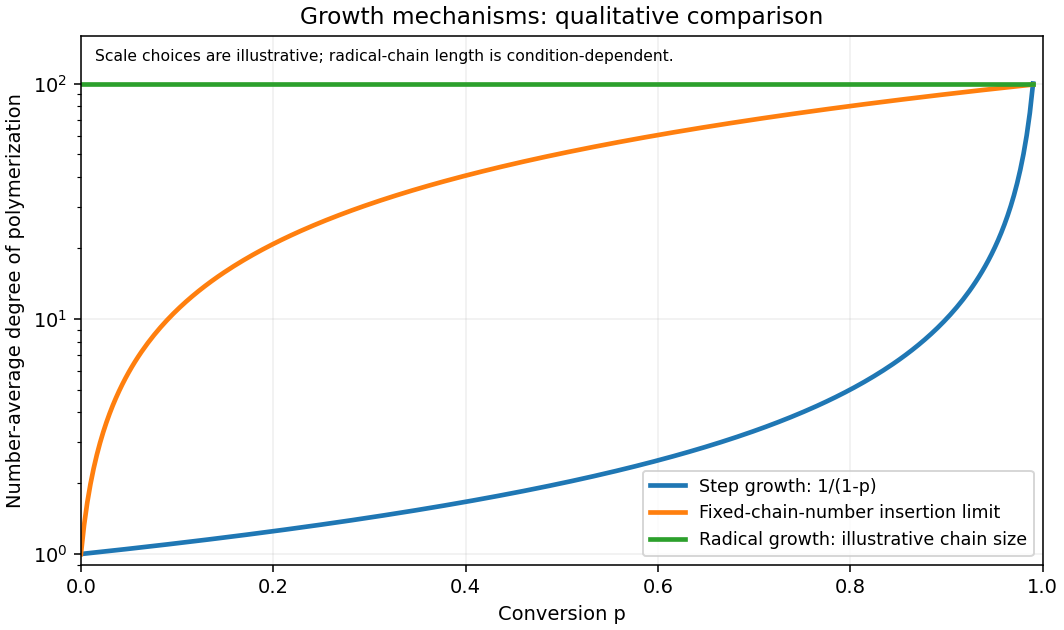
Contrasting idealized degrees of polymerization during three growth mechanisms
. Details. 
For the ideal equimolar step-growth polymerization, givesThis counts individual starting molecules, so it is only roughly one diamine–diester pair per average chain, rather than a long polymer. In a successful radical polymerization, many monomers normally add between initiation and radical termination. The styrene–maleic anhydride copolymer in (iv) therefore has the larger expected degree of polymerization.
Conversion alone does not specify the radical-chain length: the conclusion assumes ordinary polymer-forming conditions, rather than arbitrarily high initiator concentration or extremely strong chain transfer in chain polymerization.
Gel permeation chromatography separates by solution hydrodynamic volume, rather than molar mass alone. At equal molar mass, a more extended chain accesses fewer pores and elutes earlier. The relatively rigid, conjugated poly(3-hexylthiophene) is the natural first-eluting candidate, compared with the more flexible chains, provided all samples are molecularly dissolved.
This is a structural prediction, not an unconditional ordering: solvent quality, polymer aggregation and column interactions affect retention, and the hydrogen-bonding polyamide may not dissolve adequately in tetrahydrofuran. An insoluble sample cannot be assigned an ordinary solution gel permeation chromatography elution time.
A differential refractive index detector can detect all four polymers when their refractive-index contrasts are nonzero. Light scattering with an appropriate concentration detector can additionally provide molar mass. A single ultraviolet detector is unsuitable as the universal detector because polypropylene lacks the strong chromophores present in the aromatic and conjugated products.
Articles by others on the same topic
There are currently no matching articles.