The carbon–phosphorus coupling in the C spectrum is consistent with deprotonation of the methyl group rather than loss of that group:Addition to the nitrile initially gives . An intramolecular proton transfer then converts the imidoyl anion into a conjugated lithiated enamide:The phosphorus–carbon bond is retained. The rearrangement is a hydrogen migration, not a migration of the phosphoryl group to nitrogen. Addition of half an equivalent of TMEDA per Li gives the hemisolvated dimerThe tetrameric and dimeric nuclearities are established for this reaction system; the spectra in the question are consistent with them, but spectra alone would not uniquely prove every detail of the aggregates.[ref]
Lithiated organophosphorus enamines: a new synthetic approach and the first crystal structures by William Clegg and others. Abstract and structures of the unsolvated enamide and its TMEDA hemisolvate, pages 1401–1402
Let , with its O and N donors available for lithium coordination. A plausible symmetric tetramer has a LiO cubane-type core, with alternating Li and phosphoryl O vertices and an additional enamide N donor attached to each Li. The O,N-chelating Ligand in coordination chemistry can be arranged equivalently around the aggregate, consistent with one Li environment. This is a connectivity model, not a uniquely reconstructed diffraction structure.
The initially formed nitrile-addition product has an acidic group next to the phosphine oxide. Transfer of one of these protons to the nitrile-derived N gives a delocalized lithiated enamide, reinforced by O,N coordination and organolithium aggregation. The organic framework becomes .
Assign to the vinylic CH and to NH. Each integrates to one proton, as required after hydrogen migration. Their singlet appearance does not mean that the original carbon has become a freely rotating, equivalent-proton methylene group.
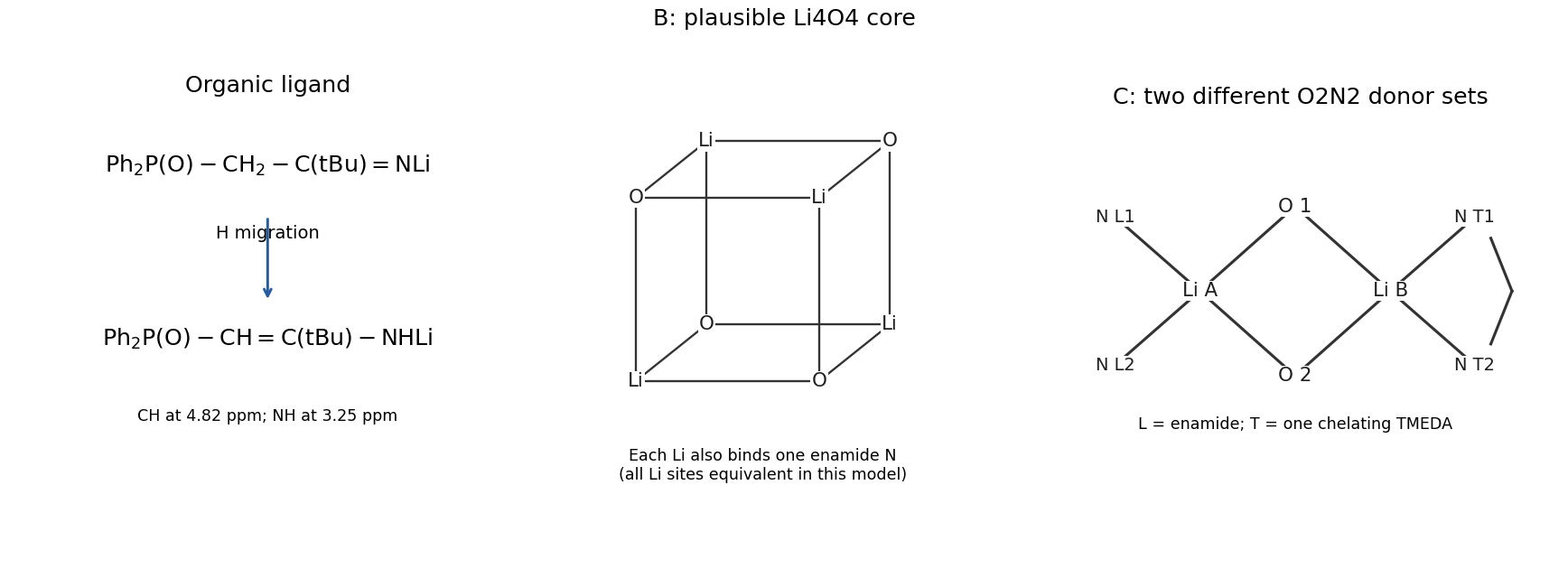

A dimer compatible with the donor count is an asymmetric LiO ring. Both phosphoryl oxygen donors bridge both Li centers. The two enamide N donors bind to one Li, whereas both nitrogen donors of a single chelating TMEDA bind to the other Li:Each Li consequently has exactly two O and two N neighbors, as required. The two donor sets differ chemically, giving two Li resonances when the solid-state connectivity is retained in solution. One TMEDA per dimer also matches the stated half equivalent per Li. The hemisolvent stoichiometry must not be drawn as one TMEDA on every Li.
Trialkylaluminium compounds commonly form dimers with two bridging alkyl groups and four terminal alkyl groups. Each electron-deficient bridge is a three-centre two-electron bond spanning Al–C–Al; the carbon–metal bond electrons are shared with the second aluminium center. A localized ordinary two-center bond to each Al would overcount the electrons.
For , hydride bridges are expected to be especially favorable, giving a four-membered Al–H–Al–H core with two terminal alkyl groups on each Al. The Al–H–Al links are again three-centre two-electron bonds. Hydride is small and can bridge without the steric cost of a bulky alkyl bridge. Aggregation still depends on substituent size, donor solvent and concentration; this is the natural dimeric model, not a statement that all dialkylaluminium hydrides are dimers under every condition.
Write the alkyne as . The product places Al at and H at :A useful Lewis acid-assisted model begins with a side-on or bridged alkyne–Al interaction. As in the unsymmetrical bonding of aryl-bridged aluminium aggregates, the electrophilic Al center can interact with more than one carbon while a donating group biases the contact. The phosphine can additionally associate transiently with Al, organizing the alkyne near an Al–H bond. Transfer of hydride to the distal carbon while the proximal carbon retains Al gives the observed regiochemistry.
The drawing requires syn addition of H and Al. In the printed alkene, and Ph are opposite; consequently Al and the newly added H are on the same side. A cyclic hydroalumination transition state produces this relationship. Steric congestion subsequently inhibits a persistent PAl bond, leaving the two sites available as a frustrated Lewis pair. A long-lived free vinyl cation or an anti hydride attack is unnecessary, and would not naturally explain the stereochemistry.
The frustrated Lewis pair captures carbon dioxide cooperatively: the phosphine lone pair attacks its carbon while a carbonyl oxygen coordinates to aluminium. A five-membered ring closes alongThe new atom is bonded to P, double-bonded to one O and single-bonded to the O bound to Al. P becomes phosphonium-like and the O–Al end completes a zwitterionic carboxylate-like adduct; the original alkene remains intact.
Articles by others on the same topic
There are currently no matching articles.