The product is 1,3,4-Oxadiazole. Protonation or phosphorylation activates one formyl carbonyl of the diacylhydrazine. The oxygen of the other carbonyl attacks intramolecularly, closing a five-membered ring containing the atom sequence O–C–N–N–C. Proton transfers and loss of water produce the conjugated ring; deprotonation restores the neutral aromatic heterocycle.
The overall transformation is . Polyphosphoric acid provides carbonyl activation and an acidic medium. PO acts as a strong dehydrating agent, consuming water and maintaining the condensation-driving environment. Neither nitrogen is expelled, and the oxygen retained in the heterocycle originates from a carbonyl rather than an inserted reagent oxygen.
The cyclic amino sugar equilibrates with its open-chain -amino aldehyde. Two such units condense head-to-tail: each amino group adds to the other unit's aldehyde, followed by dehydration to the cyclic bis-imine/dihydropyrazine system. Formula accounting identifies the observed intermediate:This corresponds to , so the accumulating intermediate has lost two waters but has not yet acquired the fully aromatic pyrazine oxidation state. The unchanged portions of both carbon chains become the substituents on opposite ring carbons.
Dehydrogenative aromatization gives B, retaining both hydroxylated side chains and releasing H: the intermediate loses two hydrogen atoms to reach , mass 320. A competing elimination of the hydroxyl group immediately adjacent to the ring in one side chain, with loss of a ring-adjacent proton, gives an exocyclic unsaturated intermediate. Proton transfers shift that unsaturation into the ring and leave a deoxygenated side-chain methylene. This dehydrative aromatization gives A, formally , rather than requiring a separate unexplained reducing agent. Both pathways gain aromatic stabilization, while only the dehydrogenative branch requires H release. The acid/base proton-transfer steps can proceed through several tautomeric representations; mass balance distinguishes the two net branches.
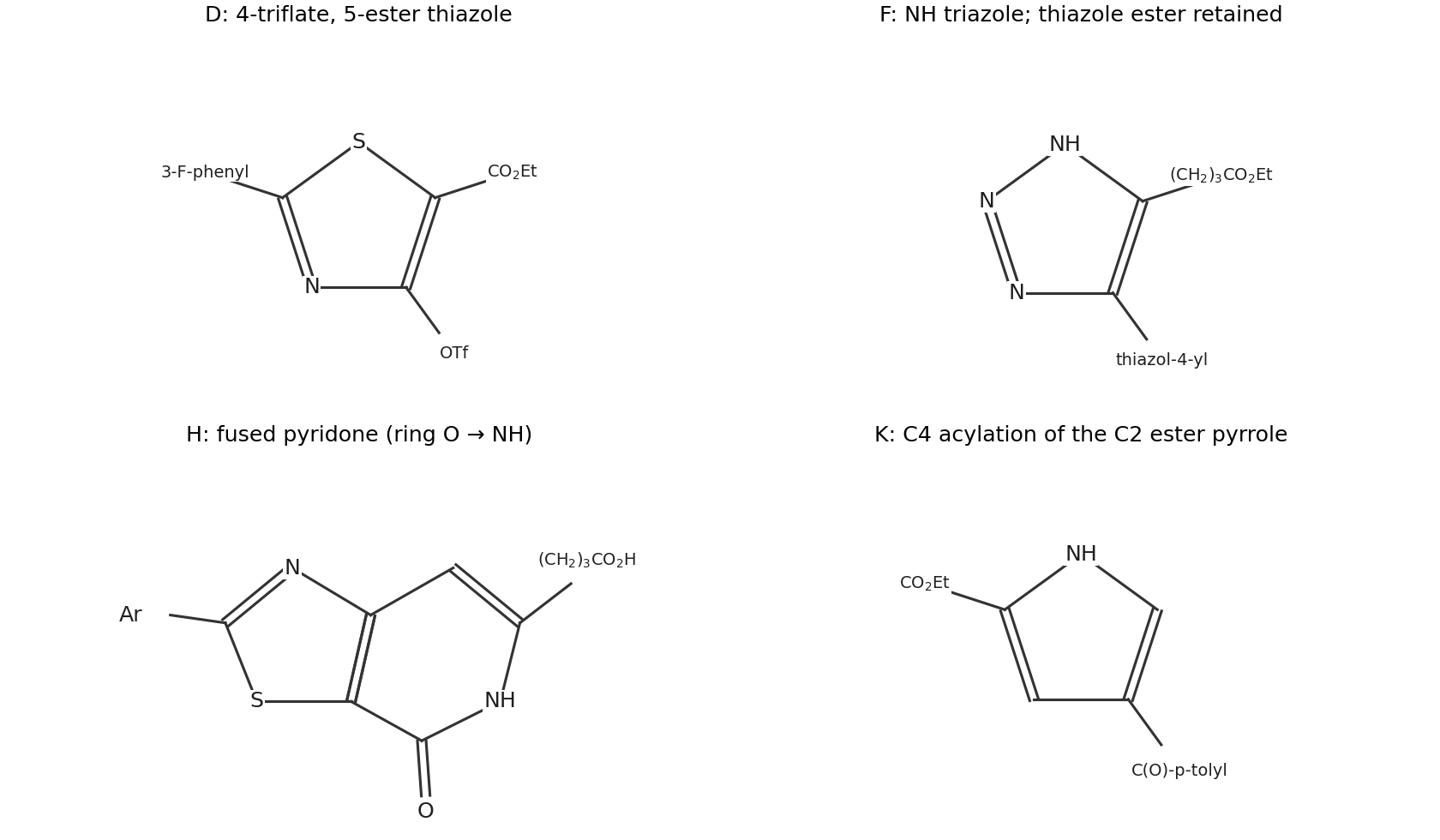
The thioamide first undergoes sulfur alkylation at the bromomalonate carbon, displacing bromide. Intramolecular attack of nitrogen on one ester carbonyl and ethanol loss produce a five-membered thiazolinone-type intermediate. Tautomerization gives ethyl 2-(3-fluorophenyl)-4-hydroxythiazole-5-carboxylate. For unambiguous atom assignment, write the ring in order as S1–C2(aryl)–N3–C4(OH)–C5(COEt): the thioamide carbon becomes C2, its nitrogen becomes N3, the attacked ester carbonyl becomes C4 and the original bromomalonate methine becomes C5.
Thus the correctly numbered intermediate is ethyl 2-(3-fluorophenyl)-4-hydroxythiazole-5-carboxylate. Triflic anhydride activates the hydroxyl oxygen; triethylamine removes its proton to give D = ethyl 2-(3-fluorophenyl)-4-(trifluoromethanesulfonyloxy)thiazole-5-carboxylate. This aryl triflate undergoes the subsequent palladium-catalysed alkynyl coupling at C4. The explicit ring atom mapping prevents interchanging the 4-hydroxy and 5-ester positions.
The acidic ethanolic step converts the terminal carboxylic acid to its ethyl ester, leaving the pre-existing thiazole ester. Azide then adds across the alkyne by 1,3-dipolar cycloaddition, followed by protonation at work-up. F contains an NH-1,2,3-triazole replacing the alkyne, with the thiazole and attached to its two carbon atoms. The thiazole's own COEt group remains.
The formula check is decisive:One can represent the cycloaddition with cyclic movement of the azide resonance-form electrons and the alkyne electrons into the two new C–N bonds. Alkali azide initially gives a triazolide; aqueous work-up provides the NH. Interchanging formal 4/5 labels for the carbon substituents in an N-unsubstituted triazole does not establish a separate permanently fixed N-substituted regioisomer.
KOH hydrolyses the thiazole ethyl ester to a carboxylate; acidification gives the acid. Silver(I) then activates the neighbouring alkyne towards intramolecular six-membered O-cyclization. The carboxylate oxygen attacks the alkyne carbon farther from the thiazole, so the new ring follows carbonyl C–O–distal alkyne C–proximal alkyne C–thiazole C4–thiazole C5. A vinyl-silver intermediate is protonated to give the fused pyrone G.
The remote terminal carboxylic acid survives. Ester hydrolysis changes E's formula by to ; the subsequent addition across the alkyne changes connectivity without altering that formula. This distinguishes the lactonizing carboxyl group at thiazole C5 from the side-chain acid, which is not the group closing the observed fused ring.
H is the fused pyridone analogue of G: replace the pyrone ring oxygen by NH, retaining its carbonyl and the remote carboxylic acid. Ammonia adds to the electron-poor pyrone system, opening its lactone/enol-ether framework into an amino-containing unsaturated acyl intermediate. Proton transfers permit intramolecular closure through nitrogen and loss of water, giving the conjugated pyridone/lactam ring. Acid work-up restores the neutral acid and the preferred neutral lactam representation.

Articles by others on the same topic
There are currently no matching articles.