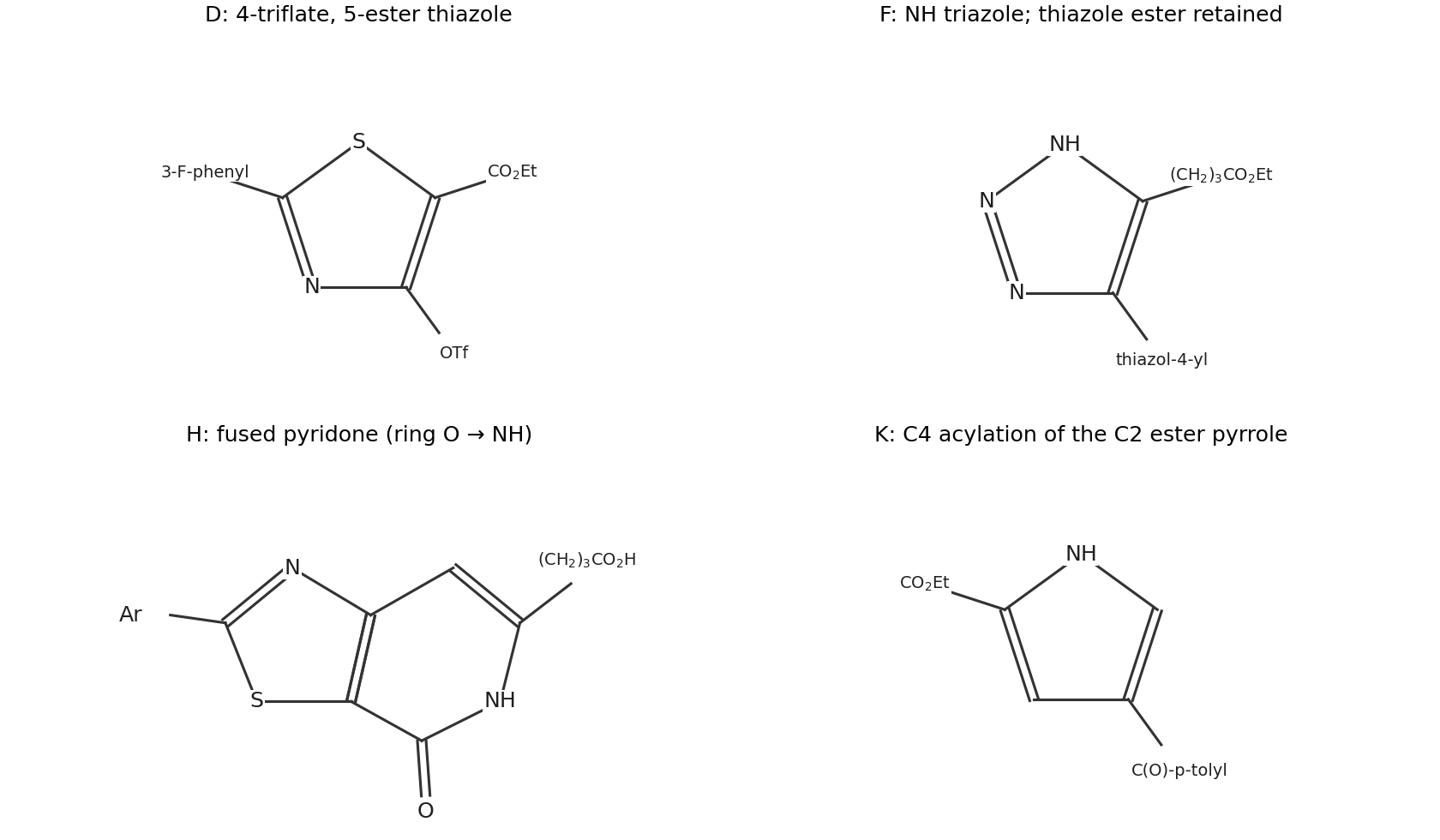
The thioamide first undergoes sulfur alkylation at the bromomalonate carbon, displacing bromide. Intramolecular attack of nitrogen on one ester carbonyl and ethanol loss produce a five-membered thiazolinone-type intermediate. Tautomerization gives ethyl 2-(3-fluorophenyl)-4-hydroxythiazole-5-carboxylate. For unambiguous atom assignment, write the ring in order as S1–C2(aryl)–N3–C4(OH)–C5(COEt): the thioamide carbon becomes C2, its nitrogen becomes N3, the attacked ester carbonyl becomes C4 and the original bromomalonate methine becomes C5.
Thus the correctly numbered intermediate is ethyl 2-(3-fluorophenyl)-4-hydroxythiazole-5-carboxylate. Triflic anhydride activates the hydroxyl oxygen; triethylamine removes its proton to give D = ethyl 2-(3-fluorophenyl)-4-(trifluoromethanesulfonyloxy)thiazole-5-carboxylate. This aryl triflate undergoes the subsequent palladium-catalysed alkynyl coupling at C4. The explicit ring atom mapping prevents interchanging the 4-hydroxy and 5-ester positions.
The acidic ethanolic step converts the terminal carboxylic acid to its ethyl ester, leaving the pre-existing thiazole ester. Azide then adds across the alkyne by 1,3-dipolar cycloaddition, followed by protonation at work-up. F contains an NH-1,2,3-triazole replacing the alkyne, with the thiazole and attached to its two carbon atoms. The thiazole's own COEt group remains.
The formula check is decisive:One can represent the cycloaddition with cyclic movement of the azide resonance-form electrons and the alkyne electrons into the two new C–N bonds. Alkali azide initially gives a triazolide; aqueous work-up provides the NH. Interchanging formal 4/5 labels for the carbon substituents in an N-unsubstituted triazole does not establish a separate permanently fixed N-substituted regioisomer.
KOH hydrolyses the thiazole ethyl ester to a carboxylate; acidification gives the acid. Silver(I) then activates the neighbouring alkyne towards intramolecular six-membered O-cyclization. The carboxylate oxygen attacks the alkyne carbon farther from the thiazole, so the new ring follows carbonyl C–O–distal alkyne C–proximal alkyne C–thiazole C4–thiazole C5. A vinyl-silver intermediate is protonated to give the fused pyrone G.
The remote terminal carboxylic acid survives. Ester hydrolysis changes E's formula by to ; the subsequent addition across the alkyne changes connectivity without altering that formula. This distinguishes the lactonizing carboxyl group at thiazole C5 from the side-chain acid, which is not the group closing the observed fused ring.
H is the fused pyridone analogue of G: replace the pyrone ring oxygen by NH, retaining its carbonyl and the remote carboxylic acid. Ammonia adds to the electron-poor pyrone system, opening its lactone/enol-ether framework into an amino-containing unsaturated acyl intermediate. Proton transfers permit intramolecular closure through nitrogen and loss of water, giving the conjugated pyridone/lactam ring. Acid work-up restores the neutral acid and the preferred neutral lactam representation.

Articles by others on the same topic
There are currently no matching articles.