Only one bromine is replaced by hydrogen. Writing the unchanged protected chain as , the product is , retaining the original internal alkene geometry and forming predominantly the terminal bromoalkene: bromine and the carbon chain lie on the same side of that new stereodefined double bond. The formula is consequently .
Phosphine dissociation exposes Pd(0), which undergoes preferential oxidative addition into the less hindered C–Br bond, the bromine trans to the carbon chain in the gem-dibromoalkene. hydride transfer from tributyltin hydride replaces the palladium bromide ligand, producing tributyltin bromide and an alkenyl–Pd–H intermediate. reductive elimination joins the alkenyl carbon and hydride, regenerating Pd(0). Retention of the alkenyl geometry through this sequence puts the surviving bromine cis to the chain. The conjugated carbon skeleton and protecting group remain intact; this is not addition of tin hydride across either alkene. The stereoselective monohydrogenolysis is established for this reagent combination.[ref]
A general and convenient synthetic method of geometrically pure (Z)-1-bromo-1-alkenes by Junichi Uenishi and others. Tetrahedron Letters 37, pp. 6759–6762: palladium/tributyltin-hydride monoreduction
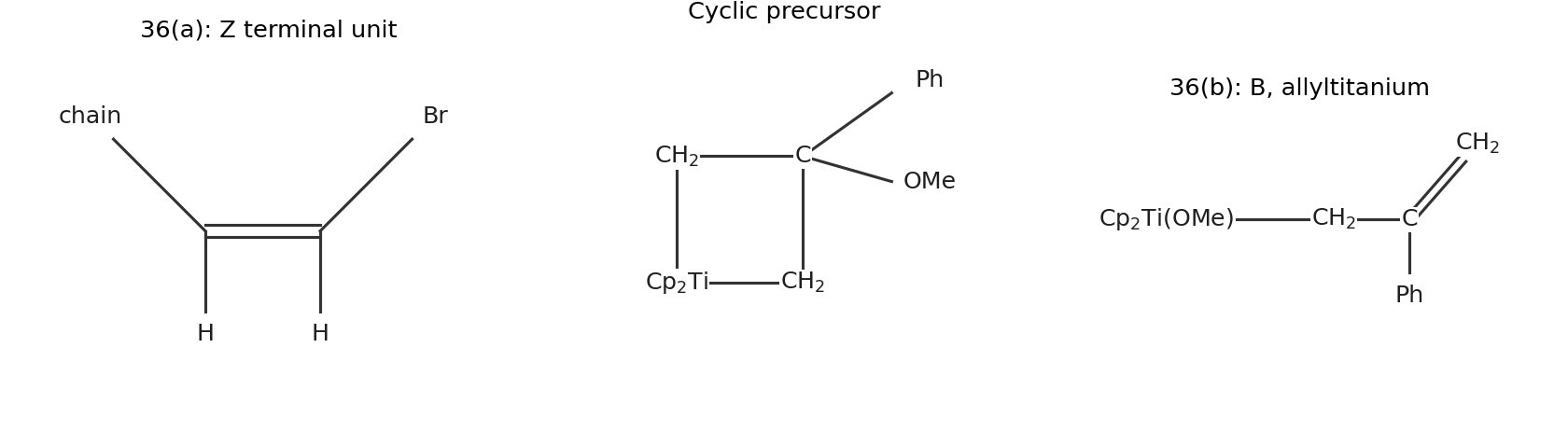
Original product and metallacycle connectivity drawings for the organometallic transformations
. Details. 
The first equivalent of titanocene methylidene methylenates the ester: the carbonyl oxygen and titanium form an oxatitanacyclobutane, whose fragmentation gives and a titanium–oxygen product. The second equivalent adds across this electron-rich double bond. The initial adduct is a titanacyclobutane with cyclic connectivity , closing from the last methylene to titanium. The ester's phenyl-substituted carbon lies opposite Ti; the two new methylenes originate from the two methylidene equivalents.
Beta-methoxy elimination opens that metallacycle to B, , the allyltitanium reagent. The C–OMe bond breaks, OMe transfers to Ti, one Ti–C bond becomes the new C=C bond, and the other Ti–C bond remains as the allylic nucleophile. The cyclic adduct is therefore a precursor to the opened reagent B; treating B as merely the one-equivalent enol ether loses the second reagent carbon.
The aldehyde oxygen coordinates to titanium. Allylic carbon transfer to its carbonyl carbon, accompanied by movement of the C=O pi electrons to oxygen, gives the titanium alkoxide . Acidic aqueous workup cleaves O–Ti and protonates oxygen, giving . A six-membered allyl-transfer arrangement is a convenient mechanistic model. No enantioselectivity is imposed by these achiral reagents.
Schwartz reagent adds syn across the terminal alkene, placing zirconium at its terminal carbon and hydrogen at the substituted carbon. The organozirconium intermediate is . The two faces of the achiral starting alkene give enantiomeric organometallic intermediates.
Boron trifluoride coordinates the ether oxygen, making the benzylic C–OMe bond susceptible to cleavage. The C–Zr bond then transfers its carbon terminus intramolecularly to the benzylic carbon as the activated methoxy group departs, closing a cyclopropane. This can be represented as a concerted, strongly assisted displacement rather than requiring a freely equilibrating long-lived benzylic carbocation. hydrozirconation fixes the relative disposition of the new C–H and C–Zr bonds, and the preferred closure conformation places the bulky phenyl and methyl groups on opposite faces. The result is racemic trans-1-methyl-2-phenylcyclopropane, with much less steric crowding than the cis alternative. The ring contains the original two alkene carbons and the original benzylic carbon; no carbene carbon is added.
Let -dimethylphenyl and -methoxyphenyl. After conversion of the Pd(OAc) precatalyst into an active phosphine–Pd(0) species, oxidative addition of gives . Carbonate-assisted replacement of chloride by the alcohol's alkoxide produces .
In the key beta-carbon elimination, the alkoxide oxygen forms a C=O bond while the bond between its carbinol carbon and cleaves, transferring to palladium. This gives acetone and a diarylpalladium(II) complex, . reductive elimination creates the new biaryl bond and regenerates Pd(0). Thus the tertiary alcohol functions as an aryl donor by carbon–carbon bond cleavage, rather than being incorporated as a carbinol substituent. The overall organic products are the cross-coupled biaryl and acetone. The carbinol carbon has no hydrogen, so ordinary beta-hydride elimination from this alkoxide cannot explain the observed aryl transfer. The bulky electron-rich phosphine helps access the aryl-chloride oxidative addition and the sterically congested biaryl-forming elimination.
Articles by others on the same topic
There are currently no matching articles.