The free allylic alcohol directs epoxidation of the adjacent alkene rather than the remote double bond. Applying the D-(−)-tartrate mnemonic gives the epoxide oxygen on the back face in the source orientation, with both new C–O bonds dashed if the original six-membered ring is kept in the plane. The CHOH substituent at the lower epoxide carbon consequently projects towards the front in an explicit tetrahedral product drawing. The remote double bond is retained. The opposite tartrate would reverse both newly created epoxide stereocentres; it would not alter the location of the epoxidized alkene.
Number the epoxide-bearing ring carbon carrying CHOH as C1, then proceed through the other epoxide carbon C2 around the ring to C6. Heating with water opens the epoxide at the less substituted C2 by backside attack: the incoming oxygen becomes C2–OH on the front face, while the original epoxide oxygen remains as C1–OH on the back face. Proton transfers complete formation of the triol. Thus the two original epoxide oxygens' roles are distinct: one is retained from B and the new hydroxyl oxygen comes from water.
Iodine next activates the remaining C4=C5 bond as an iodonium ion. The pendant primary alcohol oxygen attacks intramolecularly at C5 to make the five-membered cyclic ether with path O–CH–C1–C6–C5, opening the iodonium anti and leaving iodine at C4 on the opposite face. Bicarbonate removes the oxonium proton and neutralizes acid; it is not the source of the ether oxygen. The folded tether selects the face of closure compatible with the bridged structure, accounting for the ether/iodine stereochemistry.
The remaining two hydroxyl groups react with acid-activated 2,2-dimethoxypropane. Successive oxygen attack, methanol departure and intramolecular closure form the isopropylidene ketal of C, protecting that diol without changing its carbon configurations. The terminal primary hydroxyl has already become the cyclic ether and is not one of the two acetonide oxygens. This atom tracking distinguishes the epoxide hydrolysis, iodoetherification and protection stages.
Silver(I) promotes iodide departure, with precipitation of AgI. The oxygen of dimethyl sulfoxide substitutes at the iodine-bearing carbon to form an alkoxydimethylsulfonium intermediate. Triethylamine removes the hydrogen on that carbon; collapse forms C=O and breaks O–S, releasing dimethyl sulfide. The result is ketone D by a Kornblum oxidation. In arrow terms, the C–H electrons form the carbonyl pi bond as the O–S bond breaks. The carbon bearing iodine becomes the carbonyl carbon; the existing bridged ether and acetonide are spectators. The iodine centre loses its tetrahedral stereochemistry because it becomes trigonal planar.
A suitable sequence is selective alpha-bromination, then enol O-methylation. Use one equivalent of Br under controlled acidic enolization conditions to introduce bromine at the enolizable alpha carbon that becomes the brominated vinyl carbon. The other alpha site is a constrained bridgehead and cannot form the required ordinary enol double bond. Then O-alkylate the ketone with trimethyloxonium tetrafluoroborate and remove the brominated alpha proton with a nonnucleophilic base such as triethylamine. Collapse of the O-methylated carbonyl oxonium gives the alpha-bromo methyl enol ether E.
The methyl group belongs on oxygen, not on the alpha carbon. Simply writing methyl iodide with an unspecified enolate would not guarantee this outcome because competitive C-alkylation is possible. Use conditions designed for carbonyl O-alkylation followed by deprotonation, and limit bromine to avoid overbromination or damage to the protecting group.
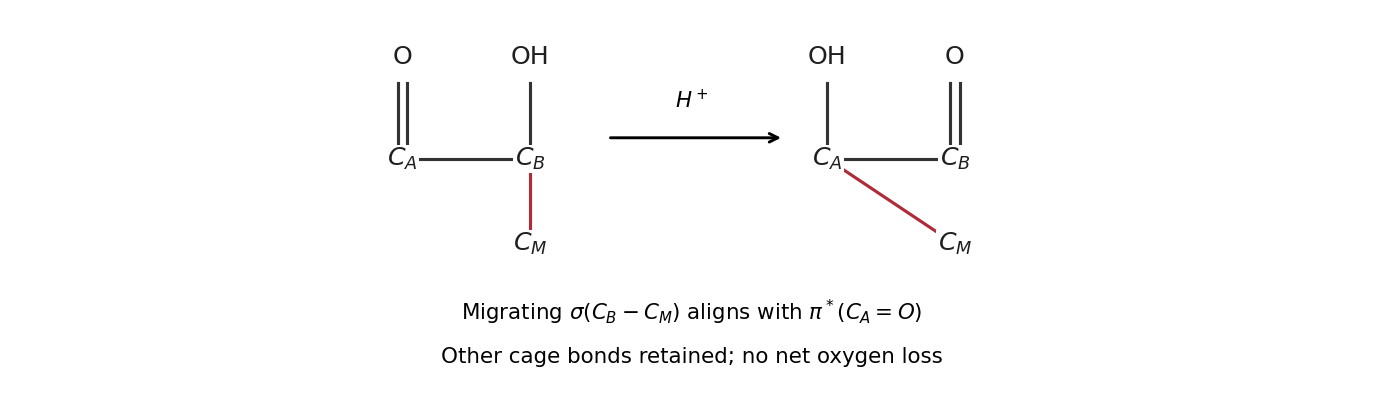
This is an acid-catalysed alpha-ketol rearrangement. Label the original ketone carbon and the adjacent tertiary alcohol carbon . Protonate the oxygen on to activate that carbonyl. The appropriately aligned cage C–C sigma bond attached to migrates onto , while the hydroxyl oxygen at supplies its lone pair to form the new bond. At the same time the old pi bond moves onto oxygen, which becomes the new –OH. deprotonation regenerates the acid.
The migration reroutes the bridge rather than removing water: the original alcohol carbon becomes the ketone, and the original ketone carbon becomes the tertiary alcohol. A productive conformation aligns the migrating sigma orbital with the accepting carbonyl pi-star orbital; the oxygen lone pair simultaneously overlaps the developing p orbital at the donor carbon. The cage's geometry controls which adjacent sigma bond has the necessary alignment and which less strained skeletal isomer results. A freely rotating isolated carbocation or a simple proton shift cannot account for the changed cage connectivity.

Manganese(III) removes one electron from the enol/enolate of H, and loss of its hydroxyl proton gives a carbon-centred radical at the tether-bearing alpha carbon of the resulting 1,3-dicarbonyl system. The enolic OH becomes the second carbonyl oxygen. This radical attacks the terminal CH of the tethered isopropenyl group, forming a new C–C bond and a six-membered ring. The residual radical is on the substituted carbon bearing methyl, which is more stable than the primary radical from the alternative regiochemical closure.
Dioxygen traps that radical as a peroxyl intermediate. reduction/proton transfer and O–O cleavage in the ensuing oxygenation/workup sequence give the new tertiary alcohol on the methyl-bearing carbon. The drawn net transformation specifies that oxygenated product, not a persistent hydroperoxide; individual electron/proton transfers require the reaction medium and workup and cannot be fixed uniquely from the abbreviated reagent line alone. The rigid cage and folded tether select the closure face and therefore the relative configuration of the new ring junction.
Finally the new hydroxyl oxygen attacks silicon of TBSCl, with imidazole assisting deprotonation and chloride departure, giving the tertiary silyl ether I. The hindered pre-existing hydroxyls remain as shown. Track the two key atom changes: the terminal alkene carbon becomes a methylene in the new ring, and the former substituted alkene carbon acquires oxygen and retains its methyl group. Calling the first step a two-electron aldol reaction would miss both the single-electron oxidant and the role of dioxygen.
Articles by others on the same topic
There are currently no matching articles.