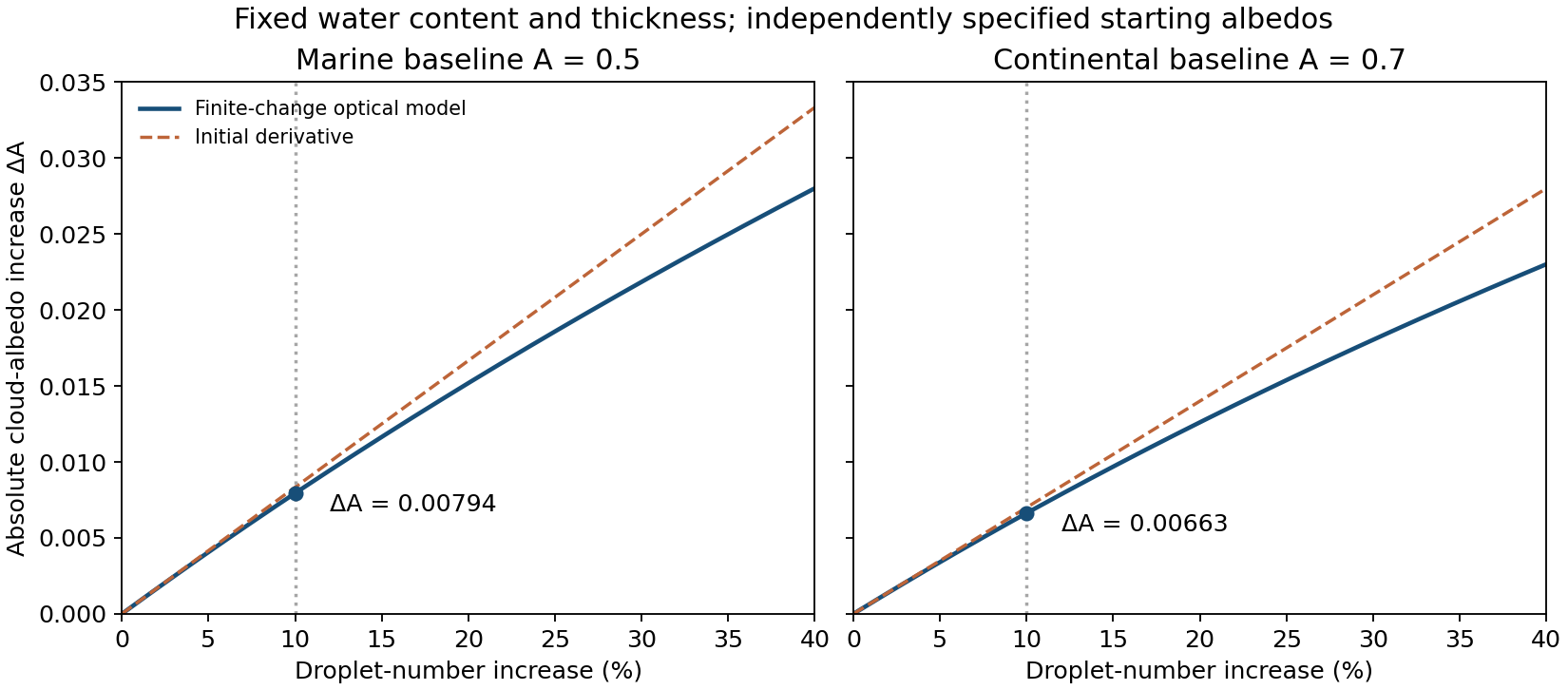
Hold liquid-water content and cloud thickness fixed, as required for a partial sensitivity to droplet number. Then , so . Differentiating the albedo relation gives , henceSince and ,The factor peaks at , so the albedo response to a fixed fractional droplet-number change is greatest at intermediate albedo and weaker near either saturation limit.
For a small fractional change , use . With the changes areThus the respective albedos become approximately 0.5083 and 0.7070 in the first-order calculation. These are increases of 0.83 and 0.70 percentage points, not 0.83% and 0.70% relative changes. Relative to the initial albedos, the increases are about 1.67% and 1.00%.
The exact finite-change version of the stipulated optical model is with , giving and . Its slightly smaller changes are consistent with curvature neglected in the differential approximation. For equal fractional number increases, the cleaner, intermediate-albedo marine cloud is somewhat more susceptible; for equal absolute number increases its susceptibility would be much greater because of the extra factor. The two starting albedos are treated as the supplied separate baselines, not as an exact common-proportionality calibration of the approximate optical-depth law.

Activation as a cloud condensation nucleus depends primarily on dry particle size, soluble composition and hygroscopicity, together with wetting and surface-tension effects. In Köhler theory, droplet curvature raises the equilibrium vapor pressure, while dissolved solute lowers water activity. Each particle therefore has a critical supersaturation; larger or more hygroscopic particles generally activate at a lower value. A size distribution cannot be replaced by an undifferentiated total aerosol count.[ref]
A single parameter representation of hygroscopic growth and cloud condensation nucleus activity by M. D. Petters and S. M. Kreidenweis. Atmospheric Chemistry and Physics 7 (2007), pp. 1961–1971, dry diameter, hygroscopicity parameter and critical supersaturation
Actual droplet number also depends on the supersaturation attained in the cloud updraught. Adding particles increases competition for condensing water vapor and can lower the peak supersaturation, leaving some particles unactivated. Updraught speed, entrainment and the aerosol size distribution therefore make the number of activated droplets a nonlinear function of the available nuclei. Suitable nuclei need sufficiently low activation thresholds, and additional aerosol does not guarantee one additional droplet per particle.
Articles by others on the same topic
There are currently no matching articles.