Photodissociation of nitrogen dioxide forms an oxygen atom, followed by third-body recombination:If NO is converted back to nitrogen dioxide only by , this is a null cycle with no net ozone production. Oxidation of a volatile organic compound by OH generates organic peroxy radicals, and often hydroperoxyl radicals, which instead oxidize NO without consuming ozone:The newly formed nitrogen dioxide can then photolyse, giving net ozone production. These chain reactions require sunlight, radical production and both precursor families.
In an NOx-limited ozone-production regime, NO is too scarce for efficient peroxy-radical conversion; competing peroxide-forming radical termination becomes important. Reducing nitrogen-oxide emissions then reduces ozone production. In a VOC-limited ozone-production regime, plentiful nitrogen oxides remove OH through , so organic oxidation and radical supply are limiting. Reducing volatile-organic emissions is effective there, while a modest nitrogen-oxide reduction can initially increase ozone by reducing radical termination and NO titration. Sufficiently large nitrogen-oxide reductions can move the system into the limited regime and eventually lower ozone. The appropriate control therefore depends on the chemical regime and the regional transport history, not merely the largest local emission. The ozone isopleth diagram below uses an explicitly schematic response function to show derivative signs, not a fitted concentration or emissions-control prediction.[ref]
The sensitivity of ozone to nitrogen oxides and hydrocarbons in regional ozone episodes by Sanford Sillman and others. Journal of Geophysical Research 95 (1990), pp. 1837–1851, model comparison of rural and urban precursor sensitivity
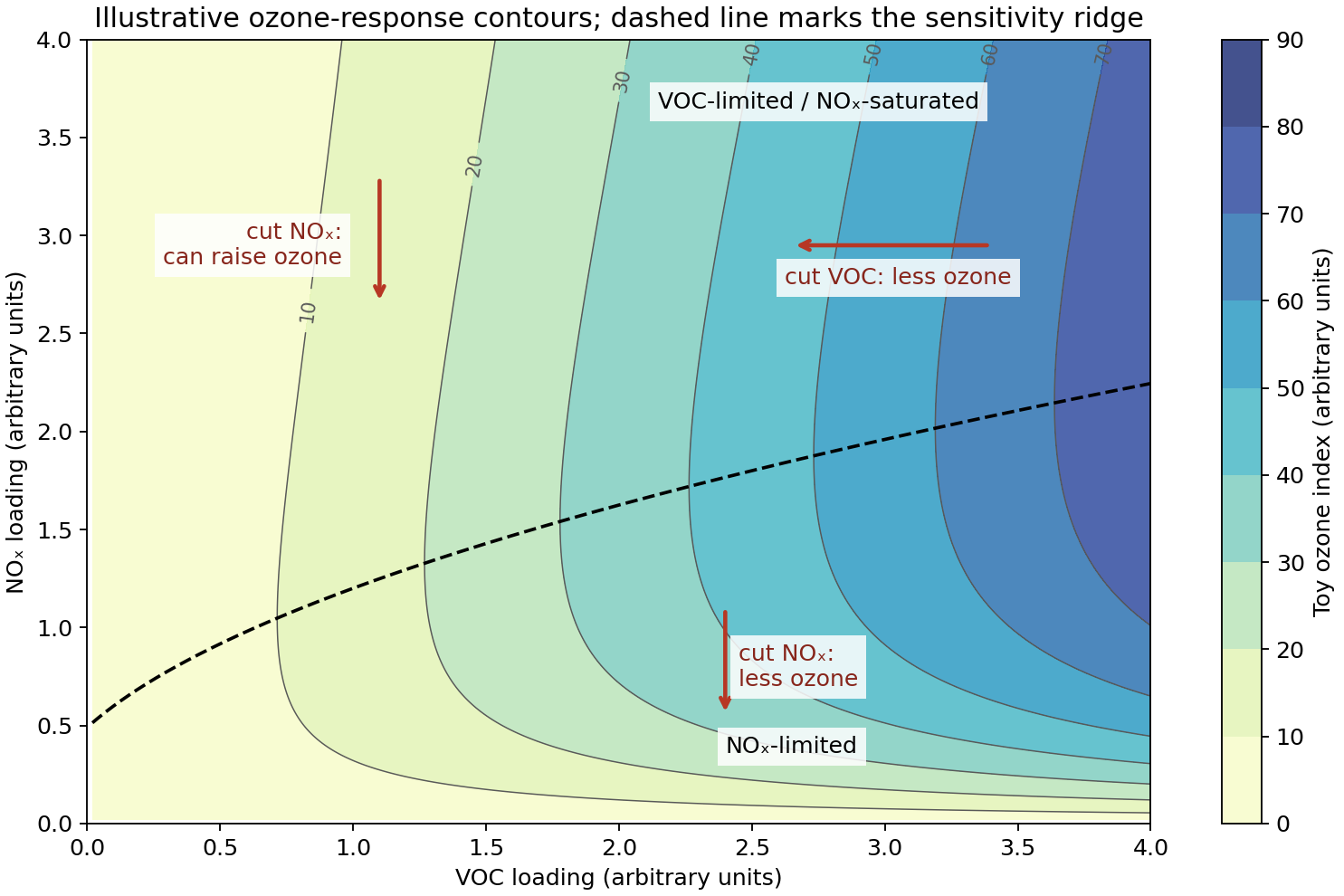
Original schematic showing opposite local ozone responses to nitrogen-oxide controls in two chemical regimes
. Details. The profile shows a low-ozone mixed layer up to approximately 2 km, with roughly 30 ppb ozone, and an overlying free-tropospheric value of roughly 50 ppb. The rise occurs through a transition layer extending to about 2.8 km, so these are approximate regime readings, not exact values for every altitude. The horizontal axis is already a mixing ratio; it does not provide a number density without additional air-density information.
Excited has two competing fates. Collisional deactivation returns ground-state oxygen, which reforms ozone rapidly; reaction with water instead gives net ozone loss and two OH radicals. The chemical branching fraction for the latter isThus only about 4.92% of these ozone photolyses directly lead to the specified net chemical loss; treating every photodissociation as permanent removal would overestimate the sink. The corresponding first-order rate is . Converting the given hydroperoxyl mixing ratio to a concentration gives , so .
For a well-mixed marine atmospheric boundary layer of depth , the downward surface flux is . Dividing by the layer volume per unit area gives a first-order dry deposition rate . The air density cancels on expressing the entire balance in ozone mixing ratio :At steady state, with ,The effective removal time is about 4.28 days. This calculation assumes a uniform layer of the diagnosed depth, fixed chemical conditions and a local time-independent balance.
The observed value is about 4 ppb higher than the local chemical–dry deposition balance predicts. Entrainment from the ozone-richer free troposphere adds a term ; horizontal Advection can likewise import ozone or longer-lived precursors from other regions. Time dependence, including the day–night cycle of photodissociation and changes in mixing depth, is also omitted. The approximately four-day model adjustment time means that air arriving at the measurement location need not have attained the assumed local steady state. These transport and history terms can raise ozone without changing the given local chemical constants.
For a liquid cloud at fixed water content and geometrical thickness, more cloud condensation nuclei can produce more, smaller droplets. The increased total extinction area raises optical depth and reflected sunlight: the Twomey effect gives negative shortwave radiative forcing. It is an indirect aerosol effect mediated by cloud microphysics, rather than direct aerosol scattering.[ref]
The Influence of Pollution on the Shortwave Albedo of Clouds by S. Twomey. Journal of the Atmospheric Sciences 34 (1977), pp. 1149–1152, fixed-water-content droplet-number and reflectance effect
Smaller droplets can also delay collision-coalescence and drizzle, potentially increasing liquid-water retention, cloud lifetime or coverage; that adjustment would usually strengthen cooling for low reflective clouds. It is not universal: evaporation and mixing with dry air can reduce water content or cloud cover, and dynamical changes can oppose the simple lifetime argument. Absorbing particles can heat an atmospheric layer, sometimes evaporating cloud and producing a positive semi-direct forcing, but their vertical position can instead stabilize a cloud layer and reverse the response. Aerosols can additionally alter ice nucleation and mixed-phase precipitation, with no single forcing sign independent of cloud type. The net response combines shortwave reflection and longwave thermal effects, and depends on cloud height, optical depth and adjustments. Thus the fixed-water Twomey sign is robust within its assumptions; adjustment and ice-cloud signs require context.[ref]
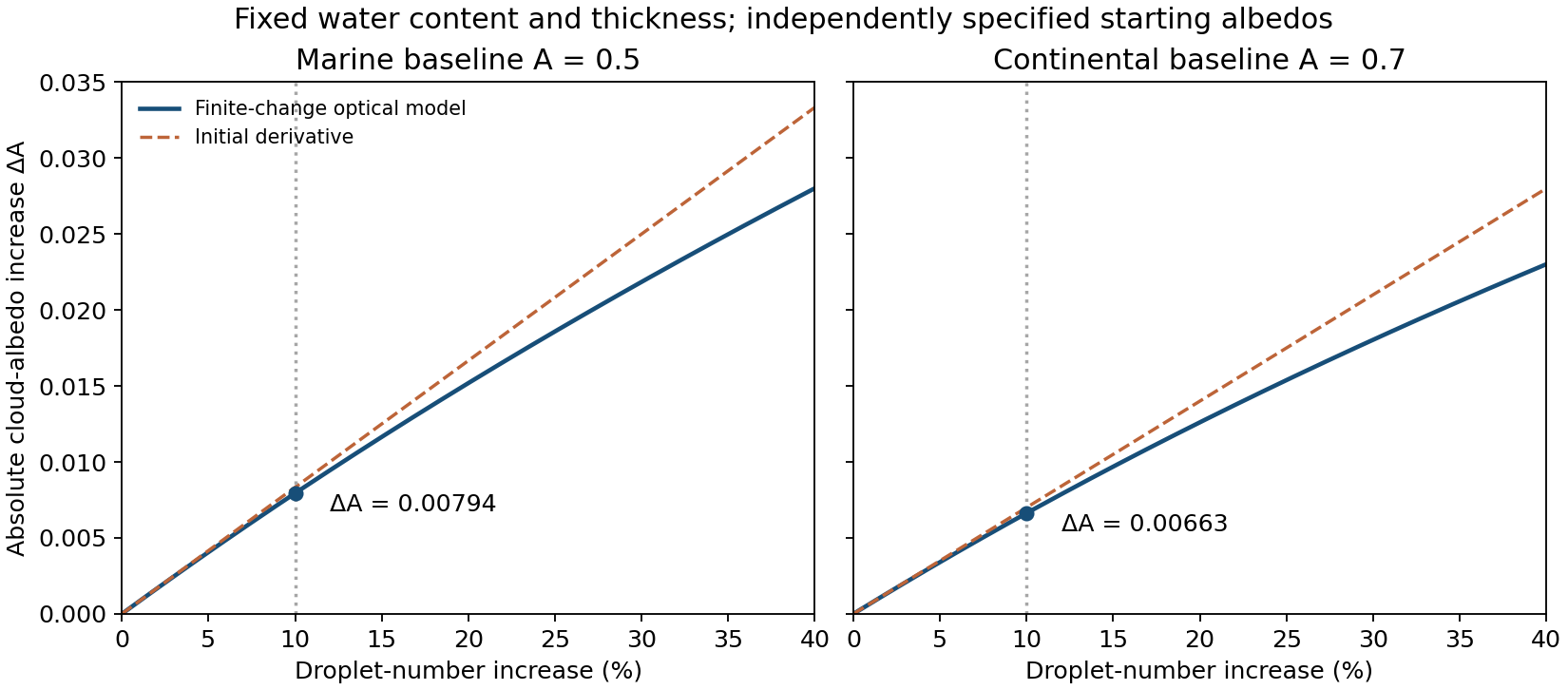
Hold liquid-water content and cloud thickness fixed, as required for a partial sensitivity to droplet number. Then , so . Differentiating the albedo relation gives , henceSince and ,The factor peaks at , so the albedo response to a fixed fractional droplet-number change is greatest at intermediate albedo and weaker near either saturation limit.
For a small fractional change , use . With the changes areThus the respective albedos become approximately 0.5083 and 0.7070 in the first-order calculation. These are increases of 0.83 and 0.70 percentage points, not 0.83% and 0.70% relative changes. Relative to the initial albedos, the increases are about 1.67% and 1.00%.
The exact finite-change version of the stipulated optical model is with , giving and . Its slightly smaller changes are consistent with curvature neglected in the differential approximation. For equal fractional number increases, the cleaner, intermediate-albedo marine cloud is somewhat more susceptible; for equal absolute number increases its susceptibility would be much greater because of the extra factor. The two starting albedos are treated as the supplied separate baselines, not as an exact common-proportionality calibration of the approximate optical-depth law.


Activation as a cloud condensation nucleus depends primarily on dry particle size, soluble composition and hygroscopicity, together with wetting and surface-tension effects. In Köhler theory, droplet curvature raises the equilibrium vapor pressure, while dissolved solute lowers water activity. Each particle therefore has a critical supersaturation; larger or more hygroscopic particles generally activate at a lower value. A size distribution cannot be replaced by an undifferentiated total aerosol count.[ref]
A single parameter representation of hygroscopic growth and cloud condensation nucleus activity by M. D. Petters and S. M. Kreidenweis. Atmospheric Chemistry and Physics 7 (2007), pp. 1961–1971, dry diameter, hygroscopicity parameter and critical supersaturation
Actual droplet number also depends on the supersaturation attained in the cloud updraught. Adding particles increases competition for condensing water vapor and can lower the peak supersaturation, leaving some particles unactivated. Updraught speed, entrainment and the aerosol size distribution therefore make the number of activated droplets a nonlinear function of the available nuclei. Suitable nuclei need sufficiently low activation thresholds, and additional aerosol does not guarantee one additional droplet per particle.
Articles by others on the same topic
There are currently no matching articles.