Put . Between successive measurement bases, the squared overlap is for retaining the same label and for changing label. The first step obeys the same rule if we regard the initial state as label 0 at angle zero. Thus the recorded labels form a Markov chain with transition matrix .
Let be the probability of label 0 after step . Then andSince , iteration yieldsThis is the total final-outcome probability, including histories that change label an even number of times. The smaller quantity counts only the history with label 0 at every step and is not the requested total. For example, at the total is , whereas the uninterrupted history has probability . At , the final basis is up to signs, so the total probability of label 0 is zero, as the formula also gives. This distinguishes nonselective measurement-guided Zeno transfer from postselection on one record.
At the last step, and . Ignoring the recorded outcome, the final density matrix isFor large , the Taylor expansion givesThus , and the final state tends to , or as a pure-state representative. In fact , and its trace distance from is exactly . With records retained, the final conditional state is with probability tending to one. These are compatible descriptions, not a coherent sum of the two outcome branches. This quantum Zeno effect guides a known preparation through slowly rotating measurement bases; it is not a unitary Pauli X gate acting coherently on an arbitrary unknown input.
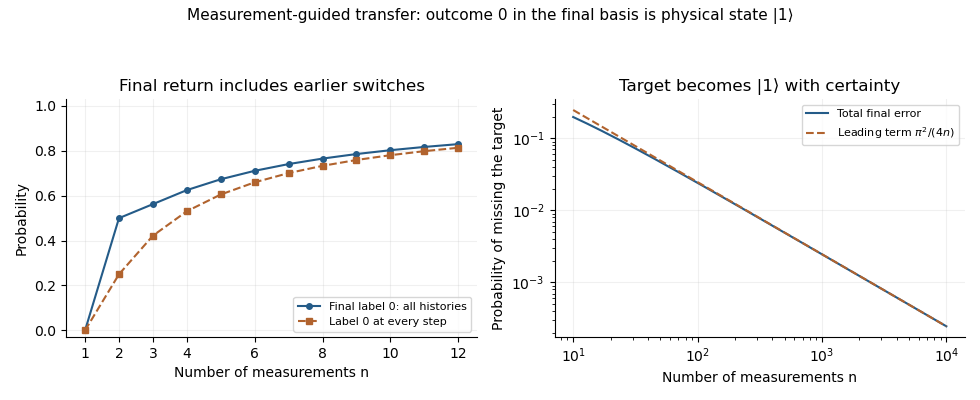
Total probability of the final target outcome versus the uninterrupted measurement record, and the asymptotic target-error probability in measurement-guided Zeno transfer
. Details. 
Articles by others on the same topic
There are currently no matching articles.