A basic measurement is specified by an orthonormal basis , with outcome associated with the rank-one orthogonal projection . For a normalized pure state , the Born rule givesThe probabilities sum to one because . Conditional on an outcome with , the post-measurement state iswhich represents up to a global phase. An outcome of zero probability has no conditional state to normalize. For a density matrix , the corresponding expressions are and . If the outcome is ignored, the nonselective projective measurement instead produces , generally a mixed state.[ref]
Basic notions of quantum information. §2.3, Definition 2.34 and the outcome-probability rule; specialize to rank-one orthogonal projections
The columns are and . Their norms are one and their inner product is zero, since are orthonormal. Thus is a unitary matrix. Equivalently,using the Hadamard gate and Pauli Z gate. The different column phases do not destroy orthonormality.
The Pauli Y gate satisfies and . With and , the given matrix is Hermitian, andTherefore is not a unitary matrix. Its eigenvalues are and , neither of which has modulus one. An expression would behave differently, but the printed matrix has no such factor of .
Set and . They are self-adjoint operators and satisfy , because the original factors are both self-adjoint and unitary. They also commute: each acts on a different tensor factor. HenceThe same calculation in the opposite order gives . Thus is a unitary matrix for every allowed pair of factors. Commutation cancels the cross terms, while their relative imaginary coefficient supplies the opposite signs. This is the commuting-involution unitary combination.
Let and . The first basic measurement has outcome probabilities and , obtained by conjugating the amplitudes in the bras. Conditional on its first outcome, the next computational-basis measurement returns 0 with probability ; conditional on its second outcome, that probability is . The law of total probability therefore givesConsequently the minimum is , attained exactly when . The relative complex phases do not affect this result. The alternatives after the first measurement form a classical mixture; their amplitudes must not be added coherently as if no measurement occurred.
Choose and its orthogonal companion . Since , either branch of
RandomFlip returns the same pure state. Alice therefore obtains label 0 with certainty, andThe alternative choice also works: its sign change under is only a global phase. The useful property is being a Pauli eigenstate of the Pauli X gate.Use the preparation and measurement from part (i).
RandomReset returns the density matrix , a maximally mixed state. In the basis its two outcomes each have probability . In contrast, RandomFlip always gives outcome 0.Guess
RandomFlip after 0 and RandomReset after 1. With the supplied equal priors,An outcome 1 identifies the reset action, but outcome 0 does not identify the flip action with certainty. For example, Bayes' theorem gives posterior probability for the flip action after 0. The total success rate already accounts for the reset runs that also produce 0.Prepare the uniform pure stateEvery permutation matrix fixes this vector, so
RandomPermute returns with certainty. Choose an orthonormal basis with first vector , for example the quantum Fourier transform basis. Under RandomReset, the returned state is , which gives each of the measurement labels probability .Guess
RandomPermute on label 0 and RandomReset on every other label. ThenThis is invariant-pure-state discrimination against a maximally mixed reset. It also agrees with the Holevo–Helstrom theorem: the eigenvalues of are once and with multiplicity , giving optimal equal-prior success . This confirms optimal discrimination of these returned states, in addition to constructing the requested strategy.[ref]The Theory of Quantum Information by John Watrous. §3.1.1, Theorem 3.4 and equation (3.20), optimal binary-state discrimination
For , the actions coincide and the formula correctly gives random-guessing success .Put . Between successive measurement bases, the squared overlap is for retaining the same label and for changing label. The first step obeys the same rule if we regard the initial state as label 0 at angle zero. Thus the recorded labels form a Markov chain with transition matrix .
Let be the probability of label 0 after step . Then andSince , iteration yieldsThis is the total final-outcome probability, including histories that change label an even number of times. The smaller quantity counts only the history with label 0 at every step and is not the requested total. For example, at the total is , whereas the uninterrupted history has probability . At , the final basis is up to signs, so the total probability of label 0 is zero, as the formula also gives. This distinguishes nonselective measurement-guided Zeno transfer from postselection on one record.
At the last step, and . Ignoring the recorded outcome, the final density matrix isFor large , the Taylor expansion givesThus , and the final state tends to , or as a pure-state representative. In fact , and its trace distance from is exactly . With records retained, the final conditional state is with probability tending to one. These are compatible descriptions, not a coherent sum of the two outcome branches. This quantum Zeno effect guides a known preparation through slowly rotating measurement bases; it is not a unitary Pauli X gate acting coherently on an arbitrary unknown input.
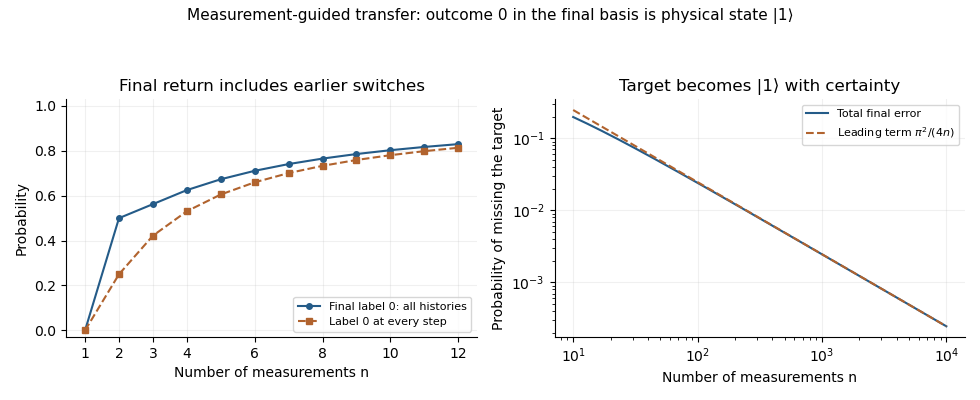
Total probability of the final target outcome versus the uninterrupted measurement record, and the asymptotic target-error probability in measurement-guided Zeno transfer
. Details. 
Articles by others on the same topic
There are currently no matching articles.