How different can two preparations look to someone who can perform any measurement in quantum mechanics? The trace distance answers this question for density operators on the same finite-dimensional vector space:Here is the absolute value of an operator, and is its trace norm. Because is Hermitian, its trace norm is the sum of the absolute values of its eigenvalues; it is not the sum of the absolute values of its matrix entries. The factor givesThe trace distance is a metric: it is symmetric, vanishes exactly when , and obeys the triangle inequality. Identical preparations have trace distance zero; preparations with orthogonal occupied eigenspaces have trace distance one and can be identified perfectly in a single measurement in quantum mechanics.
Operationally, the trace distance is the largest total variation distance between the outcome probability distributions obtainable by a POVM. Equivalently, the variational characterization of trace distance says it is the largest possible probability gap for one event in a binary measurement in quantum mechanics. For one copy of either known preparation, each chosen with prior probability , the Holevo–Helstrom theorem givesThus trace distance zero leaves only guessing, while trace distance one permits perfect quantum state discrimination. The optimum ranges over measurements; different measurement bases can expose different amounts of distinguishability. [ref]
https://cs.uwaterloo.ca/~watrous/TQI/TQI.3.pdf. Watrous, The Theory of Quantum Information, §3.1, Theorem 3.4 and Proposition 3.5
For a worked example with commuting density operators, take a qubit withTheir difference has eigenvalues , so . Measuring in the computational basis produces outcome probability distributions and , whose total variation distance is also . Guessing on outcome zero and on outcome one succeeds with probability . A projective measurement in the Hadamard basis instead produces for both preparations and gives no discrimination advantage.
The trace-distance contraction under quantum channels ensures that a common quantum channel, including the partial trace, cannot increase the trace distance. This makes trace distance a useful error measure: if , every event in every measurement in quantum mechanics has a probability gap at most . Losing access to a subsystem can hide distinguishability, but cannot create more of it.
For qubit density operators, the trace distance has a particularly simple geometry. Write their Bloch vectors as in the Bloch ball:where is the identity operator and denotes the Pauli matrices. This Bloch vector representation includes both pure states on the Bloch sphere and mixed states in the interior of the Bloch ball. [ref]
The Pauli matrix multiplication law gives . Hence the two eigenvalues of are , and their absolute sum givesThe trace distance is half the straight-line Euclidean distance between the Bloch vectors, not the angular or surface distance along the Bloch sphere. Opposite Bloch vectors have trace distance one; the centre is at trace distance from every pure state.
For the pure states and , the Bloch vectors are and . Their straight-line separation is , soThese Bloch vectors are perpendicular, but the pure states are not orthogonal: . The Helstrom measurement for the zero and plus states measures along the difference direction , rather than along either input Bloch vector.
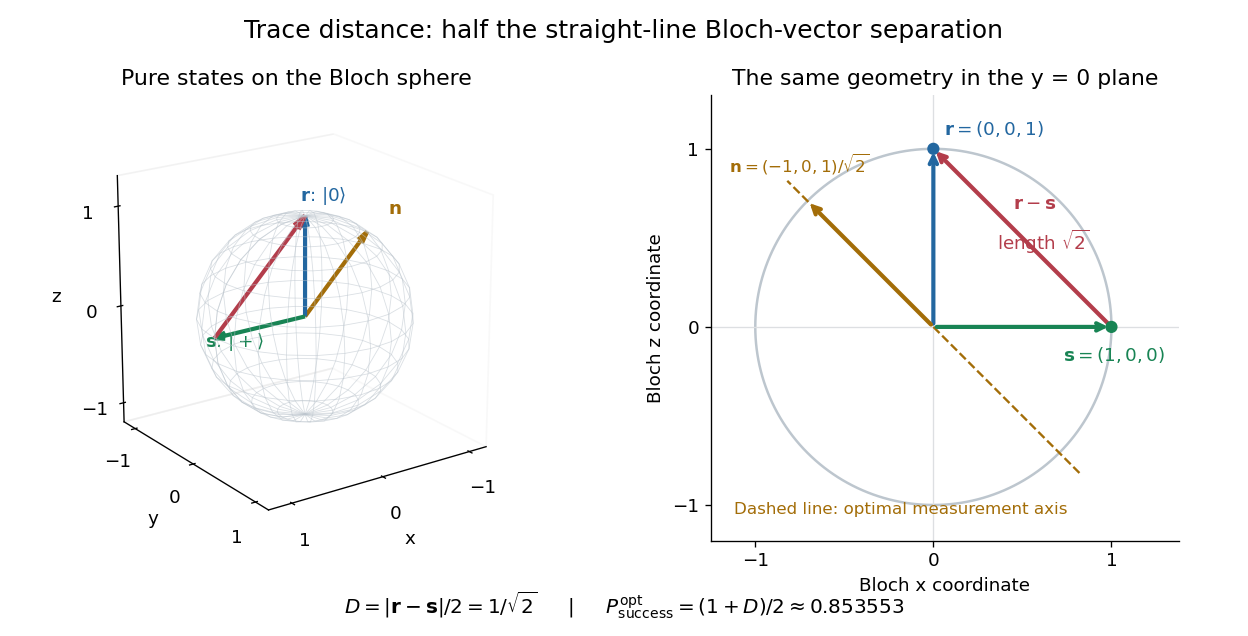
Trace distance is half a Bloch-vector chord, and the optimal zero-versus-plus measurement follows the difference direction
. Details. By the variational characterization of trace distance, maximize over . The adjoint of a quantum channel is positive and unital, so . Moving the channel onto therefore restricts, rather than enlarges, the effects available in the input variational problem. This proves the displayed bound for every pair of density operators.
For the pure qubit , subtracting the output of dephasing channel leaves a Hermitian matrix with zero diagonal and off-diagonal modulus . Its two eigenvalues are that number and its negative, giving the displayed trace distance. For real , this is .
For two normalized pure states, the difference of their projectors has two eigenvalues , giving that trace distance. Write a mixed density operator as . Convexity of the trace norm and weighted Cauchy-Schwarz inequality give . Thus a small probability of failing the pure-state projector test forces trace-distance proximity, including for correlated multipartite outputs.
For the Hermitian difference , define its positive part of a Hermitian operator and negative part of a Hermitian operator . Their supports are orthogonal and . Equal traces give , so the trace distance is both and . This explains why the positive spectral projector attains the variational characterization of trace distance.
For a density operator and pure state , the diagonal absolute-sum bound for the trace norm in a basis containing gives . The quantum fidelity is unsquared. Block-diagonal states with respect to the target and its complement attain equality.
The variational characterization of trace distance turns a matrix distance into the best possible binary experiment. For density operators on the same finite-dimensional vector space,An operator with is an effect of a POVM: both and are positive operators. The Born rule assigns the first outcome probabilities and . Their signed gap is , where . Since , replacing by reverses this gap, explaining the equality with the absolute-value maximum.
One optimal is the spectral projector onto the positive eigenspaces of . In the spectral decomposition of , this choice includes all positive eigenvalues and excludes all negative eigenvalues. Their positive sum equals the trace distance by the spectral-parts formula for trace distance. Any zero eigenspace can be assigned to either outcome without changing the gap. This is the effect selected by the equal-prior Holevo–Helstrom theorem. [ref]
https://cs.uwaterloo.ca/~watrous/TQI/TQI.3.pdf. Watrous, The Theory of Quantum Information, Theorem 3.4, equations (3.16)–(3.19)
The same optimum has a classical description. For any finite-outcome POVM , let and . ThenThe expression is the total variation distance of the entire outcome probability distributions; the expression for is the gap for one event. Grouping outcomes in gives the single effect . Conversely, an effect gives the binary POVM , whose two probability gaps are opposites, so their total variation distance is . Thus the optimum over all POVMs is already attained by one binary projective measurement. [ref]
https://cs.uwaterloo.ca/~watrous/TQI/TQI.3.pdf. Watrous, The Theory of Quantum Information, §3.1.1, Proposition 3.5 and the discussion following Theorem 3.4
For quantum state discrimination with equal prior probabilities, declare on outcome and on outcome . Directly averaging the two conditional success probabilities givesOptimizing this expression gives . For the diagonal example in trace distance, gives a gap . For zero versus plus, that same effect gives only , while the effect in Helstrom measurement for the zero and plus states gives the larger gap . The trace-distance-preserving binary measurement depends on the pair of preparations; a fixed measurement basis does not generally attain the trace distance for every pair.
For two density operators , let project onto the positive spectral subspace of . The binary POVM has output probability difference , where . Its measurement channel therefore preserves this pair's trace distance exactly. The optimizing quantum measurement depends on the pair; a single fixed measurement need not preserve every pair's distance.
Articles by others on the same topic


Trace distance is a concept from quantum information theory that quantifies the distinguishability between two quantum states, represented by density matrices. It is a useful measure for analyzing how different two quantum states are and has applications in quantum computing, quantum cryptography, and quantum mechanics in general.