Substitute the traveling normal mode . Combining the opposite-neighbour phases givesso the positive-frequency branch isFor positive spring constants this is a stable acoustic branch. At long wavelengths,The next-nearest-neighbour bond spans twice the distance, hence contributes the factor four. Relative to , positive increases the sound speed by . The chain still has one acoustic branch and no optical branch.
The group speed near and the maximum frequency need not change in the same way. The zone-edge value is always , because the next-nearest-neighbour sites then move together. For the frequency maximum moves inside the zone, with ; the small- sound speed nevertheless keeps increasing.
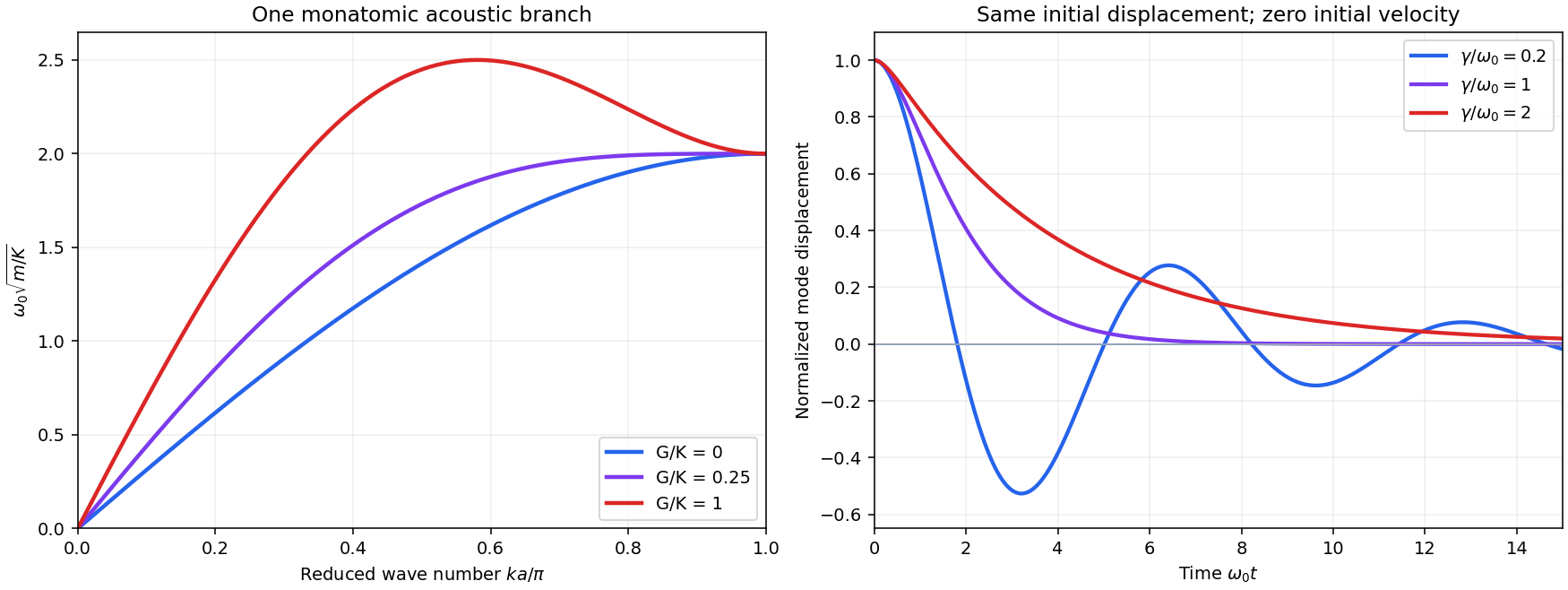
One acoustic branch with further-neighbour springs, and three viscous-decay regimes
. Original calculated dispersions for stated values of , all normalized using the same . The right panel shows a single normal coordinate with initial displacement one and initial velocity zero, for damping ratios . It illustrates that a nonoscillatory overdamped response does not have the same envelope as an underdamped phonon. Details.
Articles by others on the same topic
There are currently no matching articles.