Let be the equilibrium spacing of this monatomic chain and the displacement from . The right nearest-neighbour bond exerts and the left bond . The two next-nearest-neighbour bonds similarly connect to . ThusEvery uniform displacement gives zero force, as translation symmetry requires. There is one displacement coordinate per primitive cell. Adding further-neighbour springs does not introduce a second atom or turn this into a diatomic-chain problem.
Substitute the traveling normal mode . Combining the opposite-neighbour phases givesso the positive-frequency branch isFor positive spring constants this is a stable acoustic branch. At long wavelengths,The next-nearest-neighbour bond spans twice the distance, hence contributes the factor four. Relative to , positive increases the sound speed by . The chain still has one acoustic branch and no optical branch.
The group speed near and the maximum frequency need not change in the same way. The zone-edge value is always , because the next-nearest-neighbour sites then move together. For the frequency maximum moves inside the zone, with ; the small- sound speed nevertheless keeps increasing.
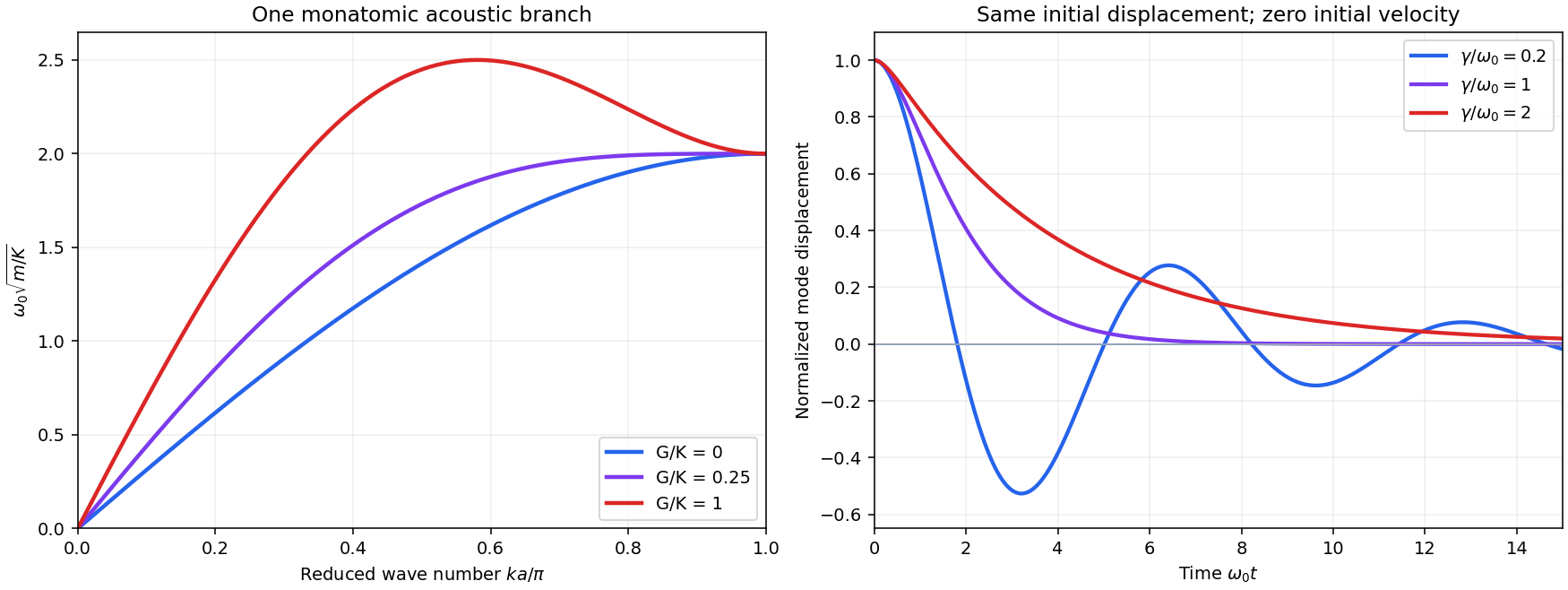
One acoustic branch with further-neighbour springs, and three viscous-decay regimes
. Original calculated dispersions for stated values of , all normalized using the same . The right panel shows a single normal coordinate with initial displacement one and initial velocity zero, for damping ratios . It illustrates that a nonoscillatory overdamped response does not have the same envelope as an underdamped phonon. Details.
For a viscously damped monatomic-chain phonon, the extra force gives on the left of the preceding equation. Keep a real wave number and permit complex frequency in the convention . The dispersion equation isWriting , its two roots areThe negative imaginary part corresponds to decay with the chosen time convention. Here has units of mass per time, while is a decay rate. A driven experiment at specified real frequency would instead solve for a generally complex wave number; it is a different way of specifying the response, not a contradictory sign choice.
For passive friction , the time dependence of each spatial normal coordinate follows its damping regime:
For any fixed positive damping, sufficiently small nonzero is overdamped because . The slow branch then has , a diffusive long-wavelength relaxation. At exactly , uniform translation has no restoring force, so and the constant displacement need not decay. Thus saying every amplitude simply decays as is valid only for the underdamped envelope, not for all wave numbers.
Articles by others on the same topic
There are currently no matching articles.