Differentiate the positive-frequency branch on either side of the origin:It tends to km/s as and to km/s as , and vanishes at either zone boundary. A positive- wavepacket therefore transports energy to the right, while a negative- one transports it to the left. At the zone edge, neighboring atoms oscillate out of phase and the dispersion is flat, giving zero group velocity even though the frequency is nonzero.
The graph has separate one-sided limits at zero because has a cusp there. Assigning one differentiable slope at exactly would erase the distinction between the two propagation directions; a precisely uniform translation has no preferred propagation direction. Plotting only is also legitimate if the missing negative branch is stated. Group velocity and phase velocity are different except in the long-wavelength linear limit.
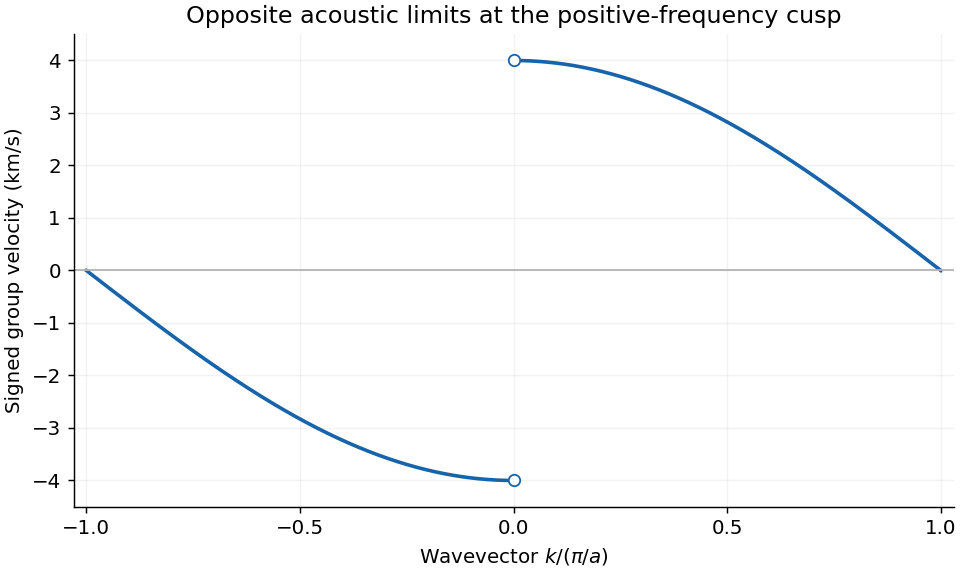
Signed group velocity across the first Brillouin zone
. Original derivative of the positive-frequency acoustic branch. Open markers show the distinct limits at zero wavevector; the derivative is not defined at the cusp itself. Details.
Articles by others on the same topic
There are currently no matching articles.