The supplied sound speed determines the spring-to-mass ratio without needing either parameter separately:ConsequentlyThe curve is even in , rises linearly from the origin with one-sided slopes km/s, and flattens at both zone edges. Its maximum is rad/s, or ordinary frequency THz. Keeping angular frequency distinct from cycles per second avoids a factor-of- error. Repeating the curve outside the first zone is a representation of equivalent crystal momenta, not the discovery of additional modes.
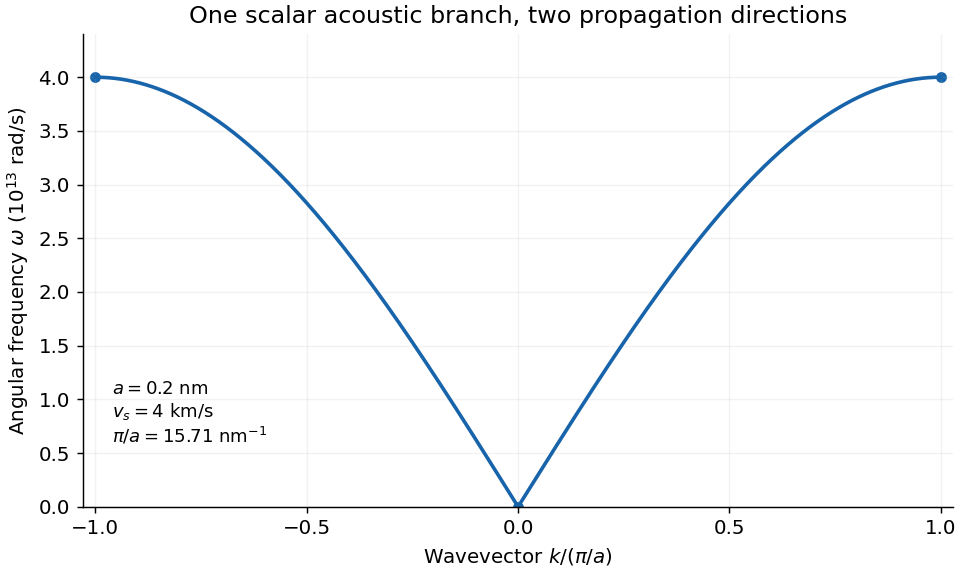
Positive-frequency acoustic dispersion of the specified monatomic chain
. Original nearest-neighbor harmonic-chain calculation, with both propagation directions in one first Brillouin zone. The plotted vertical frequency is angular frequency. Details.
Differentiate the positive-frequency branch on either side of the origin:It tends to km/s as and to km/s as , and vanishes at either zone boundary. A positive- wavepacket therefore transports energy to the right, while a negative- one transports it to the left. At the zone edge, neighboring atoms oscillate out of phase and the dispersion is flat, giving zero group velocity even though the frequency is nonzero.
The graph has separate one-sided limits at zero because has a cusp there. Assigning one differentiable slope at exactly would erase the distinction between the two propagation directions; a precisely uniform translation has no preferred propagation direction. Plotting only is also legitimate if the missing negative branch is stated. Group velocity and phase velocity are different except in the long-wavelength linear limit.
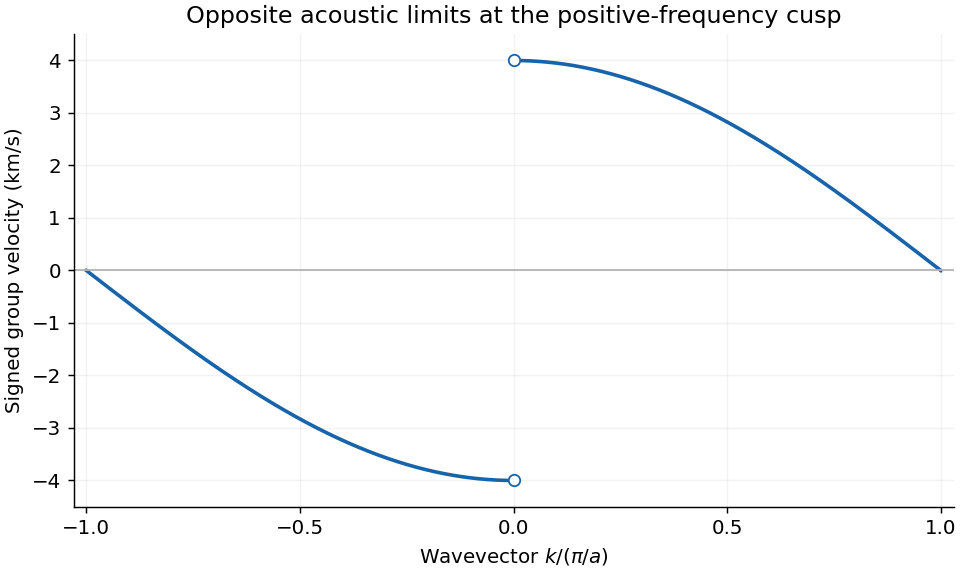
Signed group velocity across the first Brillouin zone
. Original derivative of the positive-frequency acoustic branch. Open markers show the distinct limits at zero wavevector; the derivative is not defined at the cusp itself. Details.
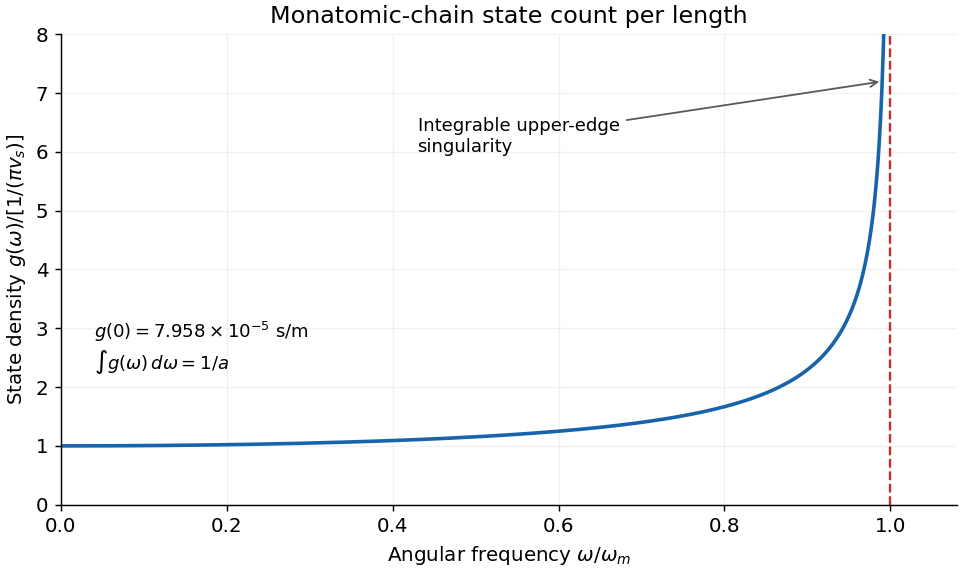
For a long periodic chain of length , neighboring allowed signed wavevectors differ by . Counting both signs once gives a state density per length on the positive half-zone. Therefore the density per angular-frequency interval and per length isIt is zero outside this band, starts at s/m and has an integrable inverse-square-root Van Hove singularity as . The state-count normalization isThus the scalar chain has one vibrational mode per atom, with no extra factor of two for the already counted propagation directions. If the horizontal variable were ordinary frequency , the density would be . A finite chain has discrete lines instead of an actual infinite peak; the smooth divergent curve is the large-chain continuum description.

At fixed chain length, each harmonic mode contributes a Bose–Einstein thermal occupation and a temperature-independent zero-point energy. The latter contributes no heat capacity. With ,At low temperature only the approximately linear part of the acoustic dispersion is excited, so . Using givesIt is linear in temperature, rather than the three-dimensional Debye law. At high temperature every scalar oscillator tends to , henceThe cutoff temperature is K. The curve rises smoothly from zero toward this plateau; sets a crossover scale, not a sharp transition. In normalized variables its initial slope is . The low-temperature continuum limit also requires temperature above the finite-size level spacing; uniform center-of-mass translation is treated separately. Below the lowest nonzero mode energy a finite chain does not retain a continuum linear law down to arbitrary temperature.
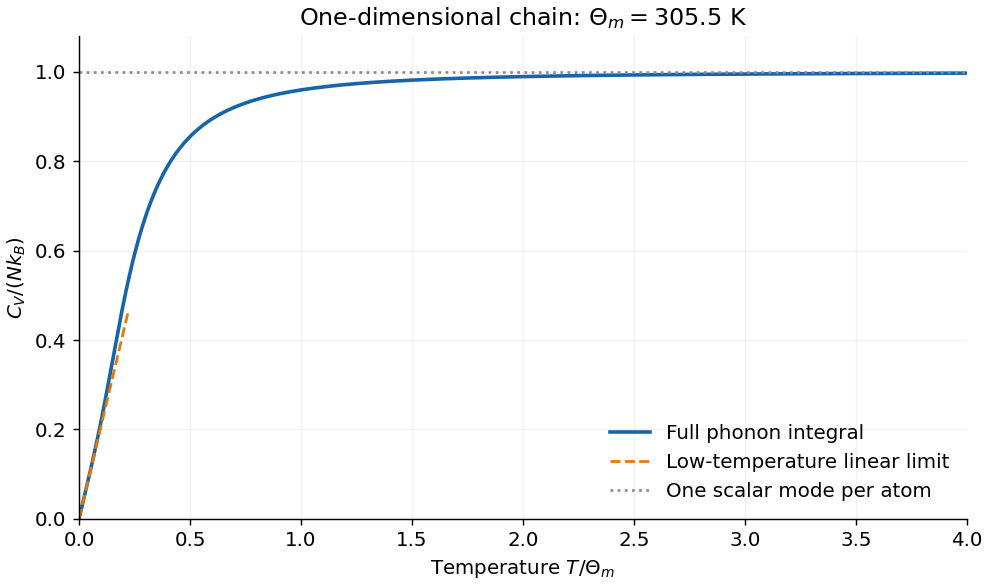
Single-branch chain heat capacity and its low- and high-temperature limits
. Original numerical Bose–Einstein mode integral. The dashed line is the low-temperature linear asymptote; the plateau is one Boltzmann constant per atom for this scalar model. Details.
Articles by others on the same topic
There are currently no matching articles.