At fixed chain length, each harmonic mode contributes a Bose–Einstein thermal occupation and a temperature-independent zero-point energy. The latter contributes no heat capacity. With ,At low temperature only the approximately linear part of the acoustic dispersion is excited, so . Using givesIt is linear in temperature, rather than the three-dimensional Debye law. At high temperature every scalar oscillator tends to , henceThe cutoff temperature is K. The curve rises smoothly from zero toward this plateau; sets a crossover scale, not a sharp transition. In normalized variables its initial slope is . The low-temperature continuum limit also requires temperature above the finite-size level spacing; uniform center-of-mass translation is treated separately. Below the lowest nonzero mode energy a finite chain does not retain a continuum linear law down to arbitrary temperature.
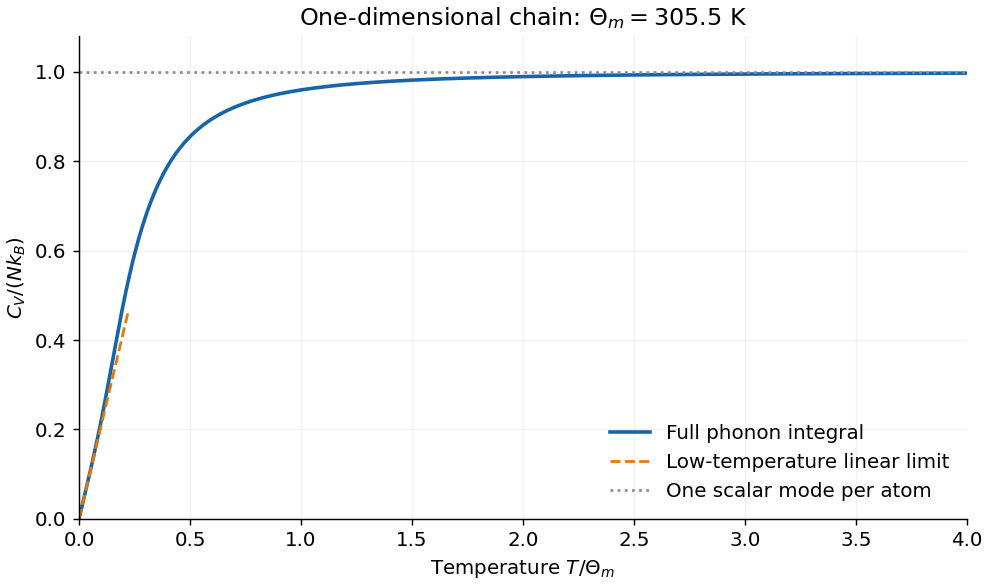
Single-branch chain heat capacity and its low- and high-temperature limits
. Original numerical Bose–Einstein mode integral. The dashed line is the low-temperature linear asymptote; the plateau is one Boltzmann constant per atom for this scalar model. Details.
Articles by others on the same topic
There are currently no matching articles.