In the Weiss molecular field approximation, the local response obeysLinearize around in the stable phase of paramagnetism. Substitution of a givesHence the Curie–Weiss law and Weiss temperature areFor positive , is the mean-field theory Curie temperature: the zero-magnetization solution becomes unstable there, and below it a spontaneous solution appears. For negative coupling, a negative fitted Weiss temperature indicates predominantly opposing interactions, but this one-uniform-magnetization treatment does not determine an antiferromagnetic ordering pattern or its transition temperature. More generally the fitted Weiss temperature need not equal the observed ordering temperature.
For , the paramagnetic curve is positive for , diverges as , and tends to at high temperature; its inverse is the straight line . The expression is not the stable susceptibility below . For example substituting would predict a negative response around the unstable branch. The nonlinear self-consistency equation must instead be expanded about the appropriate spontaneous magnetization.
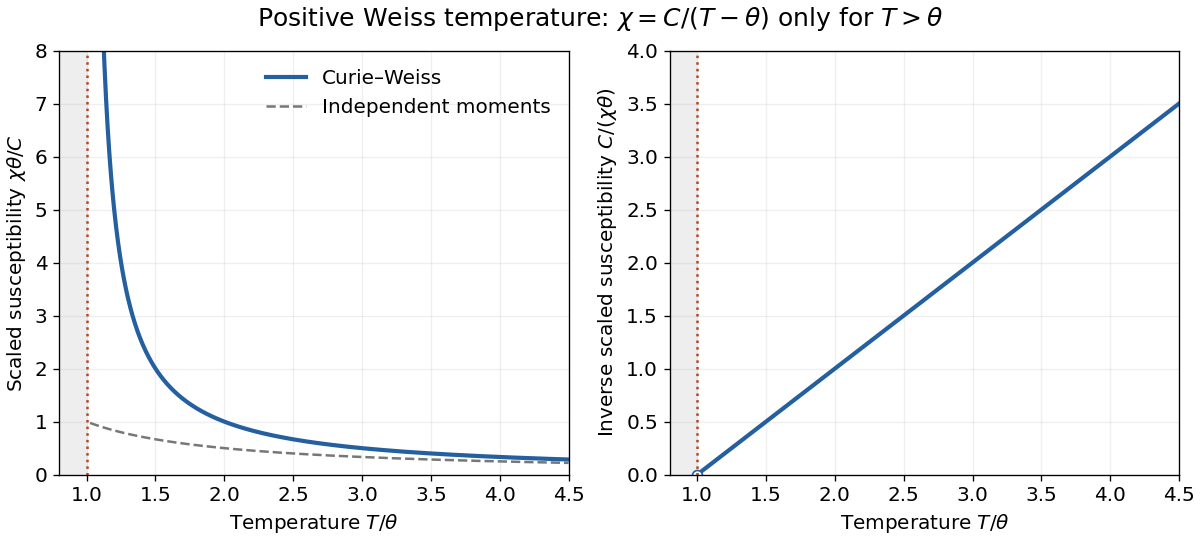
Paramagnetic Curie-Weiss susceptibility and its inverse
. The positive-Weiss-temperature mean-field law is shown only in its stable paramagnetic range . Its inverse extrapolates to zero at . The curve below the transition is not obtained by continuing the displayed rational expression. Details.
Articles by others on the same topic
There are currently no matching articles.