Take two localized spin orientations with moments along the applied magnetic field. This assumes an electron-like spin factor of two. Their energies are , so the one-moment partition function is , with . The thermal mean moment is , and the spin-one-half paramagnetic magnetization isFor , . With the same SI convention and ,This Curie law is a zero-field or weak-field susceptibility. At arbitrary field the differential response is , and saturates at ; extending the linear law to unlimited field would contradict that finite saturation magnetization.
In the Weiss molecular field approximation, the local response obeysLinearize around in the stable phase of paramagnetism. Substitution of a givesHence the Curie–Weiss law and Weiss temperature areFor positive , is the mean-field theory Curie temperature: the zero-magnetization solution becomes unstable there, and below it a spontaneous solution appears. For negative coupling, a negative fitted Weiss temperature indicates predominantly opposing interactions, but this one-uniform-magnetization treatment does not determine an antiferromagnetic ordering pattern or its transition temperature. More generally the fitted Weiss temperature need not equal the observed ordering temperature.
For , the paramagnetic curve is positive for , diverges as , and tends to at high temperature; its inverse is the straight line . The expression is not the stable susceptibility below . For example substituting would predict a negative response around the unstable branch. The nonlinear self-consistency equation must instead be expanded about the appropriate spontaneous magnetization.
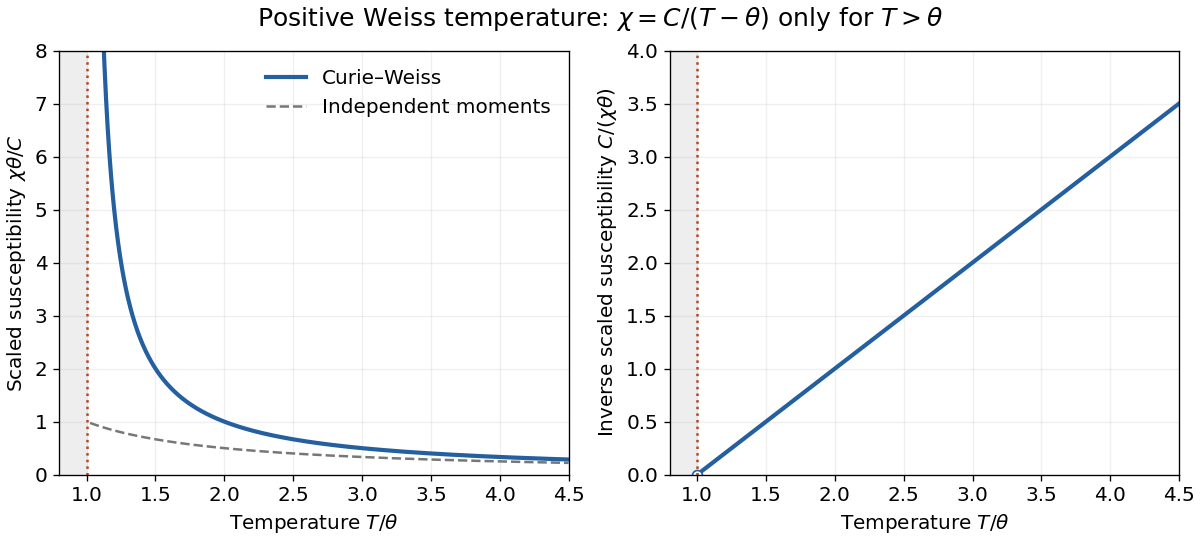
Paramagnetic Curie-Weiss susceptibility and its inverse
. The positive-Weiss-temperature mean-field law is shown only in its stable paramagnetic range . Its inverse extrapolates to zero at . The curve below the transition is not obtained by continuing the displayed rational expression. Details.
Within the stipulated localized, one-moment-per-atom spin model, the number density follows directly from mass density and molar mass:The face-centered cubic lattice is consistent with four atoms per conventional unit cell; no additional factor four is needed once has been obtained from the density. The Curie constant is . Identifying the model's with the specified Curie temperature givesAt very low temperature, a fully ordered single domain has . Its Weiss molecular field isThe cancellation of in the middle expression provides a useful check. The ordinary magnetostatic scale is only , smaller by the factor . Thus is not a plausible ordinary self-generated dipolar magnetic field of the nickel moments. It represents the exchange interaction energy in field units, not an additional Maxwell field of that magnitude. This does not assert that such large externally generated fields are forbidden. Nickel is an itinerant ferromagnet; the imposed one--per-atom model is an estimate rather than its measured microscopic moment.
A macroscopic nickel specimen can split into magnetic domains, each with nonzero local spontaneous magnetization but with different orientations. Their vector contributions can cancel, giving an almost zero measured net magnetization below the Curie temperature. This reduces the external stray-field energy, at the expense of magnetic domain wall energy; the balance favours a multidomain state in many ordinary specimens.
An applied magnetic field can move magnetic domain walls and rotate the domain moments, revealing a large response and eventually saturation magnetization. Thus a zero average does not mean that each local moment has become thermally disordered or that the material is above its Curie temperature. Preparation, shape and domain-wall pinning influence remanence.
Articles by others on the same topic
There are currently no matching articles.