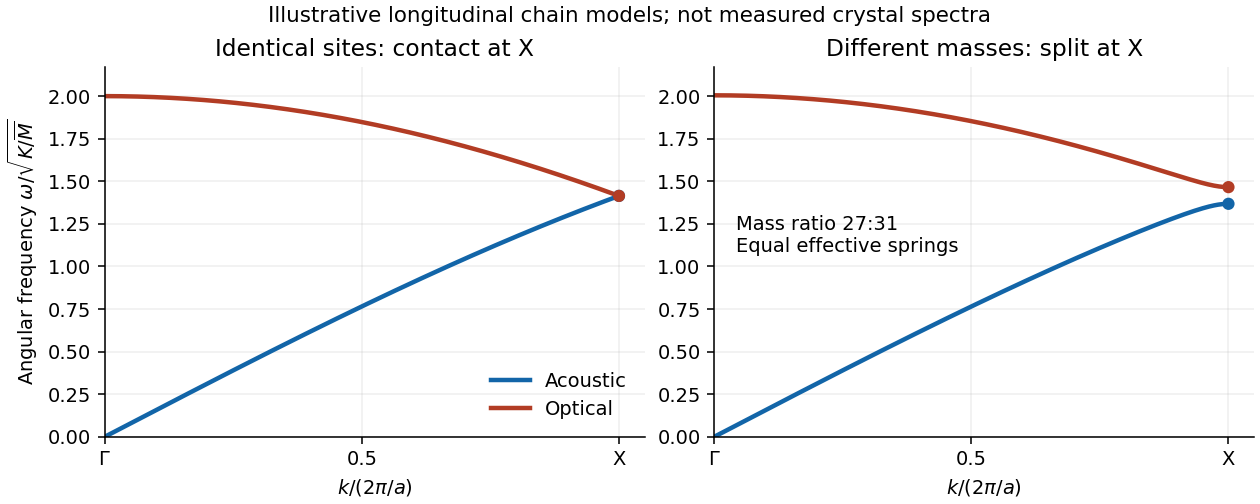
In the diamond cubic structure of silicon, the longitudinal acoustic phonon branch and longitudinal optical phonon branch meet at . The two atomic basis sites are identical, and the associated crystal symmetry protects their boundary degeneracy of normal modes. In aluminium phosphide, the two sites contain different chemical atoms. The corresponding zinc blende structure lacks the site-exchange symmetry, and these two longitudinal branches generally split at .
A simple way to see the splitting is a diatomic-chain dispersion relation with equal springs, representing successive atomic planes by alternating masses at spacing . With effective spring constant , its angular frequencies obeyAt , , so the inter-sublattice coupling cancels and the two squared angular frequencies are and . Equal masses give a contact; unequal masses giveIn aluminium phosphide, the heavier phosphorus plane moves in the lower-frequency edge mode, and the lighter aluminium plane in the higher-frequency mode in this model. Their similar atomic masses explain why the splitting is relatively small. Different electronic environments can also change the force constant matrix. The chain calculation illustrates the mechanism; a quantitative three-dimensional phonon spectrum requires its full dynamical matrix. It does not assert that all transverse acoustic and optical branches meet in silicon.

Articles by others on the same topic
There are currently no matching articles.