The Bravais lattice is a face-centered cubic lattice. Four inequivalent representatives of its lattice points in the conventional cubic unit cell, in fractional crystal coordinates, areBoundary copies in the drawing do not constitute additional independent lattice points. Attach the two-atom atomic basisto each lattice point. The resulting aluminium phosphide crystal structure is the zinc blende structure. For example, the four phosphorus positions reduced into the conventional unit cell are , , , and , reproducing the heights in the source drawing. There are four aluminium and four phosphorus chemical atoms per conventional unit cell, but only two chemical atoms per primitive unit cell.
Given independent primitive lattice translation vectors , defineThen . The reciprocal lattice consists ofequivalently all wavevectors for which for every direct lattice vector .
For the face-centered cubic lattice, chooseTheir scalar triple product is , and direct evaluation of the cross products givesEvery integer combination has coordinates with all even or all odd. Conversely, for such coordinates the coefficients are integers, so every such point occurs. The even-coordinate points are the corners of cubes of edge , and the odd-coordinate points are their body centres. ThereforeThis is a property of the Bravais lattice; the two-atom atomic basis changes structure factors rather than these reciprocal lattice translation vectors.
There are two chemical atoms in the primitive unit cell, hence six displacement coordinates and six phonon branches at each wavevector. Three rigid translations cost no restoring potential energy in the long-wavelength limit. ConsequentlyFor propagation along , one acoustic phonon has longitudinal polarization along and two have transverse polarization along . The cubic crystal symmetry makes those two transverse directions equivalent. In terms of the elastic stiffness tensor and the mass density,Thus there are two distinct acoustic velocities in general, one longitudinal and a doubly degenerate transverse value. This degeneracy of normal modes concerns the two transverse polarizations; it does not imply equality with the longitudinal speed of sound.
Subtracting the three acoustic phonon branches from the six displacement normal modes leavesAt small wavevector, these involve relative motion of the two atomic basis sites rather than a rigid translation of the primitive unit cell. Their angular frequencies remain nonzero at the zone centre. The count uses the primitive unit cell; using all eight chemical atoms in the conventional unit cell would spuriously multiply the number of distinct branches in the first Brillouin zone.
Use the long-wavelength linear dispersion relation as an estimate. The phonon energy is thenThis extrapolates the measured low-wavevector speed of sound to the point, the first Brillouin zone boundary along . It is not an exact phonon dispersion relation there: the discrete crystal structure generally bends the branch, and the initial slope alone cannot determine its boundary energy. In particular, is not a reciprocal lattice vector of the face-centered cubic lattice; the smallest such axial vector is . There is therefore no reason for this acoustic phonon energy to vanish.
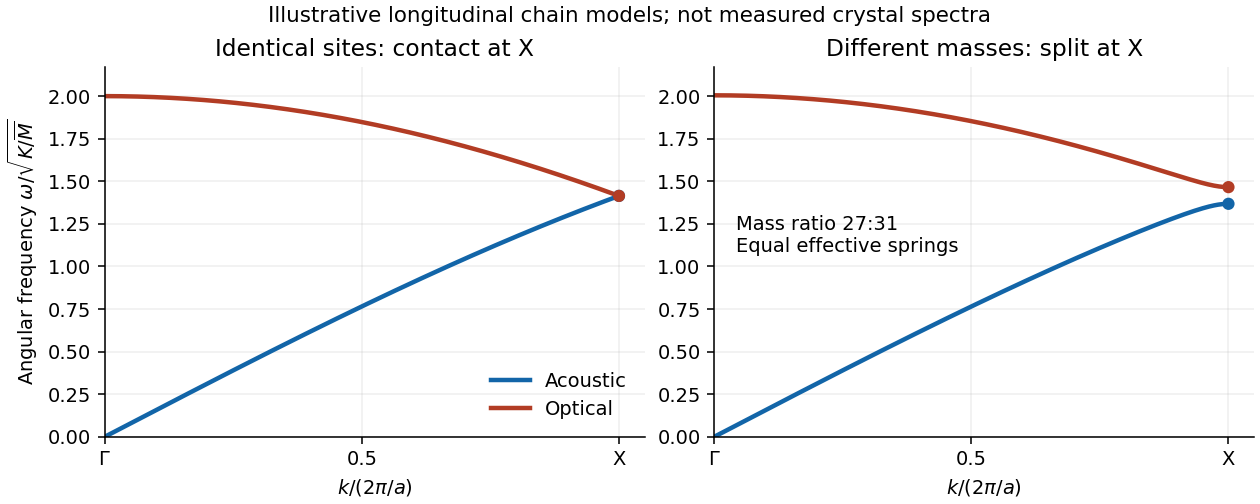
In the diamond cubic structure of silicon, the longitudinal acoustic phonon branch and longitudinal optical phonon branch meet at . The two atomic basis sites are identical, and the associated crystal symmetry protects their boundary degeneracy of normal modes. In aluminium phosphide, the two sites contain different chemical atoms. The corresponding zinc blende structure lacks the site-exchange symmetry, and these two longitudinal branches generally split at .
A simple way to see the splitting is a diatomic-chain dispersion relation with equal springs, representing successive atomic planes by alternating masses at spacing . With effective spring constant , its angular frequencies obeyAt , , so the inter-sublattice coupling cancels and the two squared angular frequencies are and . Equal masses give a contact; unequal masses giveIn aluminium phosphide, the heavier phosphorus plane moves in the lower-frequency edge mode, and the lighter aluminium plane in the higher-frequency mode in this model. Their similar atomic masses explain why the splitting is relatively small. Different electronic environments can also change the force constant matrix. The chain calculation illustrates the mechanism; a quantitative three-dimensional phonon spectrum requires its full dynamical matrix. It does not assert that all transverse acoustic and optical branches meet in silicon.

Articles by others on the same topic
There are currently no matching articles.