The boundary of the first Brillouin zone is . The unperturbed free electron model assigns the kinetic energywhere is the bare electron mass and is the reduced Planck constant. This is the free kinetic energy at the Brillouin zone boundary, not the already split energy band edge. A constant mean potential energy may be absorbed into the choice of zero of energy.
Write for the potential energy of an electron in an electrostatic potential , where . With , the coupling in the nearly-free electron model is the Fourier coefficientIf a symbol already denotes the electron potential energy, as in part (c), it replaces without another factor .
At the Brillouin zone boundary the two resonant plane waves have unperturbed energy . Their Hamiltonian operator in the two-state basis has diagonal entries and off-diagonal entries ; its eigenvalues are . ThusThis is the local band gap in the two-wave nearly-free electron model.
For zero coupling, , and the two folded energy bands areThey touch at , where the underlying free plane wave branches cross. A nonzero Fourier coefficient replaces this crossing by an avoided crossing, with . The lower energy band moves downward and the upper energy band upward. Both branches are smooth near for .
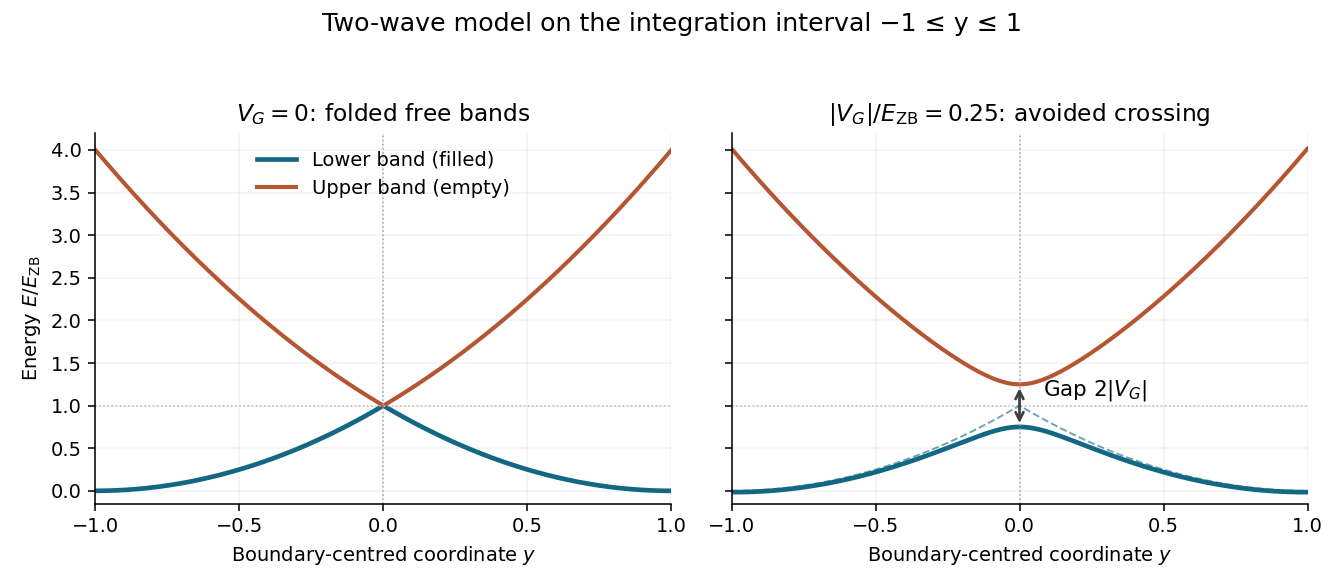

The figure uses the boundary-centred interval required in part (b). With the printed definition , this is the translated Brillouin zone . The printed instead corresponds to ; the local two-wave formula must be folded appropriately before treating it as a dispersion over that entire zone. It must not be integrated over as though it were the filled first energy band there. The subsequent calculation follows the explicit continuation prescribed in part (b).
Articles by others on the same topic
There are currently no matching articles.