The boundary of the first Brillouin zone is . The unperturbed free electron model assigns the kinetic energywhere is the bare electron mass and is the reduced Planck constant. This is the free kinetic energy at the Brillouin zone boundary, not the already split energy band edge. A constant mean potential energy may be absorbed into the choice of zero of energy.
Write for the potential energy of an electron in an electrostatic potential , where . With , the coupling in the nearly-free electron model is the Fourier coefficientIf a symbol already denotes the electron potential energy, as in part (c), it replaces without another factor .
At the Brillouin zone boundary the two resonant plane waves have unperturbed energy . Their Hamiltonian operator in the two-state basis has diagonal entries and off-diagonal entries ; its eigenvalues are . ThusThis is the local band gap in the two-wave nearly-free electron model.
For zero coupling, , and the two folded energy bands areThey touch at , where the underlying free plane wave branches cross. A nonzero Fourier coefficient replaces this crossing by an avoided crossing, with . The lower energy band moves downward and the upper energy band upward. Both branches are smooth near for .
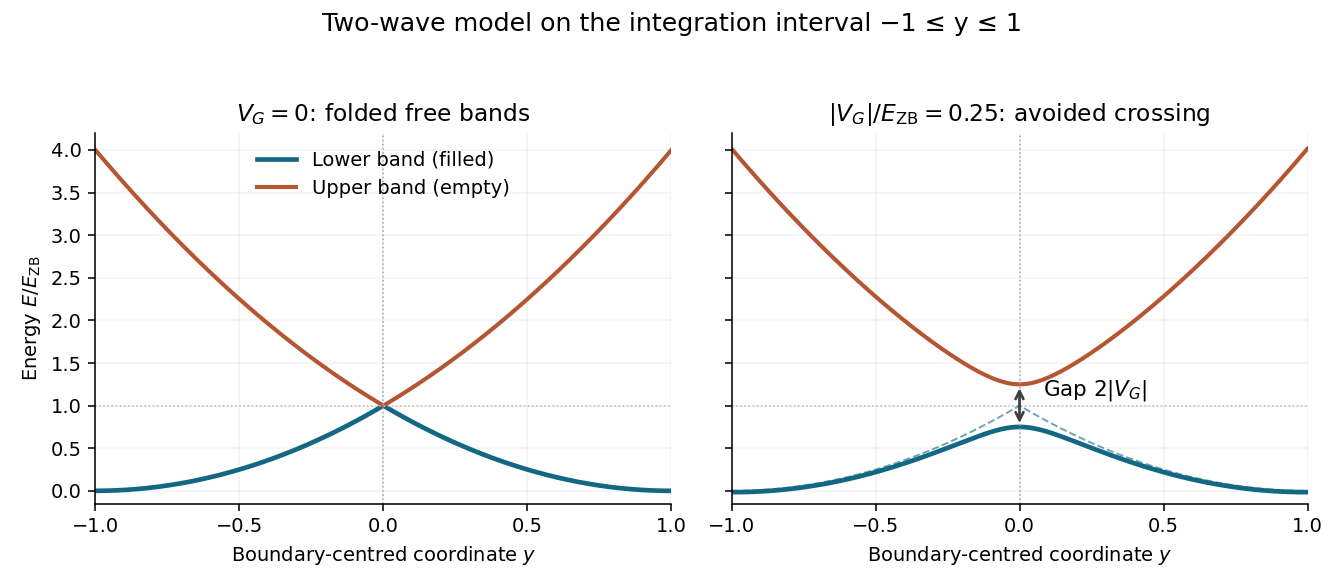

The figure uses the boundary-centred interval required in part (b). With the printed definition , this is the translated Brillouin zone . The printed instead corresponds to ; the local two-wave formula must be folded appropriately before treating it as a dispersion over that entire zone. It must not be integrated over as though it were the filled first energy band there. The subsequent calculation follows the explicit continuation prescribed in part (b).
For a long chain of length with periodic boundary conditions, each spin has quantum states in a wavenumber interval . Including two spin states, a full energy band contains electrons. The state counting in a Bloch band therefore gives the energy densityThe integral of is . For , the even square-root integral isFor example, this follows by setting , applying the supplied antiderivative, and evaluating both endpoints; the lower-end logarithm contributes . HenceThe continuous zero-coupling limit is . This agrees with directly integrating the one-dimensional free electron model up to at two electrons per unit cell.
At every and every ,so the lower energy band lies strictly below its zero-coupling counterpart. Its state counting in a Bloch band and complete occupation are unchanged. Subtracting the two energy densities directly givesThusEquality holds at . This is the downward displacement of the filled lower energy band in the sketch. The upward displacement of the empty upper energy band contributes nothing to the zero-temperature electronic energy density.
For , the Taylor expansions needed in the exact energy density areSubstitution yieldsThereforeHere Big O notation describes the neglected small-coupling terms, and the logarithm is natural. The nonanalytic term comes from the formerly degenerate quantum states near the Brillouin zone boundary; a uniform nondegenerate perturbation theory expansion of the integrand would fail there. This is the same mechanism as the Peierls energy gain.
Regard as an electron potential energy, and take . Each cosine supplies half its coefficient to each of its two Fourier coefficients. The nonzero coefficients areThe Fourier coefficient connecting the two plane waves at is , so the two-wave band gap isAt the actual periodic potential has period and no Fourier harmonic at . The crossing at the artificially halved Brillouin zone boundary then has zero band gap. Higher-order weak-potential corrections can change the proportionality coefficient at nonzero ; the displayed coefficient belongs to the given two-wave approximation.
There is also a small-displacement qualification in the source: the claimed positions of the potential energy minima are correct to first order in , not exactly. Put . ThenAt and , this equals approximately , rather than zero. For , expanding about and gives minima at and . This does not alter the leading Fourier coefficient or the linear opening of the band gap.
Without the Peierls distortion, adjacent chemical atoms are separated by . The primitive unit cell contains one chemical atom and contributes one electron. A energy band with two spin states accommodates two electrons per primitive unit cell, so the first energy band is half filled. Its true first Brillouin zone extends to , while the Fermi points are at .
Describing the same chain with a doubled unit cell of length merely folds the half-filled energy band into two branches that touch at those Fermi points. The unbroken lattice translation by prevents an artificial band gap there. A Peierls distortion breaks that smaller lattice translation and supplies the missing Fourier coefficient at ; the lower folded energy band can then be completely filled and separated from the upper energy band. Thus the zero-band gap result at agrees with the original one-electron band filling.
Define the dimensionless coupling , so that . Substitution into the energy density from part (b) gives, within the prescribed continuation of the two-wave nearly-free electron model,Its value at is understood by continuity. For ,Both electrons per doubled unit cell have been included. The fixed harmonic affects the underlying energy bands beyond the two-wave approximation; the expression here is the energy density requested from part (b), rather than an exact solution for all harmonics of the full periodic potential.
Use the same normalization for the elastic energy and electronic energy density: if is an energy per unit cell, divide it by first; if it is already per length, use it directly. Write its coefficient per length as and put . The small-distortion change in total energy density isNo minimization calculation is needed. For arbitrarily small nonzero , the logarithm is negative with arbitrarily large magnitude. Hence the negative electronic Peierls energy gain, proportional to , eventually exceeds any fixed positive quadratic elastic energy. There are distorted configurations with lower energy than the undistorted configuration for every finite and nonzero coupling. The ideal zero-temperature infinite-chain model therefore hasThe source's is correct when denotes a nonnegative distortion amplitude. If is signed, the energy density is even and the two signs describe equally stable patterns related by a lattice translation. For example, , so a negative equilibrium distortion has the same energy as the positive one. The zero-coupling case instead has its minimum at . The argument assumes a coupled chain, complete lower-energy band filling and zero temperature; it does not by itself establish finite-temperature long-range order in an isolated one-dimensional system.
Articles by others on the same topic
There are currently no matching articles.