Choose orthonormal localized orbitals . The on-site energy is , and the sign convention in the question defines . Bloch state diagonalizes this translationally invariant hopping problem. For real, inversion-symmetric nearest-neighbor amplitudes, and , so the exponential pairs yieldThe first zone is the rectangle , , wider in because . Use , , and .
For positive and , the four corner energies and the requested path areAlong a path parametrized in reduced coordinates , , the full curve is simply . In particular the two appearances of and the two diagonal traversals must have consistent endpoint energies.[ref]
Solid State Physics by David Tong. §2.1.1, localized orbitals and hopping sign convention; chapter 2, Bloch-band construction
A reversed hopping sign changes which point is the band minimum; the usual positive-hopping convention is stated explicitly here.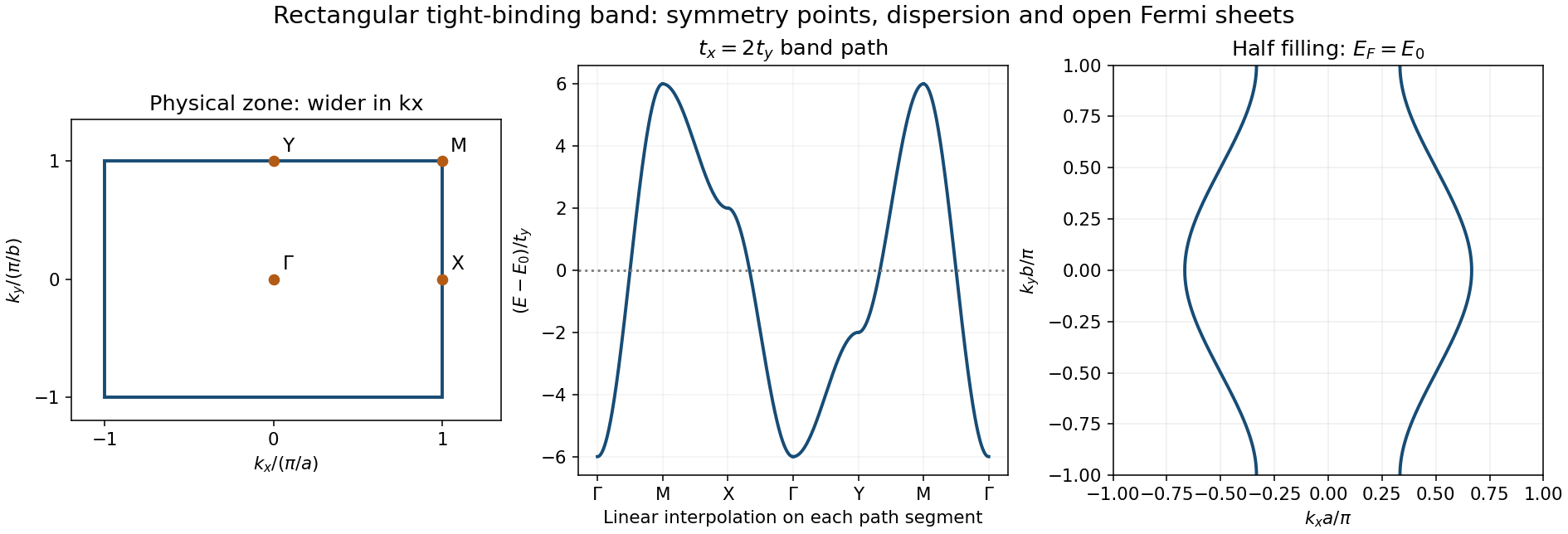
Rectangular tight-binding zone, the specified band path and half-filled Fermi lines
. Original evaluation for tx equal to twice ty. Reduced coordinates identify the symmetry points; the physical reciprocal cell is wider along kx when a is less than b. The Fermi lines are open in the repeated-zone picture. Details.
One orbital per primitive cell supplies two states per wave vector when spin is included. A monovalent metal therefore half-fills this band. Nearest-neighbor hopping on the bipartite rectangular lattice has for , fixing the half-filled Fermi energy atFor , the two Fermi surface obeyThey are corrugated open sheets in an extended-zone description, with ranging from to . They are not a small circular pocket centered at the band bottom. The same maps one Fermi line onto its nested partner. A density-wave or Peierls-like modulation at that wave vector can open additional gaps at the Fermi energy. The unperturbed single-orbital band does not acquire those new gaps without a symmetry-breaking modulation or another coupling; ordinary lattice Bragg effects are already built into its dispersion.
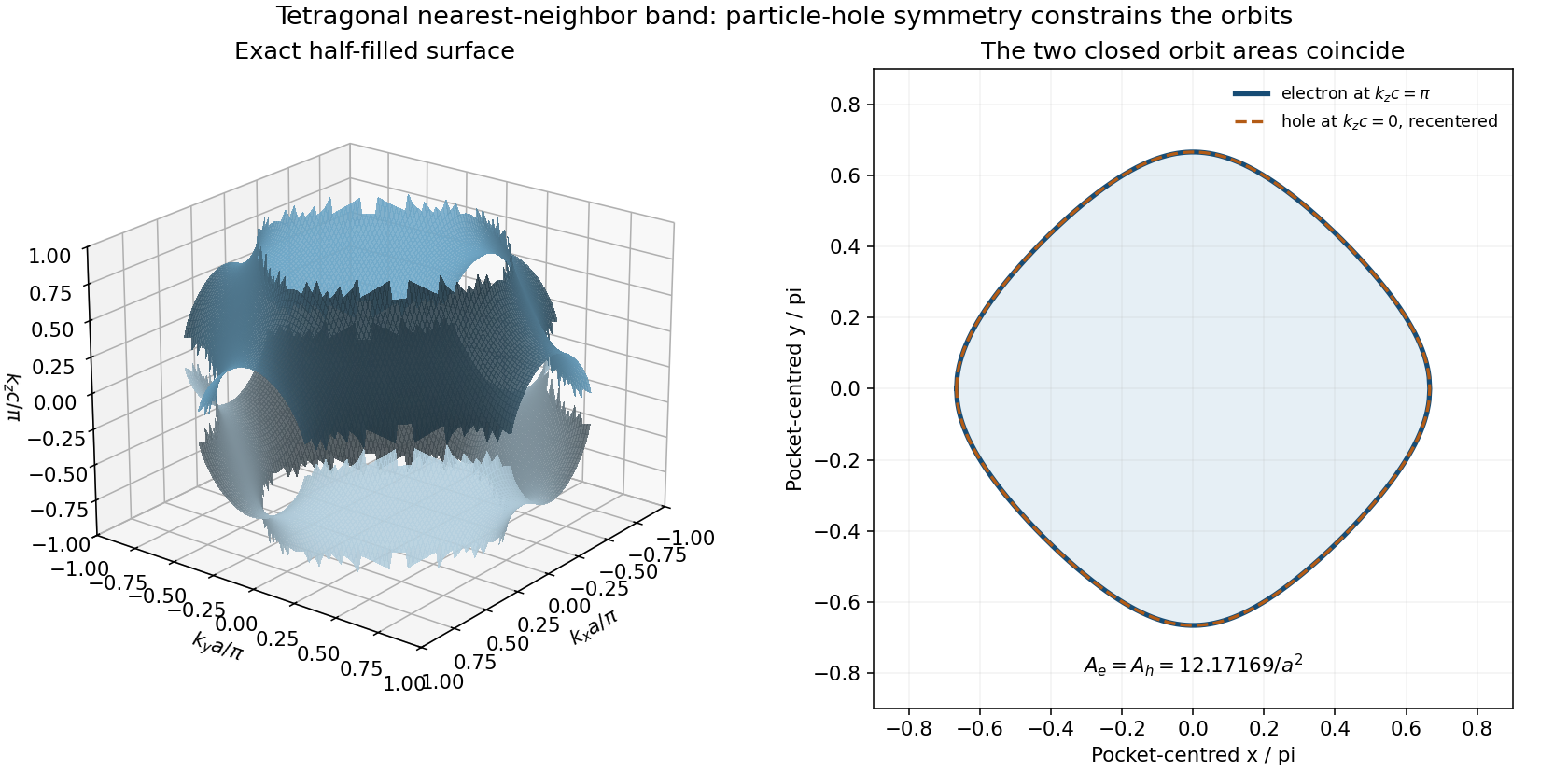
For the three-dimensional tetragonal version set , , . The corresponding half-filled surface isIt is a corrugated periodic surface, not a sphere. At its regular closed contour is electron-like around , with ; at the closed contour is hole-like around , with the sum . The topology switches through the square-lattice separatrix at . Drawing one simple weakly warped cylindrical pocket across every section misses that feature of the half-filled cosine band.
Angle-resolved photoemission can directly map the dispersion and occupied Fermi surface. Angular quantum-oscillation measurements test its closed extremal cross sections and cyclotron masses; momentum-density probes such as positron annihilation or Compton scattering give a complementary bulk test. The different techniques constrain different features rather than merely providing interchangeable pictures.

A magnetic field quantizes closed semiclassical orbits into Landau levels. Their passage through the Fermi energy modulates the density of states and scattering, producing Shubnikov-de Haas oscillations of resistivity. The fundamental frequency for a regular extremal orbit perpendicular to the field isThus two distinct fundamentals ordinarily identify two inequivalent extremal areas, rather than two arbitrary points or two spin directions automatically giving two different geometric areas.
The particle-hole equality of tetragonal extremal orbit areas is a special constraint of the exact half-filled nearest-neighbor band stated here. For , its regular closed endpoint sections are the electron contour at and the hole contour at described in b. Translation changes the sign of both cosines and maps one enclosed pocket onto the other. Their areas are equal. Direct integration givesConsequently this bare model predictsnot two distinct regular fundamental frequencies. The intermediate contour is a separatrix with a divergent cyclotron period, not another ordinary smooth extremal pocket to insert into the Onsager formula. The larger occupied-area slice at is the complement of a hole pocket on the Brillouin torus; counting that complement as a second enclosed planar orbit would give a spurious ratio.
For comparison, an additional small- parabolic approximation would replace the exact surface by and suggest a rough belly-to-neck ratio . That approximation is uncontrolled at half filling and erases the actual topology; it cannot be asserted as an exact prediction of the supplied cosine band. The observation of genuinely different frequencies in a real material therefore needs further information, such as longer-range hopping, a departure from half filling, extra bands, symmetry breaking or a resolved spin-dependent effect. The universal area-ratio inference is valid, but a nonunit numerical ratio is not determined consistently by the complete stated band assumptions alone.[ref]
Articles by others on the same topic
There are currently no matching articles.