One orbital per primitive cell supplies two states per wave vector when spin is included. A monovalent metal therefore half-fills this band. Nearest-neighbor hopping on the bipartite rectangular lattice has for , fixing the half-filled Fermi energy atFor , the two Fermi surface obeyThey are corrugated open sheets in an extended-zone description, with ranging from to . They are not a small circular pocket centered at the band bottom. The same maps one Fermi line onto its nested partner. A density-wave or Peierls-like modulation at that wave vector can open additional gaps at the Fermi energy. The unperturbed single-orbital band does not acquire those new gaps without a symmetry-breaking modulation or another coupling; ordinary lattice Bragg effects are already built into its dispersion.
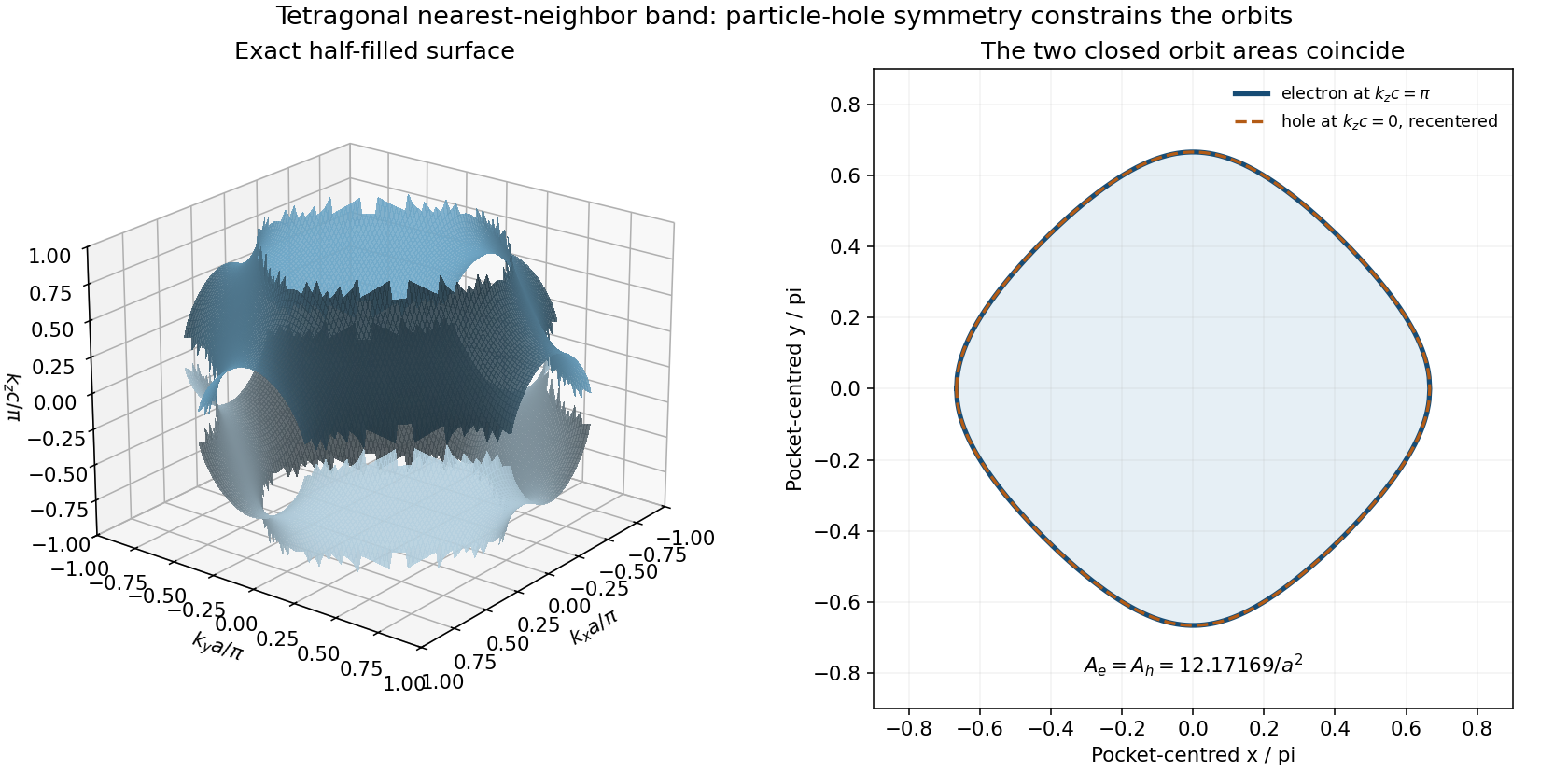
For the three-dimensional tetragonal version set , , . The corresponding half-filled surface isIt is a corrugated periodic surface, not a sphere. At its regular closed contour is electron-like around , with ; at the closed contour is hole-like around , with the sum . The topology switches through the square-lattice separatrix at . Drawing one simple weakly warped cylindrical pocket across every section misses that feature of the half-filled cosine band.
Angle-resolved photoemission can directly map the dispersion and occupied Fermi surface. Angular quantum-oscillation measurements test its closed extremal cross sections and cyclotron masses; momentum-density probes such as positron annihilation or Compton scattering give a complementary bulk test. The different techniques constrain different features rather than merely providing interchangeable pictures.

Articles by others on the same topic
There are currently no matching articles.