For competing exchanges on a body-centred cubic antiferromagnet, use the Heisenberg model convention , with each bond counted once, dimensionless spins, and positive antiferromagnetic . There are eight nearest and six next-nearest neighbours. Bond counting in the two classical collinear structures givesFor type II the eight contributions cancel, while all six bonds are antiparallel. Their crossing yields . One can also exclude a lower spiral within the classical bilinear model: writing givesFor a favourable sign of the product, . Hence when its minimum is at , the type-II ordering vectors. When , compare with the type-I value and use to obtain the complementary bound. ThusThis is a classical/mean-field energy comparison; an exact quantum ground state is not generally a collinear product state.
For type I a magnetic cell is the simple cube of side , with opposite moments at and . Its magnetic structure factor is proportional to . Allowed magnetic reflections have integer with odd. The first two families are and , with symmetry-equivalent members understood.
For type II choose magnetic primitive translations , and , enclosing four spins in volume . Equivalently, a side- cube is a convenient nonprimitive magnetic cell. On each original simple-cubic sublattice the moment at is proportional to . Accordingly,The translated body-centre basis gives , so there is no further extinction. The first two families are and . The neutron polarization factor may additionally suppress a reflection for a particular moment direction; the stated rules are the positional selection rules.
Each sublattice has number density and saturation magnetization . Replacing neighbouring spins by their averages makes their exchange energy equivalent to a molecular magnetic field. Its minus sign expresses antiferromagnetic exchange, not an externally applied field. Since ,For , . Linearizing the Brillouin magnetization formula givesThe g-factor cancels because exchange is specified in energy units. A convention with doubles these exchange energies and .
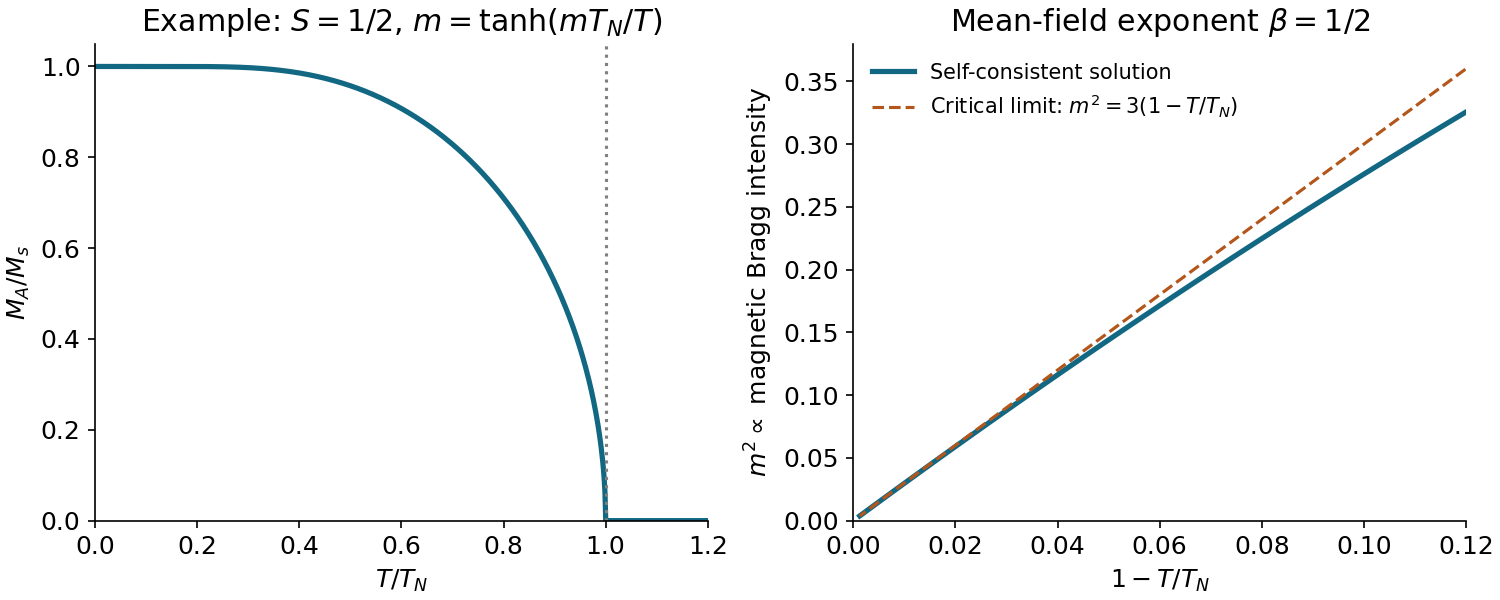
Let , and let denote the cubic coefficient of the Brillouin magnetization formula. The argument is . Thus impliesConsequently in mean-field theory. The positive branch falls from saturation at zero temperature to zero at and remains zero above it. An elastic magnetic neutron-reflection intensity scales as ; a log–log fit against has slope . Background subtraction and a suitable critical interval are needed. Fluctuations can change the measured exponent from its mean-field value; uniform bulk magnetization vanishes for a compensated antiferromagnet and is not itself this order parameter.

Articles by others on the same topic
There are currently no matching articles.