To construct the regular open dust linear growth mode, use reduction of order, writing and denoting the coefficient of by . Since solves the homogeneous linear differential equation, its terms cancel and leaveThe integrating factor for this first-order equation in is , soChoose and the lower integration endpoint zero. This selects the mode regular at early times without adding a multiple of :Its Wronskian with is , proving linear independence.
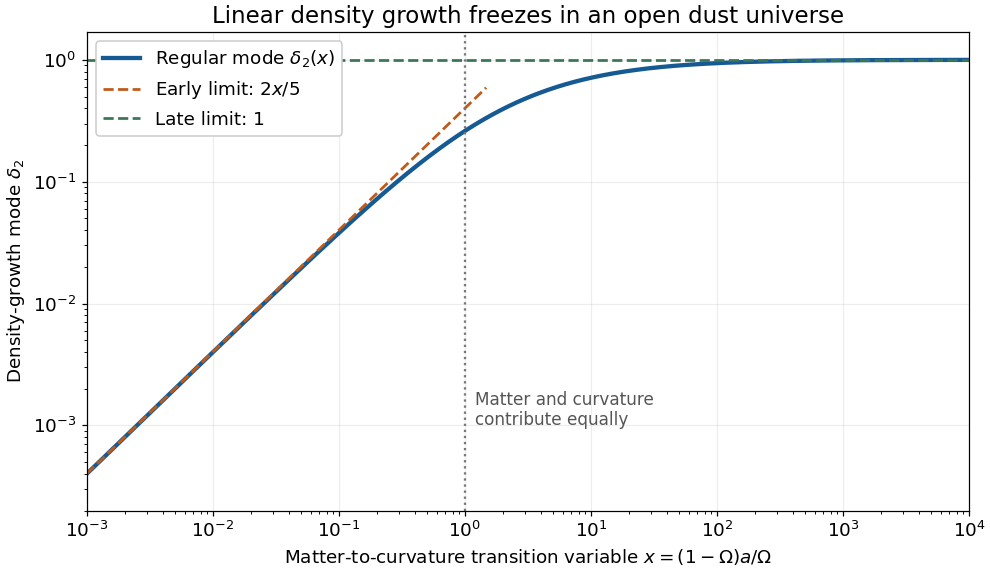
No explicit antiderivative is needed for the limits. For , the integrand is , whence its integral is . For , the integrand tends to one, so its integral divided by tends to one, while . ConsequentlyEarly matter domination permits gravitational instability to amplify the density contrast in proportion to the scale factor. Later, the matter density parameter tends to zero and Hubble friction suppresses further amplification. Indeed, for , neglecting the matter source in the linear matter perturbation growth equation gives , whose modes are a constant and . These agree with the late limits of the two exact modes.

Articles by others on the same topic
There are currently no matching articles.