Source PDF: Official corrected paper, A15276H1, Trinity Term 2025. Solutions to all three questions follow; the examination required two. Numbered headings identify the source parts without reproducing their statements. We normalize the scale factor to and set the speed of light to except where it is restored explicitly.
The cosmological principle permits a Friedmann-Lemaître-Robertson-Walker metric. The Friedmann equation, with vanishing cosmological constant, isFor separately conserved pressureless matter, the cosmological continuity equation gives : its rest energy is conserved while its physical volume grows as . Define the present critical density and matter density parameter byEvaluating the Friedmann equation today gives . Thus the model has negative spatial curvature of an FLRW universe; the second contribution to represents that spatial curvature of an FLRW universe, rather than another material fluid. Taking the expanding branch givesHere . At early times, , matter domination gives , hence, measuring cosmic time from the Big Bang,At late times the term dominates the Friedmann equation. This curvature-dominated universe has and thereforeThe late expansion approaches the coasting Milne model. The early limit belongs to this idealized matter-only model; including radiation in cosmology would alter the sufficiently early evolution.
Introduce the positive dimensionless quantity and the time scale . The Friedmann equation gives the separable relationFor , , the hyperbolic function identities giveChoose the constant of integration so that at . The resulting parametric equation for the open matter-dominated Friedmann solution isFor , the Taylor series giveEliminating yields , exactly the early matter-dominated universe result. For , , whereas . The ratio of the two parametric expressions tends to , recovering the curvature-dominated universe result including its coefficient.
The matter density parameter at general scale factor isThe reference to the definition of in the printed part points to the wrong equation number: the needed definition is the substitution in part (b). Write , so , , andExpanding the matter growth equation as a function of scale factor first givesUsing and dividing by , we obtainwhere these primes denote derivatives with respect to . For the proposed linear cosmological density perturbation ,The left side of the differential equation, divided by , has numeratorover the common denominator . This proves the result directly. Also for every , so it is a decaying mode:It is proportional to the Hubble parameter, an instance of the Hubble parameter as a solution of the dust growth equation.
To construct the regular open dust linear growth mode, use reduction of order, writing and denoting the coefficient of by . Since solves the homogeneous linear differential equation, its terms cancel and leaveThe integrating factor for this first-order equation in is , soChoose and the lower integration endpoint zero. This selects the mode regular at early times without adding a multiple of :Its Wronskian with is , proving linear independence.
No explicit antiderivative is needed for the limits. For , the integrand is , whence its integral is . For , the integrand tends to one, so its integral divided by tends to one, while . ConsequentlyEarly matter domination permits gravitational instability to amplify the density contrast in proportion to the scale factor. Later, the matter density parameter tends to zero and Hubble friction suppresses further amplification. Indeed, for , neglecting the matter source in the linear matter perturbation growth equation gives , whose modes are a constant and . These agree with the late limits of the two exact modes.
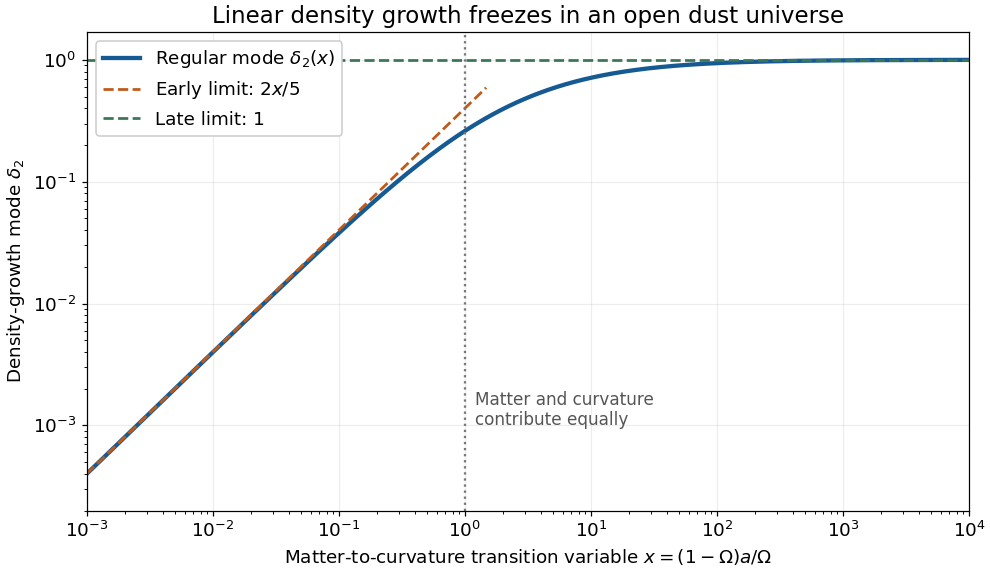

In the integral from part (d), set . Its upper endpoint is , equal to in part (b). The hyperbolic function identitygives the antiderivativeMultiplication by therefore yieldsAt small , cancellation between the terms leaves the Taylor series . At large , , so the correction to one is . Both checks agree with part (d); the integral or the small- Taylor series is preferable to subtracting large nearly equal terms in a numerical evaluation near zero.
The Helmholtz decomposition separates the peculiar velocity into a gradient field and a transverse vector field:With decaying or periodic spatial boundary conditions this is equivalently the Fourier transform projection, for ,The transverse projection operator annihilates a gradient, because . Both forces in the linear cosmological Euler equation are gradients, with spatially homogeneous coefficients. Applying the transverse projection operator therefore givesSince , this is , and henceAt this order the scalar pressure and gravitational forces cannot generate vorticity; an initially vanishing transverse vector field remains zero. Its nonzero initial value is damped by cosmic expansion.
Use the source's metric signature and , with conformal time derivatives denoted by primes. For this vector cosmological perturbation, the metric tensor and inverse metric through first order areSpatial indices on perturbations are raised with the background Kronecker delta. The Christoffel symbol formula isBecause only, it givesFor the other requested Christoffel symbols, only the time derivative of the spatial metric tensor contributes:ThusFinally contract the first upper and first lower spatial indices, summing over :Since by the transverse vector field condition on ,The useful Christoffel symbol traces are consequently and to first order: the first uses and the second uses the contraction just proved.
Define the momentum density , lowering its spatial label with , so the mixed stress-energy tensor obeys and . All products of or its derivatives with are second order and must be dropped in linear cosmological perturbation theory.
For , the three terms in stress-energy conservation areHere the trace vanishes, , and . ThusFor , spatial pressure gradients vanish because this is a purely vector cosmological perturbation. The first two terms areIn the remaining contraction, the two background-connection times momentum density terms cancel:The other terms are and . ConsequentlyExpanding this conservation law and using the background cosmological continuity equation gives the equivalent peculiar velocity equation, when ,
The result is the background cosmological perfect-fluid continuity equation. For a comoving region of physical volume proportional to , it is preciselyexpressing local conservation of energy including the pressure-volume work done during cosmic expansion. A transverse vector field has no velocity divergence, and the vector spatial metric tensor has no trace perturbation, so neither produces a first-order compression or density change.
The spatial result is vector-fluid momentum dilution and integrates immediately:Thus, for any specified background perfect fluid,A statement about alone does not fix the velocity scaling independently of the equation of state. For constant equation-of-state parameter , the cosmological continuity equation gives and henceFor pressureless matter, and , exactly as in the Newtonian calculation in part (a). For radiation in cosmology, and the vector peculiar velocity remains constant, although its momentum density still falls as . More generally, for a barotropic perfect fluid with cosmological adiabatic sound speed , the equivalent equation is . The Newtonian damping law describes nonrelativistic inertia; it need not apply to a relativistic perfect fluid. A pure cosmological constant has and supplies no such fluid velocity degree of freedom.
The cosmic microwave background consists of relic photons from the early hot, nearly thermal photon-baryon fluid. Before cosmological recombination, abundant free electrons repeatedly scatter photons by Thomson scattering. Their mean free path is short and their Thomson scattering rate is much greater than the Hubble parameter. An earlier photon therefore cannot stream directly to us: subsequent scattering repeatedly changes its direction.
As cosmic expansion cools the plasma to about , electrons and protons combine into neutral hydrogen. The free-electron abundance drops rapidly, the scattering optical depth to the observer becomes of order one, and photon decoupling occurs. Since the cosmic microwave background temperature scales as , with , this occurs at . The small baryon-to-photon ratio delays neutralization to well below : the high-energy tail contains enough photons to ionize hydrogen until the temperature is much lower than the Hydrogen binding energy expressed as a temperature. The observed cosmic microwave background is primarily this pre-existing radiation undergoing its last scattering; its nearly blackbody spectrum is then preserved by cosmological redshift.
For the requested estimate take a flat matter-dominated universe, . Restore in distances. The comoving particle horizon at cosmological recombination and the comoving radial distance to the Cosmic microwave background last-scattering surface areThe proper particle horizon is and the angular diameter distance is . Therefore the angular particle-horizon size in a power-law universe, taking one horizon radius as the transverse length, isThe angular diameter of a patch of that radius is about . The factor of two is a radius-versus-diameter convention; either gives a horizon scale of only a few degrees. This is a particle horizon, rather than the smaller sound horizon. Including early radiation in cosmology changes the numerical estimate but preserves its order of magnitude.
The horizon problem is that the cosmic microwave background has almost the same temperature across the whole sky, including pairs of regions whose past light cones do not overlap in this noninflating model. Local thermal equilibration cannot explain that observation within this history. A sufficiently long period of cosmic inflation makes the comoving Hubble radius decrease: a region once small enough to share a causal past can expand to encompass our entire observed Cosmic microwave background last-scattering surface. After reheating, it can be homogeneous across many later particle horizon patches. The matter-only estimate integrates from a decelerating Big Bang; extending the earlier history by cosmic inflation changes that causal conclusion.
The four contributions have distinct physical origins. The intrinsic photon temperature perturbation is : a local blackbody radiation energy density satisfies , so its first-order fractional perturbation is four times the fractional temperature perturbation. The endpoint cosmological Newtonian potential term is the gravitational redshift between the emitting plasma and the observer; escaping a negative potential well lowers the measured photon energy. Together with the intrinsic contribution it produces the ordinary Sachs-Wolfe effect. The term is the Doppler CMB anisotropy, caused by the plasma's line-of-sight peculiar velocity at last scattering, with the source's direction convention.
Finally, is the Integrated Sachs-Wolfe effect. A photon passing through a static potential well gains energy on entry and loses it on exit, with no net shift. When the potential evolves while the photon crosses, the two shifts fail to cancel. The factor two is the sum of the temporal and spatial scalar-potential contributions when anisotropic stress is negligible, so the two potentials are equal. The prime is a partial derivative at fixed comoving coordinate; it is not the total derivative along the light ray.
For a low-cosmological redshift galaxy sample, the intrinsic, endpoint-potential and last-scattering Doppler CMB anisotropy terms are localized near , whereas the galaxy density contrast is measured much nearer us. In the Limber approximation their radial kernels have no overlap, so their leading cross correlations vanish. The late Integrated Sachs-Wolfe effect samples the same nearby evolving potentials as the galaxies, giving the desired late-time CMB-matter cross correlation. The early Integrated Sachs-Wolfe effect near matter-radiation equality is likewise radially separated.
This is the leading linear, separated-kernel description intended here. The primary Cosmic microwave background anisotropy and late density contrast share primordial initial conditions, so their exact large-angle correlation need not be identically zero outside the Limber approximation. Additional secondary effects, such as the Sunyaev-Zeldovich effect, can also correlate with galaxies in real maps; they are absent from the stipulated linear expression.
Let be the normalized galaxy probability density per unit cosmological redshift, , and let be its linear galaxy bias. In a spatially flat background with , . Thus the projected galaxy density contrast isso its radial kernel is . The cosmological Poisson equation in Fourier transform variables givesHere denotes today's matter density parameter, not its time-dependent value. For a growing linear cosmological density perturbation, write , where is the linear growth factor, and define the logarithmic linear growth rate . At fixed comoving coordinate,ConsequentlyIn particular, during matter domination makes the linear potential constant and eliminates this Integrated Sachs-Wolfe effect.
To use the supplied Limber approximation without hiding its scale dependence in a radial kernel, take , , , and . The corresponding three-dimensional cross-power spectrum iswhere is the matter power spectrum. Substitution givesThe Limber approximation relation cancels , yieldingBoth powers of are necessary: one converts the redshift selection to a distance kernel, and the other differentiates the potential in conformal time. The factor two in the Integrated Sachs-Wolfe effect cancels the factor from the cosmological Poisson equation. For positive galaxy bias and , the predicted correlation is positive: an overdense region whose negative potential becomes shallower gives a positive integrated temperature shift. The result assumes linear, scale-independent growth and the Newtonian cosmological Poisson equation; the Limber approximation becomes less accurate at the very lowest angular multipoles.
The sample is expected to show the stronger late Integrated Sachs-Wolfe effect correlation, for comparable galaxy bias and selection quality. In the stated flat Lambda-CDM model, neglecting radiation in cosmology,At the universe is nearly matter-dominated universe, and , so the cosmological Newtonian potential is nearly constant. A photon then receives little net Integrated Sachs-Wolfe effect shift. At , dark energy has substantially suppressed the linear growth factor relative to , so and the potentials decay appreciably.
For a quantitative indication, the approximation gives at and at . Thus fractional potential evolution, , is much larger for the nearby sample. The high-cosmological redshift matter power spectrum also has a smaller growth amplitude. The entire correlation still depends on , galaxy bias, , and the matter power spectrum at the sampled wavenumber; redshift alone does not fix a universal numerical ratio or guarantee an ordering at every multipole. The robust expectation is
Articles by others on the same topic
There are currently no matching articles.