The cosmological principle permits a Friedmann-Lemaître-Robertson-Walker metric. The Friedmann equation, with vanishing cosmological constant, isFor separately conserved pressureless matter, the cosmological continuity equation gives : its rest energy is conserved while its physical volume grows as . Define the present critical density and matter density parameter byEvaluating the Friedmann equation today gives . Thus the model has negative spatial curvature of an FLRW universe; the second contribution to represents that spatial curvature of an FLRW universe, rather than another material fluid. Taking the expanding branch givesHere . At early times, , matter domination gives , hence, measuring cosmic time from the Big Bang,At late times the term dominates the Friedmann equation. This curvature-dominated universe has and thereforeThe late expansion approaches the coasting Milne model. The early limit belongs to this idealized matter-only model; including radiation in cosmology would alter the sufficiently early evolution.
Introduce the positive dimensionless quantity and the time scale . The Friedmann equation gives the separable relationFor , , the hyperbolic function identities giveChoose the constant of integration so that at . The resulting parametric equation for the open matter-dominated Friedmann solution isFor , the Taylor series giveEliminating yields , exactly the early matter-dominated universe result. For , , whereas . The ratio of the two parametric expressions tends to , recovering the curvature-dominated universe result including its coefficient.
The matter density parameter at general scale factor isThe reference to the definition of in the printed part points to the wrong equation number: the needed definition is the substitution in part (b). Write , so , , andExpanding the matter growth equation as a function of scale factor first givesUsing and dividing by , we obtainwhere these primes denote derivatives with respect to . For the proposed linear cosmological density perturbation ,The left side of the differential equation, divided by , has numeratorover the common denominator . This proves the result directly. Also for every , so it is a decaying mode:It is proportional to the Hubble parameter, an instance of the Hubble parameter as a solution of the dust growth equation.
To construct the regular open dust linear growth mode, use reduction of order, writing and denoting the coefficient of by . Since solves the homogeneous linear differential equation, its terms cancel and leaveThe integrating factor for this first-order equation in is , soChoose and the lower integration endpoint zero. This selects the mode regular at early times without adding a multiple of :Its Wronskian with is , proving linear independence.
No explicit antiderivative is needed for the limits. For , the integrand is , whence its integral is . For , the integrand tends to one, so its integral divided by tends to one, while . ConsequentlyEarly matter domination permits gravitational instability to amplify the density contrast in proportion to the scale factor. Later, the matter density parameter tends to zero and Hubble friction suppresses further amplification. Indeed, for , neglecting the matter source in the linear matter perturbation growth equation gives , whose modes are a constant and . These agree with the late limits of the two exact modes.
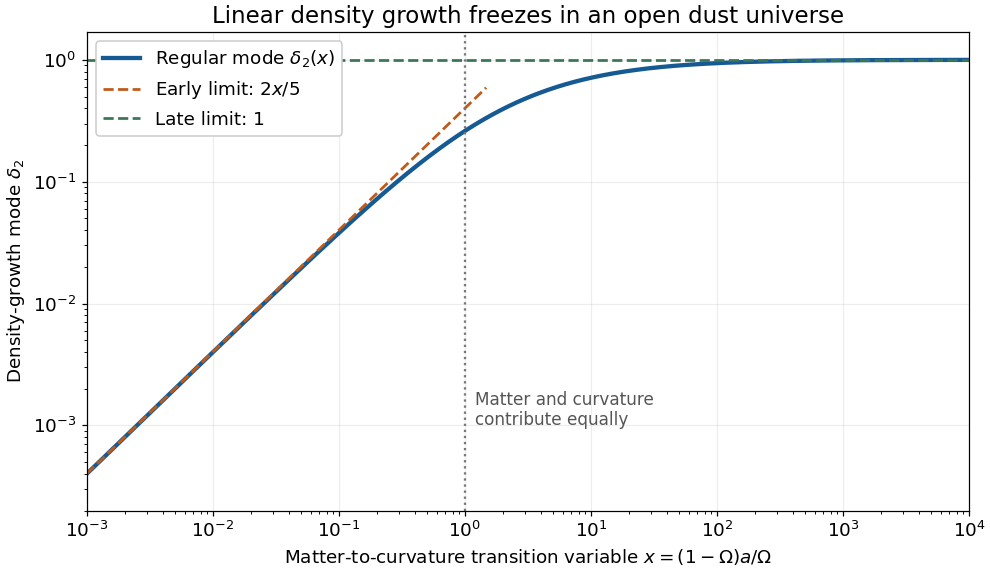

In the integral from part (d), set . Its upper endpoint is , equal to in part (b). The hyperbolic function identitygives the antiderivativeMultiplication by therefore yieldsAt small , cancellation between the terms leaves the Taylor series . At large , , so the correction to one is . Both checks agree with part (d); the integral or the small- Taylor series is preferable to subtracting large nearly equal terms in a numerical evaluation near zero.
Articles by others on the same topic
There are currently no matching articles.