Intersect the nullclines and . Their intersection equation is , giving the origin and . The Jacobian matrix isAt the origin, , andFor , only the origin is in the nonnegative quadrant, and it is a saddle because its determinant is negative. For , the origin is an unstable node, with two distinct positive eigenvalues, and there is a second equilibrium in the open quadrant. At that second equilibrium, , so it is a saddle. These signs give hyperbolic equilibria, so the nonlinear classifications follow from the linearization stability theorem. The boundary value is excluded from the two stated cases.
Draw the downward-opening nullcline , meeting the axes at , and the line . Their positive intersection is . Use the sign rulesAbove both curves the arrows point northwest; below both they point southeast. For , the parabola lies above the line, so arrows between them point northeast. For , their order reverses, so arrows between them point southwest. For , throughout the nonnegative quadrant, with the vertical direction still determined by the line. Mark the origin as an unstable node and as a saddle, and trace sample trajectories consistent with those directions.
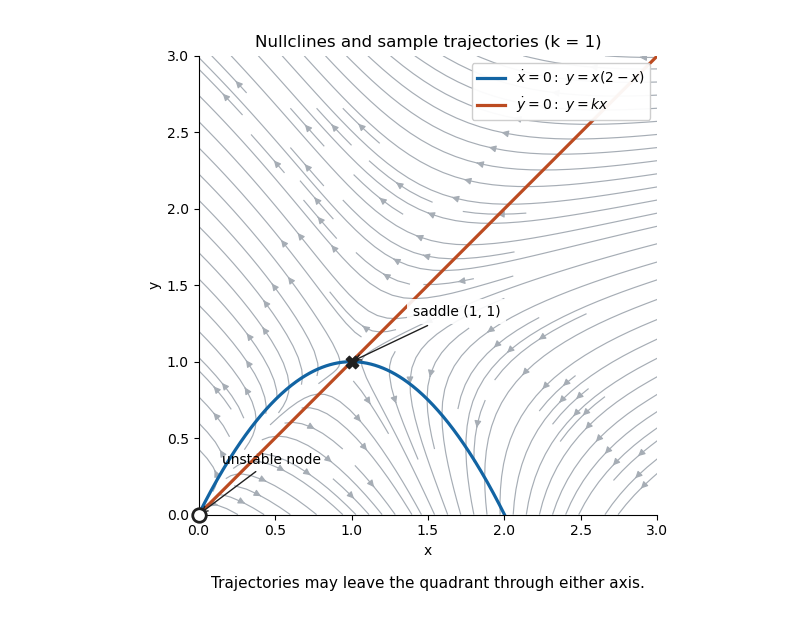

The quadrant is not positively invariant: on , ; on , . Trajectories reaching either axis there leave the plotted region. The phase portrait describes the portions inside the quadrant, not a claim that all forward trajectories remain inside it.
Let and choose the positive Dulac functionMore generally, for , direct differentiation givesTaking cancels the linear term and makes the quadratic term nonnegative:The open positive quadrant is simply connected, so the Bendixson-Dulac theorem excludes every nonconstant periodic orbit entirely inside it. Such an orbit cannot touch while staying in the closed quadrant, since its differentiable coordinate would have a local minimum there but . The same argument applies on . It cannot pass through the origin either, by local uniqueness of this smooth autonomous system. Therefore there is no nonconstant closed trajectory in the entire nonnegative quadrant. The calculation illustrates an exponential Dulac multiplier for a quadratic planar system.
Articles by others on the same topic
There are currently no matching articles.