The autonomous planar system has two real state variables, so its phase space is a subset of . It is autonomous because its vector field has no explicit time dependence. The nullclines are and , on which the respective coordinate's instantaneous rate of change vanishes. A critical point of a dynamical system is an intersection where ; the constant trajectory at that point is an equilibrium of an autonomous differential equation. A nullcline alone need not consist of equilibria.
Assume are continuously differentiable near the equilibrium. Put , and expand the vector field:This Jacobian matrix defines the linearized system. For distinct real eigenvalues, two negative values give a stable node, two positive values an unstable node, and opposite signs a saddle point of a dynamical system. A complex-conjugate pair with negative real part gives a stable focus, and one with positive real part an unstable focus. Thus a hyperbolic saddle has two real eigenvalues of opposite signs, equivalently .
The linearization stability theorem transfers these stability conclusions to the nonlinear system when no eigenvalue has zero real part. Distinctness alone is insufficient: a zero eigenvalue or a purely imaginary conjugate pair leaves a nonhyperbolic equilibrium, for which the nonlinear terms must be examined. In the purely imaginary case the linearized trajectories form a centre, but that does not establish a nonlinear centre.
One useful form of the Bendixson-Dulac theorem is this: let be open and simply connected, and let be continuously differentiable on . Ifhas one strict sign throughout , then there is no nonconstant periodic orbit lying entirely in . More generally the divergence may have a weak sign provided it is not identically zero on any nonempty open subset. The multiplier is a Dulac function. Green's theorem proves the criterion: the vector field is tangent to a hypothetical closed orbit, so its scaled flux across that boundary is zero, whereas the signed area integral of its divergence would be nonzero.
Intersect the nullclines and . Their intersection equation is , giving the origin and . The Jacobian matrix isAt the origin, , andFor , only the origin is in the nonnegative quadrant, and it is a saddle because its determinant is negative. For , the origin is an unstable node, with two distinct positive eigenvalues, and there is a second equilibrium in the open quadrant. At that second equilibrium, , so it is a saddle. These signs give hyperbolic equilibria, so the nonlinear classifications follow from the linearization stability theorem. The boundary value is excluded from the two stated cases.
Draw the downward-opening nullcline , meeting the axes at , and the line . Their positive intersection is . Use the sign rulesAbove both curves the arrows point northwest; below both they point southeast. For , the parabola lies above the line, so arrows between them point northeast. For , their order reverses, so arrows between them point southwest. For , throughout the nonnegative quadrant, with the vertical direction still determined by the line. Mark the origin as an unstable node and as a saddle, and trace sample trajectories consistent with those directions.
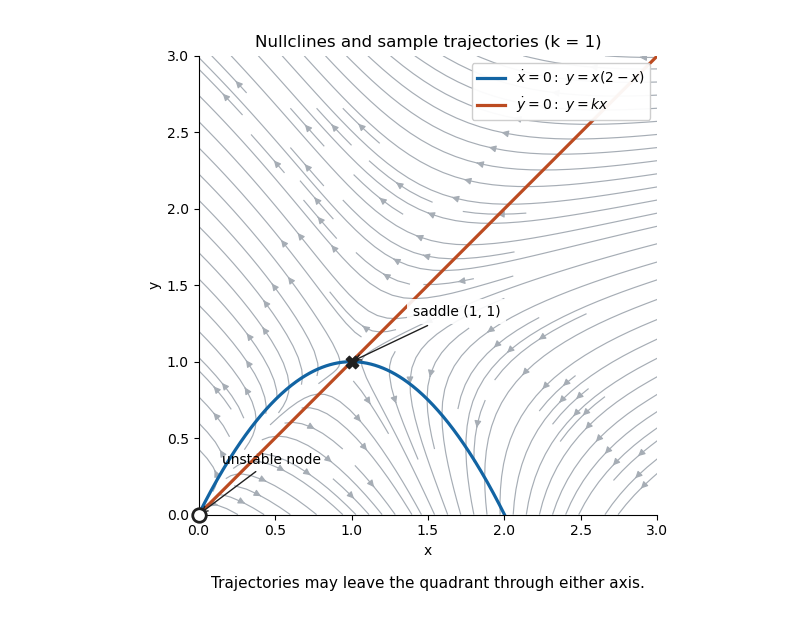

The quadrant is not positively invariant: on , ; on , . Trajectories reaching either axis there leave the plotted region. The phase portrait describes the portions inside the quadrant, not a claim that all forward trajectories remain inside it.
Let and choose the positive Dulac functionMore generally, for , direct differentiation givesTaking cancels the linear term and makes the quadratic term nonnegative:The open positive quadrant is simply connected, so the Bendixson-Dulac theorem excludes every nonconstant periodic orbit entirely inside it. Such an orbit cannot touch while staying in the closed quadrant, since its differentiable coordinate would have a local minimum there but . The same argument applies on . It cannot pass through the origin either, by local uniqueness of this smooth autonomous system. Therefore there is no nonconstant closed trajectory in the entire nonnegative quadrant. The calculation illustrates an exponential Dulac multiplier for a quadratic planar system.
Articles by others on the same topic
There are currently no matching articles.