The principal coefficients are , , , in the convention . Their discriminant is . Thus it is a hyperbolic partial differential equation where and an elliptic partial differential equation where . Its principal part has parabolic type where ; however the full equation contains and is undefined on . On its actual domain , the parabolic locus is .
The characteristic equation of a partial differential equation isIn a hyperbolic region this gives two distinct real characteristic directions. The singular lower-order coefficient should not be mistaken for an ordinary parabolic point of the full equation on .
In , the characteristic equation of a partial differential equation gives . Integration yields the characteristic coordinatesTheir Jacobian determinant is , so they are valid independent coordinates. To see cancellation of the lower-order terms explicitly, first put , and . The chain rule givesSubstitution cancels the first-derivative terms, leaving . With , and , the characteristic normal form is . Integrating once in each variable giveswhere are arbitrary twice continuously differentiable functions on the relevant coordinate intervals. This is a curvilinear reduction to the one-dimensional wave equation.
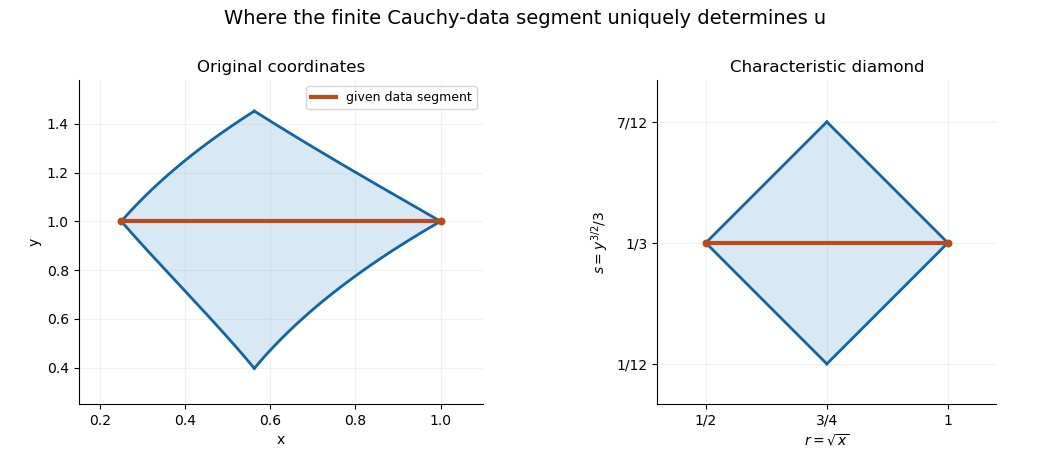
On , the transformed variables satisfy and . Differentiating the displacement data tangentially and using givesHence on , on , and the additive constants have sum . The uniquely determined solution is thereforeIt is fixed by the data exactly where both needed characteristic arguments belong to their known intervals:Equivalently, in the plane this is the diamond . In the original coordinates it is bounded by four curved characteristic curves. It lies wholly in . The displayed formula supplies one smooth extension beyond the diamond too, but the specified finite data segment does not determine that extension: one may change or outside its known argument interval. This is the characteristic-coordinate domain of dependence.

The initial curve is , with , so it is characteristic. The displacement data force and therefore on that interval. Along the curve,The derivative data in case (i) are compatible precisely when . They place no restriction on the rest of . For example, for every real constant ,solves the equation and has both prescribed data on the curve. Choosing and exhibits more than one solution directly. The initial curve follows one characteristic family, so its data do not determine the other wave family. This is the compatible case of compatibility of Cauchy data on a characteristic curve.
As in case (i), the initial curve is characteristic and its displacement data force . The new derivative data would therefore requireThe right-hand side varies along the initial segment. A single number cannot satisfy those conditions, so no classical solution exists.
Characteristic Cauchy data impose a compatibility condition on transverse derivatives without determining the missing independent wave family. Compatible data can leave nonuniqueness, as in case (i); incompatible data have no solution, as here. The distinction follows from compatibility of Cauchy data on a characteristic curve, rather than a noncharacteristic existence-and-uniqueness theorem.
Articles by others on the same topic
There are currently no matching articles.