Start with a fundamental solution of the second derivative operator:Here is the Heaviside step function and the last equality holds in the sense of distributions. The factor removes a jump in the function itself, while its first derivative has a unit jump. Adding any homogeneous solution preserves the Dirac delta source.
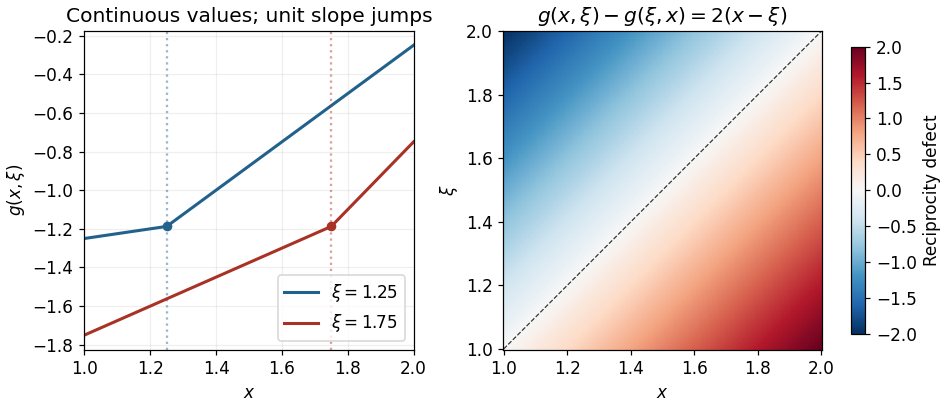
Choose and . They are independent homogeneous solutions, with , , , and . Since , the fundamental solution has and . Imposing the two boundary conditions on the proposed combination therefore gives and . ConsequentlyEquivalently,At both expressions equal and the right slope minus the left slope is . At the endpoints, and , while and . These explicitly verify both coupled boundary conditions. The homogeneous equation has only affine solutions; its two boundary conditions give , hence , proving uniqueness of the Green function.
The reciprocity defect is . It records how the coupled boundary conditions affect self-adjointness, even though the differential expression is formally self-adjoint. The construction is an instance of the boundary-matrix construction of an ordinary differential Green function.

Articles by others on the same topic
There are currently no matching articles.