With the negative coefficient of , the reduced equation is unchanged, but the fast mode now decays away from the right endpoint. Apply the left boundary condition to the outer solution, givingThe boundary layer still has width . Put and . The rescaled equation isIts leading inner expansion has . The asymptotic matching condition is , while . ThusSubtracting the overlap in the additive composite expansion givesIts graph starts exponentially close to one, follows the gently decreasing outer solution, and drops from near to zero in a right boundary layer of width . The right endpoint value is exactly zero; the left endpoint error is . Its right endpoint slope is , showing the rapid final descent.
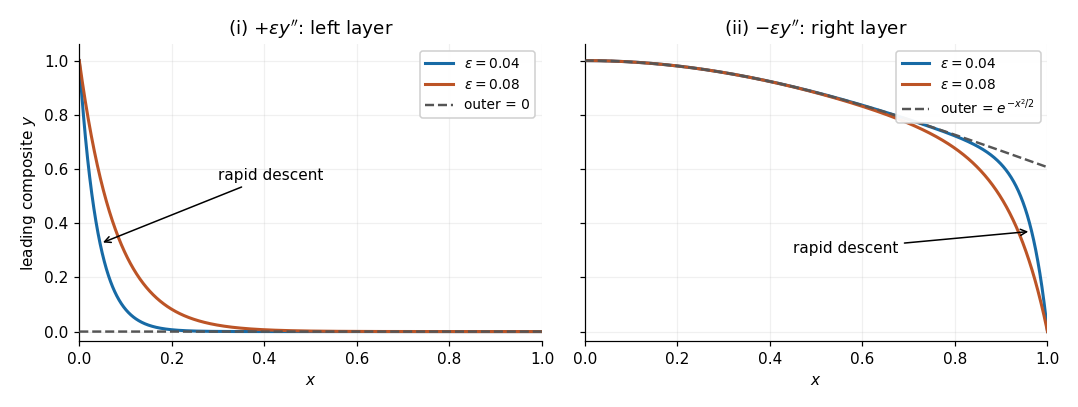
Leading composite profiles for the two signs of the highest derivative
. Original sketches from the derived additive composite expansions, for and . Left: the positive sign gives a left boundary layer and zero outer solution. Right: the negative sign gives a right boundary layer and the outer solution . Dashed curves show the corresponding outer solutions. Details.
Articles by others on the same topic
There are currently no matching articles.