An inner expansion resolves a region in which a stretched independent variable makes otherwise small effects enter the leading balance.
The singular perturbation equation balances its derivatives on the width . The inner equation is , so . Its solution with and is the displayed , since . Near zero , so the first derivative is finite while the second is singular. Treat the differential equation on the open interval and impose the endpoint value by continuous extension.
An inner variable is a stretched coordinate such as that remains order one inside a thin region of width . Its scale is chosen by a dominant balance, rather than by the size of a coefficient alone.
For the singular perturbation problem with , , set and . The chain rule givesThus both derivative terms survive in the inner differential equation . The exact domain is , withFor bounded , as : the inner expansion has a nonconstant limiting profile even though the outer solution is constant. The finite- profiles nearly collapse onto after rescaling, with their remaining difference coming from the normalization at the distant right endpoint.
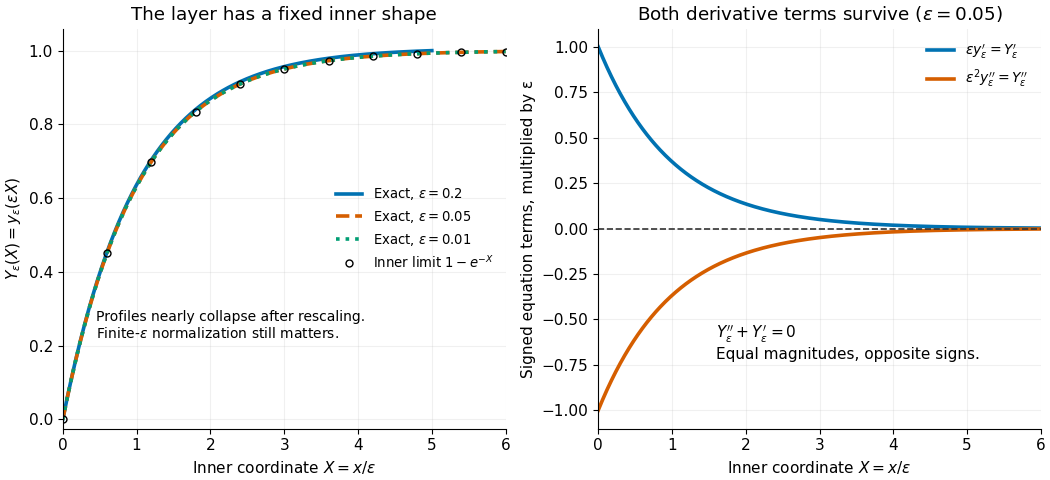
Inner rescaling reveals the common profile and derivative balance
. Left: the exact normalized profiles nearly coincide as functions of the inner variable ; the curve ends at , its actual right boundary. Right: multiplication of the original differential equation by gives the signed terms and , which cancel exactly. Details.
Articles by others on the same topic
There are currently no matching articles.