Write the parameter along a characteristic curve as . Charpit's equations areAt , prescribe , , and choose satisfying both and the compatibility relation . Direct differentiation givesThus the initial constraint propagates. A chosen initial-gradient branch is locally unique whenThis is simultaneously the implicit-function determinant for the initial gradients and the projection map determinant for the surface generated by the method of characteristics. Uniqueness continues while that projection map is invertible, the flow remains regular, and distinct characteristic curves do not give competing values at the same point. Multiple initial-gradient branches, characteristic curve initial points or a caustic require separate analysis.
Here the initial coordinate is , so and the equation forces , hence . The projection map determinant on the initial line is , nonzero for . Solving the characteristic curve ordinary differential equations giveswith and . These satisfy both the equation and all the noncharacteristic initial values.
The projection map determinant is . Starting from , the first caustic occurs at . At the initial endpoint the non-characteristic condition fails, and its entire characteristic curve remains the single point ; it does not generate an open region of determination.
The maximal regular sheet connected to the initial line uses . Its interior image is exactlyIndeed the inverse on this sheet isand the inequalities say and . The upper boundary is the caustic; the lower boundary is the characteristic curve from . Endpoints of that latter boundary can be retained as one-sided data. For forward characteristic curves alone, also impose : this retains , with lower boundary zero for and the displayed endpoint characteristic curve for . The other square-root branch belongs to the folded sheet after the caustic and does not provide a unique regular continuation from the initial data.
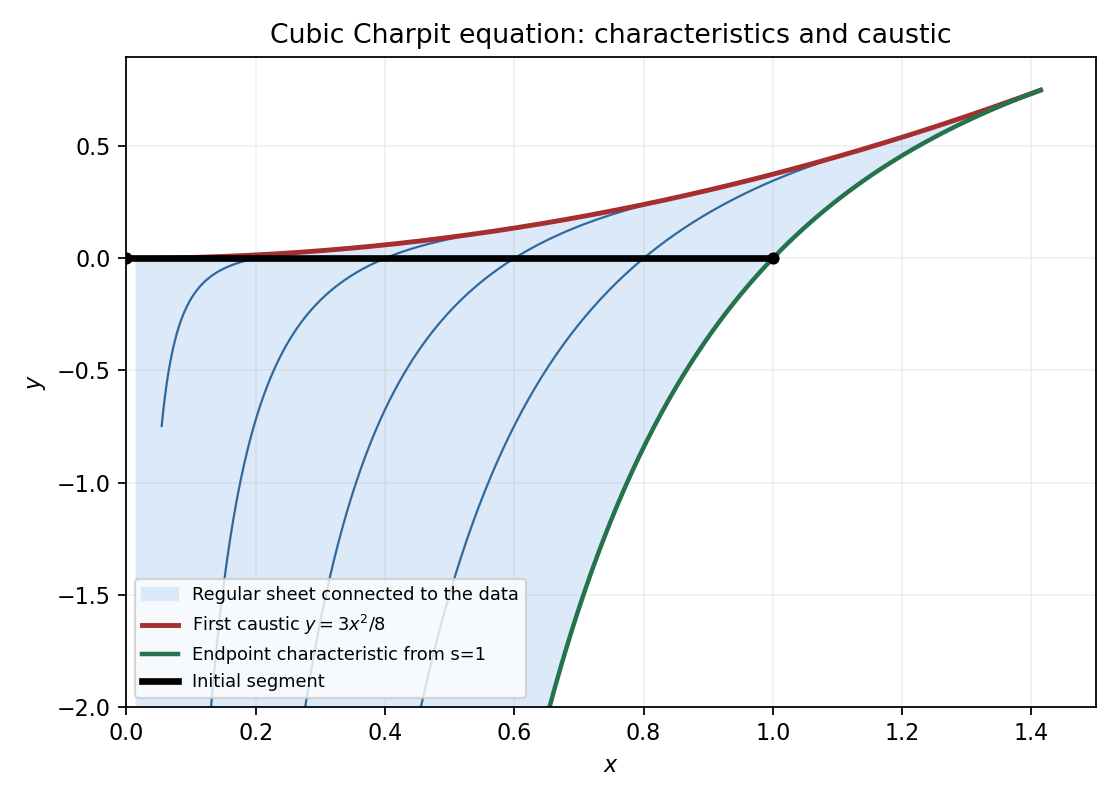
The regular characteristic sheet issued from the initial segment, its endpoint characteristic and the first caustic
. Details. 
Articles by others on the same topic
There are currently no matching articles.