Integrate the conservation law over : . The Gaussian data and their finite-time characteristic/entropy evolution have vanishing far-field flux. Taking yields and hence . After a shock forms, its Rankine-Hugoniot condition preserves the same integral mass; the formal multivalued characteristic surface itself must be replaced by the conservative entropy solution.
Expanding the flux gives . Along characteristics, and . Labeling the initial point by givesEquivalently, time reparametrization for a separable conservation-law flux uses . The projection derivative is . For large enough it becomes negative on an interval of positive , although it tends to one at both far ends. The projection then folds and assigns several density values to one position. This establishes multivaluedness of the formal characteristic continuation, not of the admissible shock solution.
The first fold occurs when . Differentiation gives , so the maximum is at . ThereforeAt that point the first singular projection is at , with density .
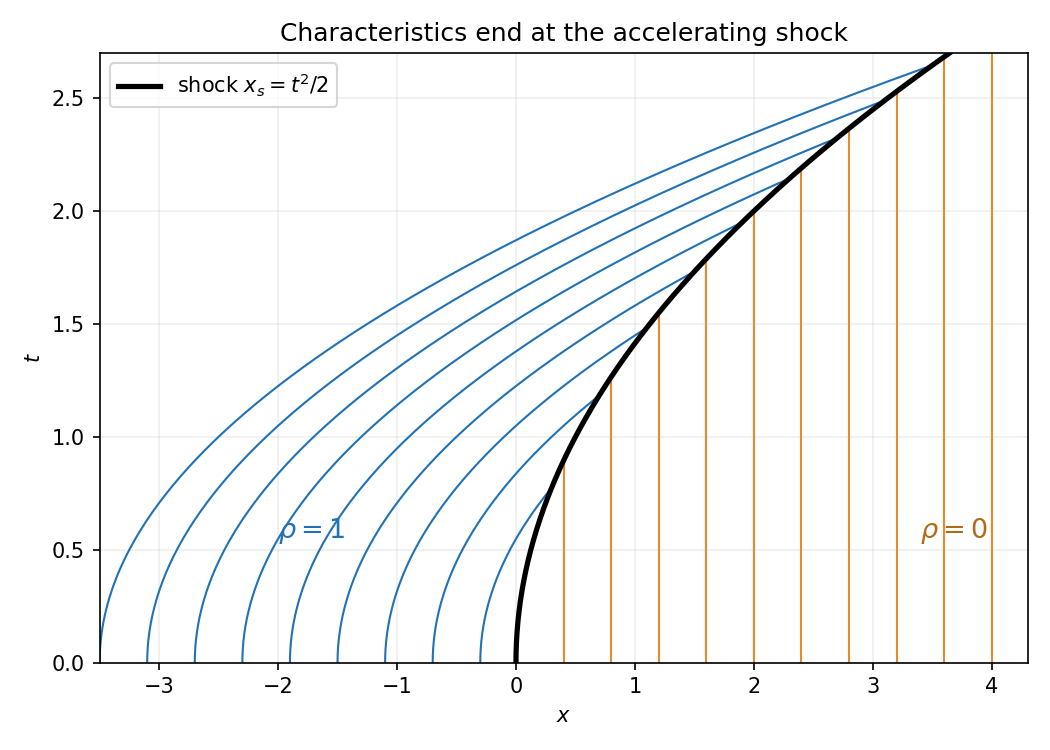
The two characteristic families are , for left-state labels, and , for right-state labels. The explicit time-dependent flux is , so the shock speed isStarting at zero givesThe characteristic speeds are behind and zero ahead, with shock speed between them. The left parabolas and right vertical lines terminate at the compressive shock.

Try , . The boundary data force and . The time derivative scales as , advection as and the source as . Balancing all three gives and . Substitution then yieldsFor the pointwise initial trace at any fixed , the far-profile requirement is as on any smooth branch extending that far; a compact-support continuation also meets it. Solving or selecting a shock continuation was not required. The time-dependent source is singular at , so the similarity reduction is stated on .
Articles by others on the same topic
There are currently no matching articles.