Use the initial-curve parameter and a characteristic parameter . Charpit's equations areAt prescribe , and . The two initial derivatives must satisfyThe second equation is the chain rule along the initial curve. For the usual local Cauchy construction also require the non-characteristic condition . It ensures both local determination of an allowed branch of and local inversion of the projected characteristic coordinates.
Along a characteristic, the chain rule and the five equations giveSince initially, along each constructed curve. With the contact compatibility propagated by this system, an invertible characteristic chart reconstructs and hence a local classical solution.
Set . Parametrize the data by , , . Tangential differentiation gives ; substitution into then gives . Thus the data allow two normal-derivative branches, indexed by , with . For each branch is non-characteristic; the endpoint is degenerate.
The Charpit's equations reduce to , , , and . Integrating with these initial values givesDirect substitution checks , and recovers the initial data. The projection onto the plane has Jacobian determinantIt first vanishes at . These points form the characteristic caustic , ; a single classical solution cannot in general be continued through the fold by treating all projected characteristic curves as a graph.
For a precise description put . On the chart containing the initial curve and lying before the fold, , elimination givesThe plus square-root is forced by , rather than a free second choice. The conditions give the complete unfolded chartInterior points of the domain have strict inequality at the boundary generated by as well. The other boundary is the characteristic caustic; the original endpoint contributes no open chart. On the portion obtained by following characteristics forward from the data, , the region is more specificallyThe boundary is and meets the characteristic caustic at . Negative characteristic times give the continuation across the initial segment into the opposite half-plane. Each sign branch is a distinct local solution; the initial values alone do not select one of them.
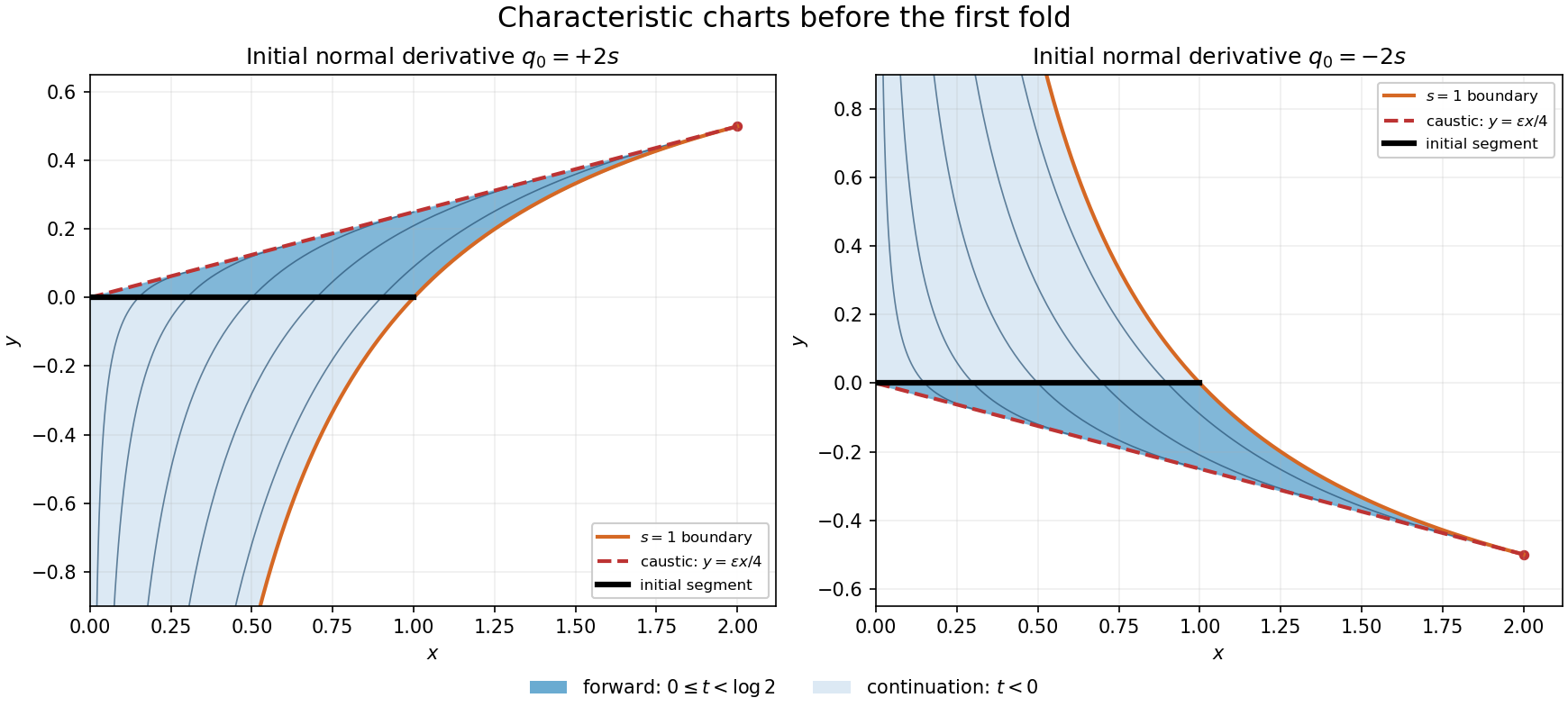

The solid shading follows ; the lighter shading shows the same smooth chart at . Reflected panels correspond to the two allowed signs of the initial normal derivative. Beyond the dashed characteristic caustic the characteristic parametrization no longer gives this smooth graph.
Articles by others on the same topic
There are currently no matching articles.