Let be arc length, so inextensibility makes a unit tangent vector. The curvature is , hence for uniform bending stiffness. Balance of linear momentum in static equilibrium gives a constant resultant .
Taking the cross product directly,The scalar component of conservation of angular momentum therefore becomesTogether with and , this Euler elastica equation determines the centerline once the appropriate boundary conditions are supplied.
Put . With , the Euler elastica equation is . Linearization about the straight configuration gives . Under the boundary conditions explicitly stated, , a nonzero solution requiresThus with only the stated boundary conditions, the first critical compressive force is . The corresponding linear transverse displacement field, with , isand to first order. These are the successive small-amplitude buckling modes. The nonlinear branches retain the simple pendulum equation; if the angular amplitude is and , fitting half-periods into the rod gives , which tends to as . Here is the complete elliptic integral of the first kind, with its modulus, not its squared parameter.
Endpoint position compatibility for the Euler elastica adds a condition when fully fixed clamps have equal transverse height. If the word “clamped” also imposes , then . With , this retains only even , yieldingThe same exclusion is exact on the nonlinear branches: integrating the elastica equation gives , and an odd number of half-periods reverses the nonzero endpoint slope. Hence odd changes the endpoint height. The conventional fixed-clamp first Euler buckling load is the second boxed value, whereas the source's explicitly listed boundary conditions alone give the first. Additional clamped modes with a nonzero transverse reaction require releasing the imposed . Load-controlled buckling also permits axial shortening; an exactly inextensible rod whose endpoint separation is fixed equal to its full length has no room to buckle.
Set . The Euler elastica equation becomes . Multiplying by gives the first integralStraight asymptotic ends require and a horizontal tangent, so . This is the separatrix of a simple pendulum with its angle shifted by . A nonconstant solution moves from to , with the same physical tangent at both ends, taking infinite arc length to approach either limit. One explicit representative isUsing and and integrating gives the tensile elastica loopThis solution is nontrivial, tends to horizontal straight tails, and has finite excess bending energy. It is also necessarily self-intersecting. Indeed is even and is odd. For , let . Near zero , while , so there is a root . At the two distinct parameters , both points have and the same . Numerically .
Any nonconstant smooth solution with the same straight asymptotic conditions has this first integral. Between consecutive horizontal orientations, separating variables gives the displayed solution up to translation, reflection, and reversal. It cannot pass through a straight equilibrium at a finite parameter, by uniqueness of the ordinary differential equation. Thus all such nontrivial branches have the same loop crossing. This is an ideal zero-thickness rod solution; a physical rod with self-contact excluded cannot realize the crossing without adding contact forces.
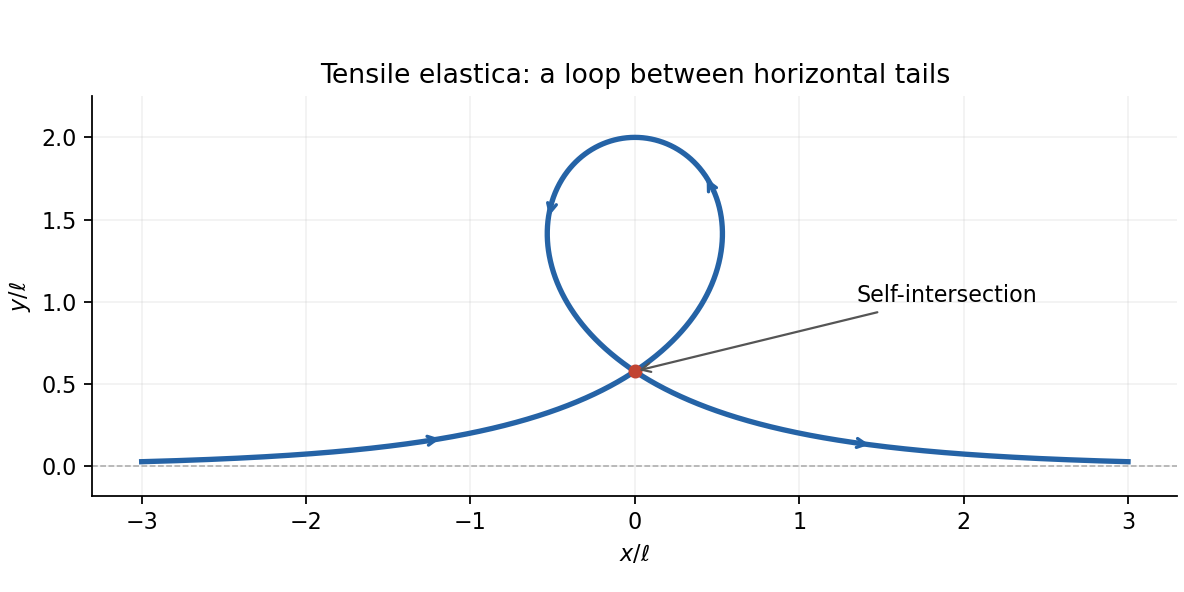
The tensile elastica loop and its self-intersection
. Details. 
Take the clamp at with . An end force without an applied end moment gives the free-end condition . With , the Euler elastica equation is . For , is small, so the leading equation isIntegrating with the two boundary conditions givesTo first order, and . HenceEquivalently at leading order, the familiar cantilever response. Because , the deflection is downward. The free-end displacement field and slope are and . The remainder notation holds with fixed positive and nondimensional unit rod length.
Articles by others on the same topic
There are currently no matching articles.