An irrotational flow satisfies . On a simply connected region, or locally on any small regular region, this gives a velocity potential with . The incompressibility condition is , soThus the potential is a harmonic function. The locality qualification matters: a curl-free circulation around an excluded vortex core need not admit a globally single-valued potential. No such circulation is needed for the sphere flow below.
Put the stagnation point at the origin and the local tangent plane at . A regular Taylor expansion has no linear term because . The impermeable tangent plane imposes at to leading order, excluding mixed quadratic terms . For the illustrated axisymmetric approach, rotational symmetry in the tangent plane makes the and coefficients equal and removes . Finally the Laplace equation fixes the normal coefficient to minus twice the tangential one. Up to an irrelevant additive constant,For incoming flow from , . This is a local leading form under the stated symmetry, not the exact universal potential near every possible wall stagnation point; a generic tangential strain can have unequal principal rates.
A streamline solves , , , hence , , . Eliminating the parameter givesEach streamline lies in a meridional plane. With cylindrical radius , its shape is . The symmetry axis and wall are limiting invariant streamlines. A particle exactly on the incoming axis approaches the stagnation point asymptotically.
Choose the positive direction along the sphere's laboratory velocity . In its rest frame the far-field fluid velocity is . Therefore the far-field potential is . The impermeable sphere imposes at . The monopole coefficient vanishes because the sphere is not a source or sink, and the dipole coefficient follows from the wall condition:ThusThe regular exterior boundary value problem has no forced higher multipoles; uniqueness fixes their coefficients to zero. Differentiating givesHere is the polar velocity component. An equivalent Cartesian form isOnly no-penetration, not no-slip, is appropriate to this ideal inviscid solution. The sphere density does not enter the velocity field for an externally prescribed constant speed.[ref]
On the surface, and . The only surface stagnation points are thereforeThere are no other stagnation points in the exterior: away from the axis the polar component is nonzero, and on the axis the radial component vanishes only at .
Near the front point put . Expanding the potential from solution givesso the linear velocity field is . This agrees with solution for .
At the rear point, using instead, the quadratic term has the opposite sign: . Incoming axial flow and tangential outflow at the front become tangential inflow and axial outflow at the back. The local streamline geometry is unchanged while its direction reverses.
The flow is steady and irrotational, so the Bernoulli equation has the same constant throughout the connected exterior. Far from the sphere it equals . On the surface the speed is , givingThe maximum stagnation pressure is at both poles. At the equator, where the flow is fastest, the pressure is . The fore-aft symmetry gives zero integrated pressure drag in this inviscid model, the content of D'Alembert's paradox; it does not predict zero drag for a real viscous separated flow.
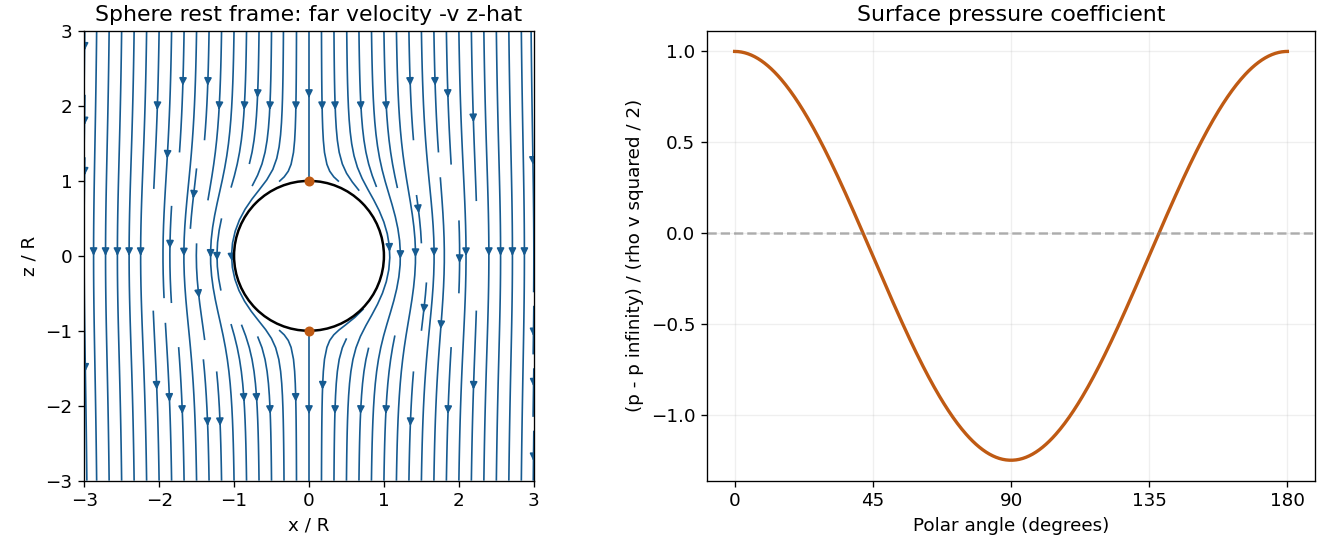
Original streamlines around a sphere in its rest frame and the associated surface-pressure coefficient; the far flow is downward along negative z
. Details. 
Articles by others on the same topic
There are currently no matching articles.