For an incompressible Newtonian fluid at low Reynolds number, the quasi-steady Stokes equations areThe first equation expresses local conservation of volume for constant density; the second balances pressure, viscous stresses and body force with negligible inertia. Convective inertia is negligible when at the relevant flow scale. Quasi-steady flow also requires the viscous diffusion time to be short compared with the evolution time. Low convective Reynolds number alone does not justify neglecting a rapidly oscillating unsteady acceleration.
For a thin layer, slenderness further changes the comparison of longitudinal and transverse derivatives; these scalings, as well as low inertia, are needed for lubrication theory.
Let the cylinder radius be , with and slowly varying thickness. Arc length is , with increasing following the upward-moving surface at the right-hand side. Gravity has tangential component . In the leading thin-film balance, normal viscous gradients dominate tangential ones, curvature corrections are small, and the longitudinal hydrostatic-pressure gradient is smaller by the aspect ratio. Neglect capillary-pressure gradients and imposed gas shear. The tangential Stokes balance is thenThese assumptions also require that inertia and curvature effects from rotation remain small on the thin-film scale; an arbitrary high-speed coating need not obey this equation.
No-slip at the solid wall and negligible shear stress at the free surface giveTwice integrating the constant normal forcing determines the two integration constants:The profile is most strongly retarded by gravity on the ascending side. The surface velocity is , not generally equal to the wall speed.
Integrate the profile over the thickness:This is a volume flux per unit axial length. In a steady layer with no evaporation, sources or axial variation, mass conservation gives to leading lubrication order. Therefore is constant around the cylinder even though the local speed and thickness vary.
Assume for the wall-entrained branch, and substitute into the flux formula. After division by ,ConsequentlyThe cubic correction measures gravitational drainage relative to transport by the rotating wall. The nondimensionalization would need modification for zero or oppositely directed mean flux.
Seek the branch continuous from a uniformly wall-advected film, . Expanding either the flux equation or the left-hand side givesEquating this to one yields , henceThe film is thicker on the ascending side, where a reduced mean fluid speed must be compensated by greater thickness to carry the same flux. It is thinner on the descending side, where gravity assists the wall motion. The approximation is uniformly small only while , not near the critical turning point discussed next.
Define for positive thickness. Its derivative is , so its maximum is attained at and equals . At , the equation requires , proving the necessary condition .
It is also sufficient for a continuous finite periodic branch. On , increases monotonically from to , so every value in the required range has exactly one root on this branch. It joins where . The second large-thickness root on the ascending side does not extend to a finite periodic branch through those points.
Thus the limiting maximum thickness occurs at the ascending point of the critical film:Subcritical films satisfy a strict thickness bound there. Equivalently the largest carried flux and critical absolute thickness areThe mechanism is a transport capacity limit: wall transport grows only as , while opposing gravitational drainage grows as . At the critical point, adding thickness no longer increases the upward flux. Indeed on the steady branch and vanishes at . Excess liquid cannot be maintained as this globally wall-entrained film and must redistribute or drain.
The algebra establishes existence and the limiting branch of the steady lubrication model. A full temporal free-surface stability result requires its time-dependent equation and, when relevant, pressure and capillary corrections; the sign of alone is not a proof of growth of perturbations.
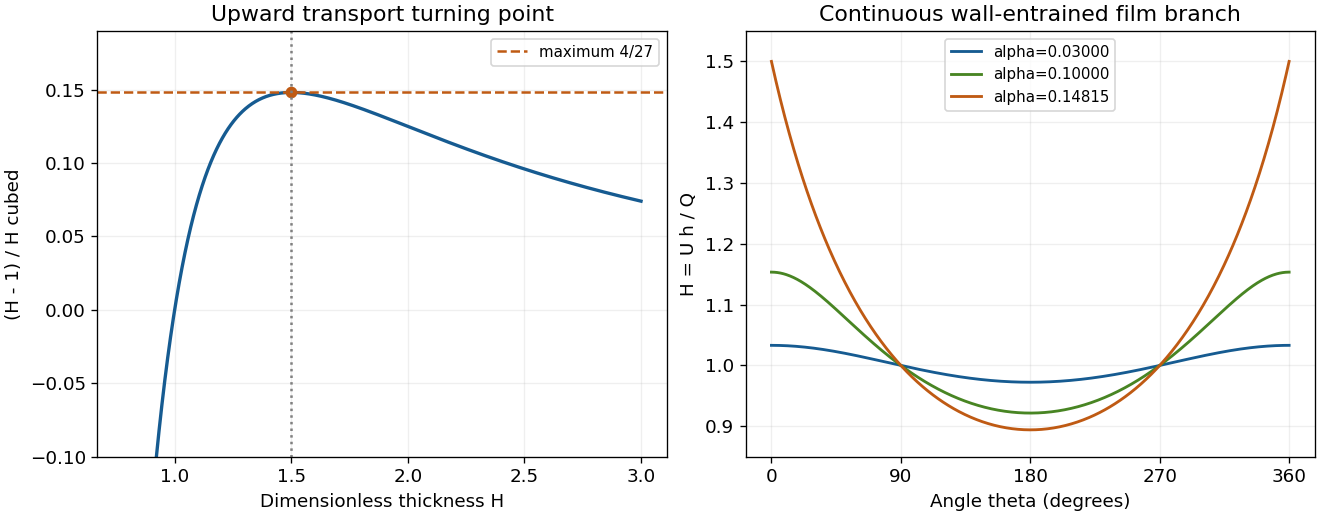
Turning point of the coating-film flux relation and the continuous thin-film profiles approaching the critical value alpha = 4/27
. Details. 
Articles by others on the same topic
There are currently no matching articles.