Using and the complex velocity convention ,The streamlines are , a family of rectangular hyperbolas whose asymptotes are the coordinate axes. The origin is a stagnation point. Fluid moves inward along the axis and outward along the axis, with the same directions approached by the neighbouring streamlines. This is a planar extensional incompressible flow, illustrated in the left panel below.
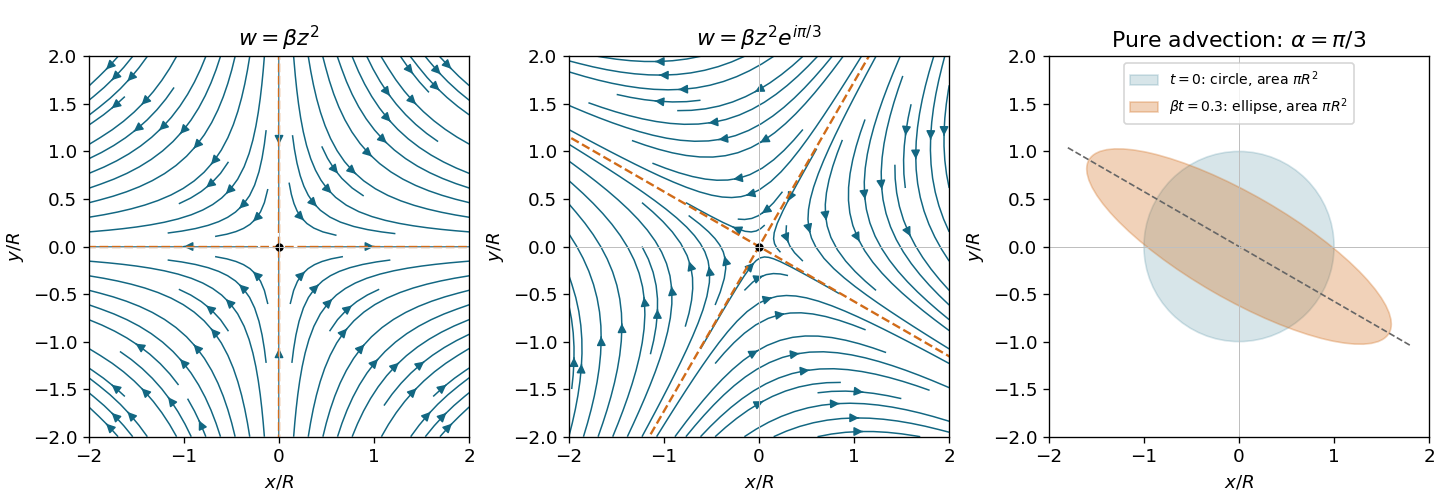
Quadratic complex potentials give hyperbolic streamlines and area-preserving dye deformation
. Original streamlines for zero phase and phase , with arrows from the analytic velocity fields. The principal extension axis rotates by . The right panel compares a unit dye circle with its image at for ; the ellipse has the same area. Details.
Taking the imaginary part of the complex potential gives the streamfunctionThe corresponding velocity field isPut . Then and . Thus the streamlines are the previous rectangular hyperbolas rotated clockwise by . Their separatrices have angles ; the extension axis is and the compression axis is perpendicular to it. The middle panel of the figure shows this rotation.
For pure advection, a marked fluid element obeysConsequently the dye circle becomes an ellipse with semiaxes and . Its area isStretching in one principal direction exactly compensates compression in the other. Equivalently the flow-map Jacobian determinant is one, as required by incompressibility. Negligible diffusion is needed to regard the sharp dye boundary as a material curve.
Articles by others on the same topic
There are currently no matching articles.