For the simple shear flow, the vertical vorticity isFor , this is not an irrotational flow. A complex potential of a two-dimensional potential flow , analytic in the flow region, has complex velocity . The Cauchy-Riemann equations imply both incompressibility and zero vorticity, so this shear has no such complex potential. It does have a Cartesian streamfunction, . In the degenerate case , the resting fluid has a constant complex potential.
Using and the complex velocity convention ,The streamlines are , a family of rectangular hyperbolas whose asymptotes are the coordinate axes. The origin is a stagnation point. Fluid moves inward along the axis and outward along the axis, with the same directions approached by the neighbouring streamlines. This is a planar extensional incompressible flow, illustrated in the left panel below.
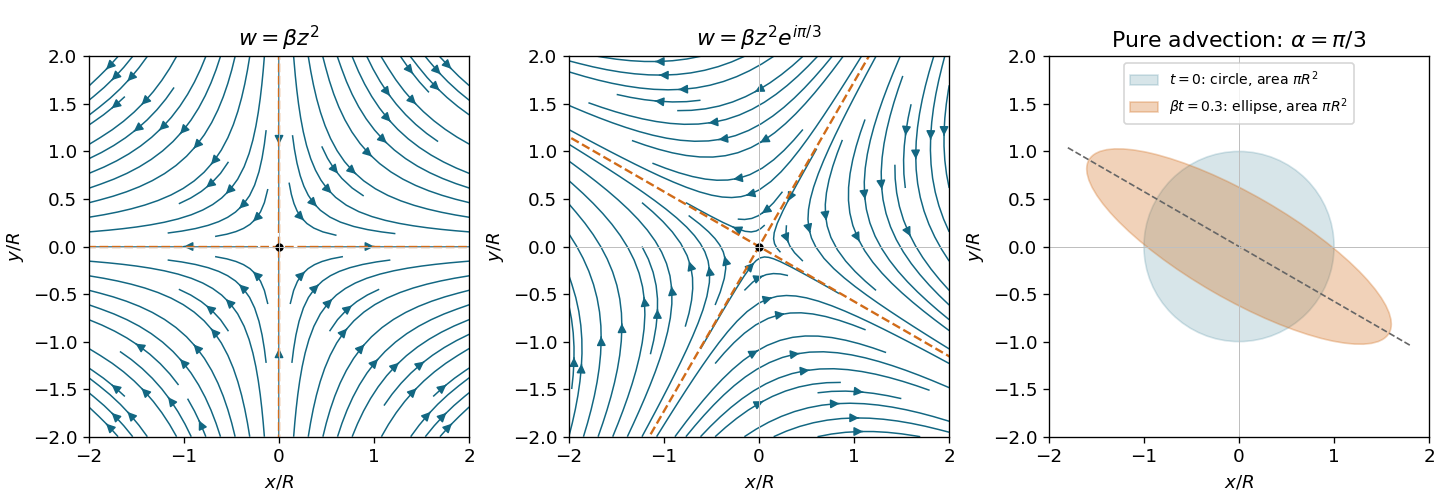
Quadratic complex potentials give hyperbolic streamlines and area-preserving dye deformation
. Original streamlines for zero phase and phase , with arrows from the analytic velocity fields. The principal extension axis rotates by . The right panel compares a unit dye circle with its image at for ; the ellipse has the same area. Details.
Taking the imaginary part of the complex potential gives the streamfunctionThe corresponding velocity field isPut . Then and . Thus the streamlines are the previous rectangular hyperbolas rotated clockwise by . Their separatrices have angles ; the extension axis is and the compression axis is perpendicular to it. The middle panel of the figure shows this rotation.
For pure advection, a marked fluid element obeysConsequently the dye circle becomes an ellipse with semiaxes and . Its area isStretching in one principal direction exactly compensates compression in the other. Equivalently the flow-map Jacobian determinant is one, as required by incompressibility. Negligible diffusion is needed to regard the sharp dye boundary as a material curve.
The coefficient of the growing term is fixed by the far-field complex potential: . On , the no-penetration boundary condition makes the cylinder a streamline, so the imaginary part of must be constant. Choosing the two terms to be complex conjugates makes that constant zero, givingThis is the zero-circulation solution, also obtained by the Milne-Thomson circle theorem. Impermeability and the leading far field alone permit an additional circulation term ; the requested algebraic form implicitly selects . No no-slip boundary condition is imposed on an inviscid flow.
The streamfunction in polar coordinates isIt gives andThe liquid still exerts normal pressure on each surface element even though tangential viscous traction is absent. For this steady flow with zero vorticity, the Bernoulli equation has one constant throughout the connected fluid region:There is no finite uniform far-field pressure to substitute for , because this straining velocity field grows with radius. Taking outward from the cylinder, the fluid force per unit axial width isIndeed while : diametrically opposite elements cancel exactly. Zero resultant force does not mean zero local pressure or zero deformation tendency.
Use the Joukowski map with , in particular its intended range . On the original circle,Define the exterior inversewhere the holomorphic square root is chosen so that at infinity. Then is the branch mapping the exterior of the ellipse to . Composition of the zero-circulation complex potential from part 4(c) with this inverse givesThe ellipse is a streamline because its inverse image is the circle, and at infinity. An additive constant in the complex potential has no effect on the velocity.
The transformed complex velocity obeys the chain rule:Since , the denominator is nonzero on and outside . The four stagnation points therefore come fromTheir physical locations areThey all lie on the ellipse, and their positions are independent of , which only sets the overall speed scale.
The printed restriction that is real and is insufficient literally: satisfies it but makes at in the exterior, so there is no exterior conformal map of the claimed type; the stated minor semiaxis would also be negative. The intended positive-parameter range, or more generally , is needed for the above solution. The reference to a sphere in the source is a wording slip: the geometry is two-dimensional flow around the mapped cylinder's elliptical cross-section.
Articles by others on the same topic
There are currently no matching articles.