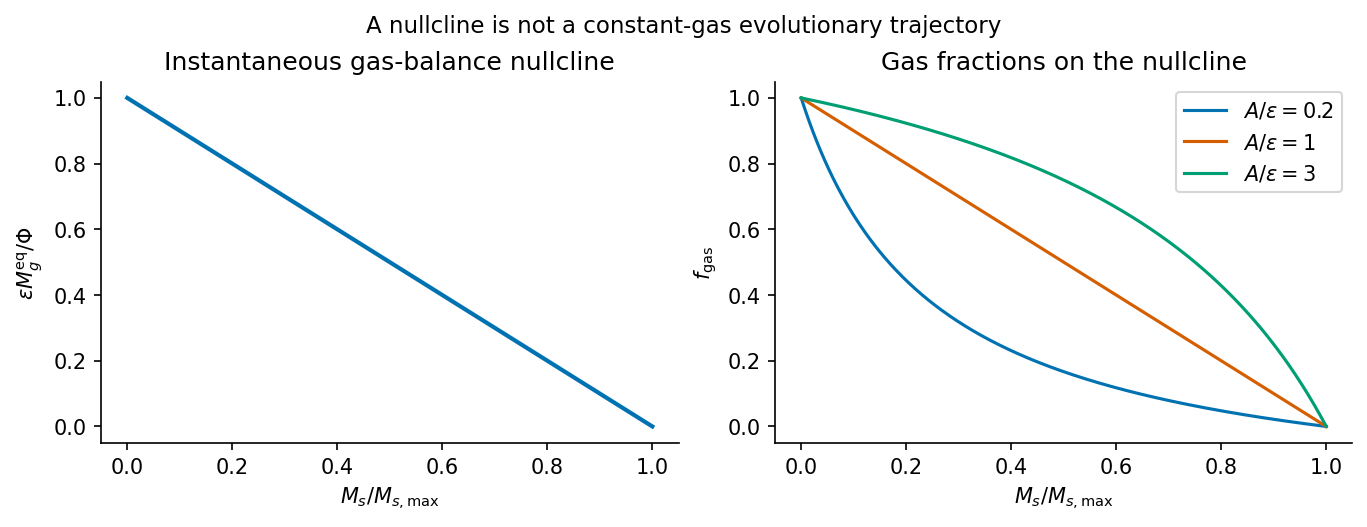
Write , where . For ionized hydrogen with Thomson scattering opacity, radiation force on one electron-proton pair balances gravity whenThe mass-loading coefficient has units of inverse time. With the stated neglect of returned and directly accreted gas, mass conservation givesAt a specified stellar mass, the gas-balance nullcline isA positive reservoir exists only below the limiting massEquality has zero gas, so this is the supremum of masses with a positive instantaneous equilibrium. For , the corresponding gas fraction isIt decreases from one to zero: the derivative is . This is a gas regulator with an outflow increasing with the stellar mass through the assumed black-hole scaling.
There is an important time-dependence qualification. A positive gas mass cannot remain exactly constant forever while the stellar mass continues to increase and is maintained: differentiating would require . The expression above is the instantaneous equilibrium, or a quasisteady approximation when gas relaxation is fast relative to stellar-mass evolution. The only exact fixed point of the coupled idealized equations is . It is not a sustained star-forming state.
Above the limiting mass, for every nonnegative reservoir: the assumed Eddington-driven wind already demands more than the incoming supply, even before star formation consumes gas. The reservoir is depleted and star formation is quenched. The equations must cease to apply when gas runs out; one cannot continue to negative gas mass or power an indefinitely Eddington-luminous nucleus without fuel. At fixed the depletion time from isAllowing to grow only strengthens the initial depletion tendency. If , this particular feedback threshold is absent.

Distinguish the rest-mass supply from the actual black-hole mass growth. With the usual radiative-efficiency definition,At the Eddington limit the growth is exponential:The available time is the difference of the supplied ages, ; no new cosmological age-redshift relation is needed.
Using the printed , together with , , and a Julian year of , givesThereforeThis is about e-folds. The constants just listed are evaluation constants, not additional observational inputs asserted to be on the paper.
Sometimes an elementary growth convention identifies directly with and drops the radiated fraction of the incoming rest mass. That approximation instead gives and . The first result retains the physically distinct supplied and retained masses; the convention must be stated because exponential growth magnifies this difference.
The main implication is already severe in the optimistic calculation: a low-mass stellar-remnant seed has insufficient time under the specified efficiency and strictly Eddington-limited accretion. A heavier seed, earlier formation, a different efficiency, mergers or episodes beyond that idealized luminosity limit can relax the inference. Any duty cycle below unity or sub-Eddington episodes require a larger initial mass within the adopted model. The reported high-redshift quasar motivating this calculation was identified spectroscopically at ; its published age estimate need not replace the ages supplied here.[ref]
Only the photon energy above the hydrogen ionization threshold initially becomes photoelectron kinetic energy. The stated mean therefore suppliesLet be the local number of ionizations per volume per time. Photoionization equilibrium makes this equal to the recombination rate. If is the mean kinetic energy removed per recombination, thermal balance reduces toNeither the ionization threshold nor the density remains in this event-by-event balance. The threshold energy is stored as atomic ionization energy and returned in recombination radiation; it is not a net thermal input. This separation between photoelectron heating and kinetic energy lost by recombining electrons is the relevant cooling balance.[ref]
Heating and Cooling of HII regions by Ian Czekala. Heating by photoionization and Recombination radiation sections
In the elementary mean-thermal-energy approximation, a captured electron removes . This gives the concise estimateThat coefficient is a stated approximation, not a universal recombination identity. Real recombination weights the electron distribution by its velocity-dependent capture rate. If the chosen cooling model instead writes , the precise answer is . The source supplies no recombination cooling coefficient or capture kernel from which a unique more accurate coefficient can be computed. Its emitted-photon average is also being used as the average of the absorbed ionizing photons; spectral filtering would require a different weighted average.
Use the supplied flat radiation-era background equations. Write , with constant. On the expanding branch,Choosing the origin at the big bang givesThe supplied perturbation equation consequently becomesA trial gives , so . Thus both independent modes areThe growing mode is , and the other decays as . At sufficiently late times any nonzero growing-mode coefficient dominates while linearization remains valid.
The calculation follows the stated differential equation, including its coefficient . The name Einstein-de Sitter ordinarily denotes a flat pressureless matter universe, whose growth law is different; here the explicit radiation scaling fixes the intended background. Nor does this scale-free equation describe every subhorizon radiation perturbation: including a pressure-gradient term introduces acoustic behavior. No wavelength-independent claim beyond the supplied model is needed.
Articles by others on the same topic
There are currently no matching articles.