The geometric path difference for a direction at zenith angle is . Equal cable lengths leave that difference unchanged; the inserted electronic delay cancels for the tracking center. The residual delay is thereforeThe complex visibility of the unresolved source has phase , giving in the chosen baseline ordering. Reversing the signal order complex-conjugates it without changing the measured visibility magnitude. Tracking the antennas geometrically does not itself provide this fringe stopping.
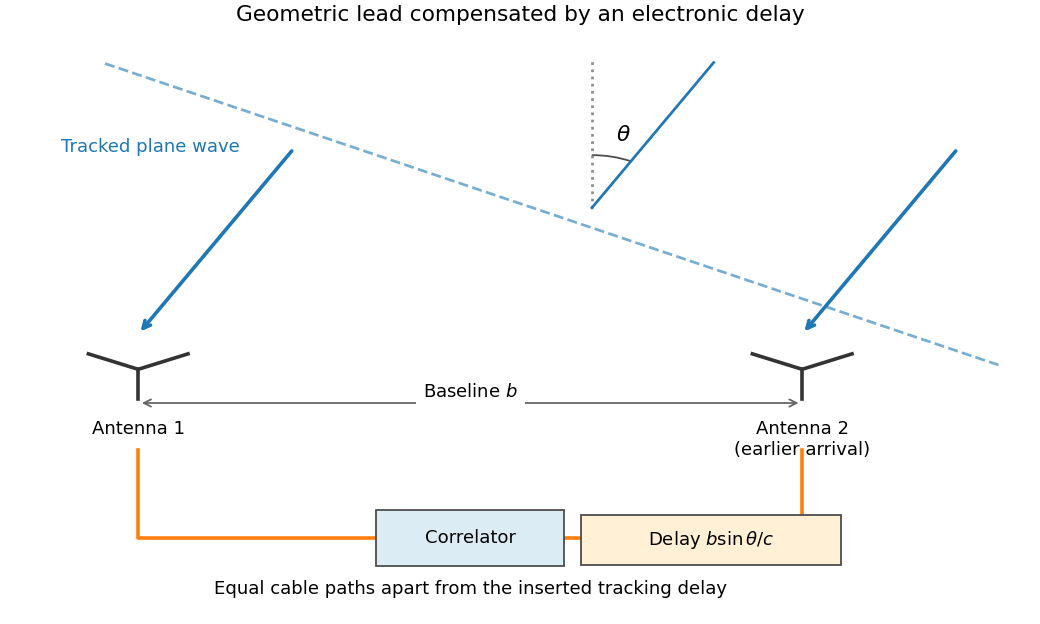
Tracking delay in a two-antenna interferometer
. Original functional schematic. The nearer antenna receives the tracked wave earlier and its electronic delay compensates that geometric lead. Angles are exaggerated and cable paths are schematic. Details.
For a top-hat band centered at , let . Averaging the residual fringe givesAfter removing the central fringe phase, its envelope is exactlyThe full complex average retains the displayed central-frequency phase; the bare sinc in the question is the phase-referenced envelope or an average written in frequency-offset coordinates. This bandwidth decorrelation of a point source is cancellation between different frequency-dependent phases, not absorption of source radiation.
The center-to-center extent is on each side and diagonally, while the shortest nonzero baseline is . At , characteristic scales areThese describe the finest synthesized scale, a largest recoverable scale estimate, and the individual-dish field of view, respectively. Along an array side the longest baseline is only , giving rather than the diagonal estimate. Projection, weighting and sidelobes determine an actual synthesized beam.
There is no sharp universal largest-scale cutoff: the commonly used convention would give . For an ideal uniformly illuminated circular dish, the primary-beam full width at half maximum is approximately , while the first-null angular radius is . These definitions should not be mixed. Uniform lattice spacing also produces grating sidelobes; the primary beam restricts the useful field but does not supply the missing zero-baseline flux.
Use the projected baseline along the source offset, , and . The first bandwidth null occurs at . A worst-case gives . That is a zero of the response, not a good usable bandwidth. A quantitative maximum needs an allowed attenuation.
For example, requiring a response of at least gives at . Hencefor that worst projection. A strictly east-west offset in a sides-aligned square instead samples at most , giving a first null and a ten-percent-loss bandwidth. The original two-antenna geometry supplies an additional projection; these examples use its maximum magnitude. Thus a bandwidth of order is a reasonable conservative estimate with a stated small-loss criterion, rather than a unique geometry-free limit.
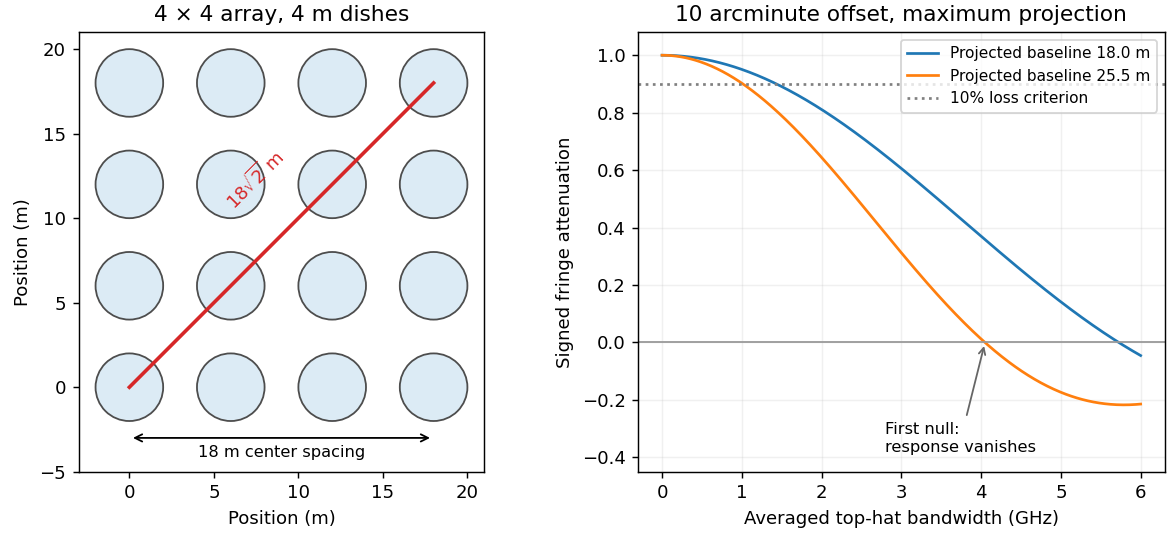
Array baselines and bandwidth decorrelation away from the tracking center
. Original array geometry and rectangular-band sinc calculations for a ten-arcminute offset. The marked ten-percent-loss bandwidth is an illustrative response criterion; the first null is not a usable-bandwidth recommendation. Details.
To use a much wider total band, channelize the signals before correlation or before irreversible frequency averaging. Correlate sufficiently narrow channels, track the reference delay and phase at each frequency, and combine frequency-aware visibilities or images. This preserves sensitivity while avoiding field-dependent averaging losses in radio interferometry. Merely adding a phase correction after a broad channel has decorrelated cannot recover the lost signal; nor can one tracking delay cancel every sky direction simultaneously.[ref]
Field of View by National Radio Astronomy Observatory. VLA Observational Status Summary 2018A, bandwidth and time-averaging limitations
The wavelength corresponds to about , in the low-frequency decrement part of the thermal Sunyaev-Zeldovich effect. Hot cluster electrons inverse-Compton scatter CMB photons. In the Rayleigh-Jeans limit,The signal probes integrated electron pressure. Short baselines give sensitivity to extended arcminute-scale cluster structure, while the primary field covers the cluster and surrounding sky. The array's several-arcminute resolution suits many such structures; it is not equally well matched to every cluster size.
Simultaneous cross-correlations reject uncorrelated receiver noise and provide spatial information; compact radio sources can be constrained with the relatively longer baselines and separated from extended structure. Broad frequency coverage helps sensitivity provided channel smearing is controlled. Correlated atmospheric emission, calibration error, primordial CMB fluctuations and radio-source contamination remain relevant. The lack of zero and very short spacings also means that total integrated cluster flux requires a model or complementary data. An interferometer is therefore useful for the spatially resolved decrement, rather than automatically measuring every cluster's full pressure integral.
Articles by others on the same topic
There are currently no matching articles.