Normalize the plane waves in a periodic crystal of area or volume . The Fourier coefficients of the periodic potential obeyTranslation of the integral by any lattice vector leaves it invariant but multiplies it by . A nonzero result therefore requires to be a reciprocal lattice vector.
Near an isolated Bragg scattering degeneracy, ordinary nondegenerate perturbation theory fails because the free energies coincide. Retain the resonant plane waves , and apply degenerate perturbation theory. Absorb the constant into the energy origin. Since a real potential has , the projected Schrödinger equation has coefficient matrixA nonzero eigenstate requiresOff-resonant plane waves give higher-order energy shifts omitted in this leading nearly-free electron model.
Let andAt the two degenerate plane waves have momenta and and coupling . ThusTheir symmetric and antisymmetric combinations are the lower and upper states respectively. The local band gap is .
Put . At , the free energy is . The four cyclic combinations in the supplied secular equation give the four-plane-wave splitting at a square-zone cornerFor example, the normalized coefficient vectors in the source's cyclic basis are , , , and . Because , these are ordered as written: a lower singlet, a central doublet and an upper singlet. The sketch puts the and energies on one common scale; its representative negative couplings are stated in the caption.
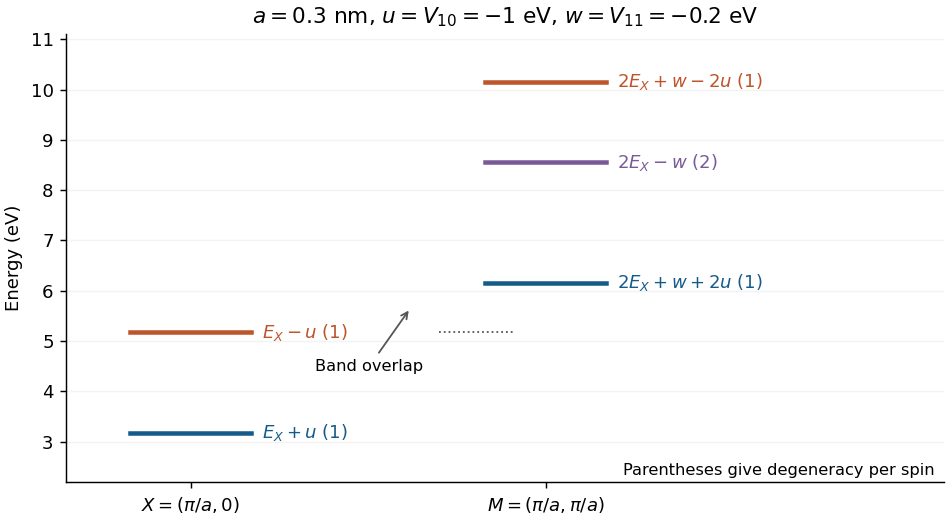
Common energy scale at the square-zone edge and corner, with illustrative couplings V10 = −1 eV and V11 = −0.2 eV
. Details. 
There are two electrons per primitive unit cell; a spin-degenerate energy band accommodates exactly that number. A semiconductor results when the first band is full and does not overlap the second. In the leading two-wave/four-wave approximation, compare the first-band maximum at with the second-band minimum at :This is an indirect band gap; a nonzero local splitting at alone is insufficient. At the onset,With , gives , henceFor more negative than this value the estimated indirect band gap is positive; at equality the bands just touch. This is the onset estimate within the source's nearly-free electron model truncation, not an exact critical potential after coupling all plane waves.
Articles by others on the same topic
There are currently no matching articles.